
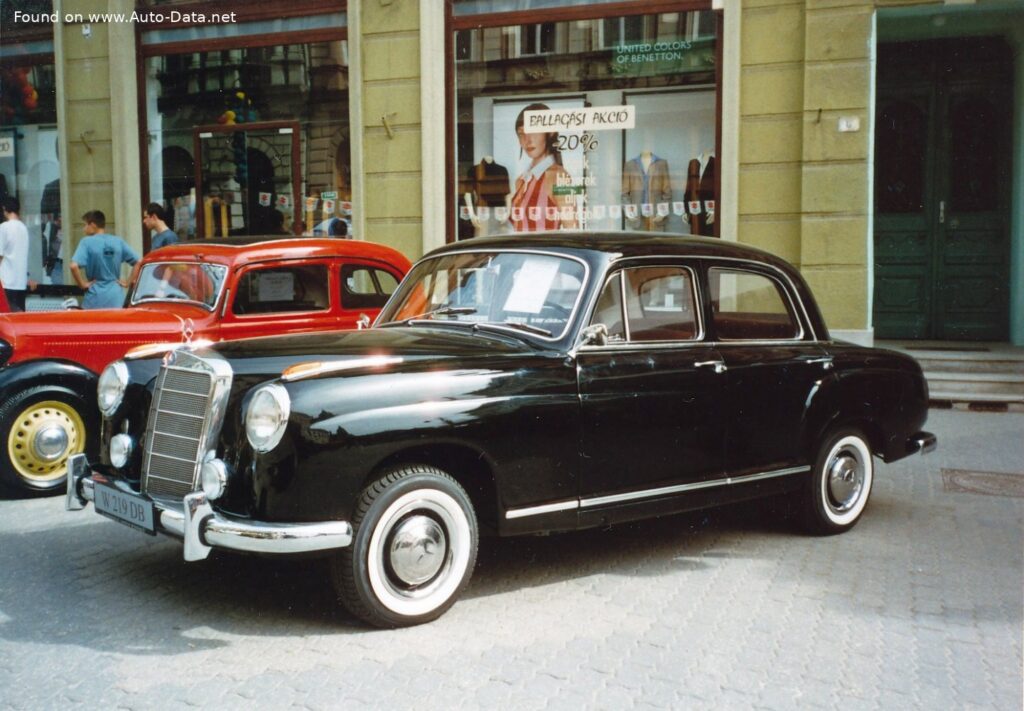
The Mercedes-Benz W105 Sedan 219 (90 Hp) Hydrak represents a significant chapter in the storied history of German automotive engineering, emerging during a period of remarkable post-war recovery and innovation for Mercedes-Benz. Part of the iconic “Ponton” generation, the W105 series, specifically the 219 model, was introduced in August 1957 and remained in production until July 1959. Positioned as a mid-range luxury sedan, it skillfully blended the robust, reliable underpinnings of the four-cylinder W120/121 models with the more potent six-cylinder engine of the larger W180 220S. This strategic combination offered customers a compelling balance of performance, comfort, and the undeniable prestige associated with the Mercedes-Benz marque, all wrapped in the distinctive, full-width “Ponton” body style that revolutionized automotive design in the mid-20th century. The inclusion of the innovative Hydrak semi-automatic transmission further distinguished the Mercedes-Benz W105 Sedan 219 (90 Hp) Hydrak, providing a glimpse into the future of driving convenience.
Engine and Performance of the Mercedes-Benz W105 Sedan
At the heart of the W105 Sedan 219 model lay the formidable M 180 II / 180.921 inline-six engine, a unit renowned for its smoothness and durability. This naturally aspirated, carbureted powerplant boasted a displacement of 2195 cm³ (133.95 cu. in.), delivering a respectable 90 horsepower at 4800 revolutions per minute. Torque figures were equally impressive for the era, peaking at 123.17 lb.-ft. at a low 2400 rpm, ensuring ample pulling power and a flexible driving experience. The engine’s inline-six configuration, combined with an SOHC (Single Overhead Camshaft) valvetrain and two valves per cylinder, was a testament to Mercedes-Benz’s commitment to refined engineering. With a compression ratio of 8.7:1 and a bore of 3.15 inches paired with a piston stroke of 2.87 inches, the engine was designed for efficient combustion and longevity.
Performance-wise, the 219 (90 Hp) Hydrak was a capable cruiser. It could accelerate from 0 to 60 mph in a calculated 16.2 seconds, with 0 to 100 km/h taking 17 seconds. Its maximum speed reached 91.96 mph (148 km/h), making it well-suited for the burgeoning highway networks of the late 1950s. Fuel economy, while not a primary concern for luxury vehicles of the time, was a respectable 20.6 US mpg (11.4 l/100 km) in a combined cycle, thanks in part to the engine’s inherent efficiency and the relatively light curb weight of 2810.89 lbs. (1275 kg). The power-to-weight ratio stood at 14.2 kg/Hp, or 70.6 Hp per tonne, further underscoring its balanced performance characteristics. The engine’s front, longitudinal layout and rear-wheel-drive architecture provided classic driving dynamics, emphasizing stability and a comfortable ride.
Perhaps the most distinctive mechanical feature of this particular model was the “Hydrak” transmission. This innovative system was a semi-automatic, four-speed manual gearbox that incorporated an electro-magnetic clutch, eliminating the need for a clutch pedal. Drivers would select a gear using the conventional shift lever, and the Hydrak system would automatically engage and disengage the clutch, providing a smoother and less fatiguing driving experience, particularly in urban environments. While not a fully automatic transmission in the modern sense, the Hydrak represented a significant step towards greater driving convenience and showcased Mercedes-Benz’s pioneering spirit in powertrain technology during a transitional period for the automotive industry.
Design and Features of the Mercedes-Benz W105 Sedan
The Mercedes-Benz W105 Sedan, commonly referred to as a “Ponton,” adopted a revolutionary design philosophy that moved away from the pre-war style of separate fenders and running boards. The “Ponton” designation itself refers to the pontoon-like, full-width bodywork that integrated the fenders into a unified, streamlined form, a design trend that emerged in the early 1950s and quickly became the standard. This four-door, five-seat sedan presented a clean, elegant, and timeless silhouette that exuded understated luxury and engineering precision.
Dimensionally, the W105 Sedan measured 184.25 inches (4680 mm) in length, 68.5 inches (1740 mm) in width, and 61.42 inches (1560 mm) in height. Its substantial 108.27-inch (2750 mm) wheelbase contributed significantly to its comfortable ride quality and spacious interior, allowing ample room for five occupants. The vehicle’s wide stance, with a front track of 56.3 inches (1430 mm) and a rear track of 57.87 inches (1470 mm), further enhanced its stability and road presence. The generous fuel tank capacity of 14.79 US gallons (56 liters) ensured a decent cruising range, suitable for the longer journeys that owners of such a vehicle would undertake.
Inside, the W105 Sedan offered an interior typical of Mercedes-Benz at the time: well-appointed, functional, and built with high-quality materials designed for longevity. While modern amenities like air conditioning or power windows were still largely absent or rudimentary, the focus was on ergonomic design, clear instrumentation, and robust construction. Safety, by 1950s standards, was addressed through the car’s solid construction and predictable handling. The braking system, utilizing drum brakes at both the front and rear, was effective for the vehicle’s weight and performance capabilities. The steering system, a cone worm with recirculation balls, provided precise control and a reassuring feel.
The suspension system was sophisticated for its era, featuring a double wishbone setup with a transverse stabilizer at the front, offering excellent wheel control and comfort. The rear suspension employed trailing arms, contributing to the car’s stable and composed ride over varied road surfaces. This combination of robust chassis engineering, a refined powertrain, and a spacious, elegant body style cemented the Mercedes-Benz W105 Sedan 219 (90 Hp) Hydrak’s reputation as a well-engineered and desirable automobile, a true classic that continues to be admired for its heritage and mechanical integrity.
Technical Specifications
| Brand | Mercedes-Benz |
| Model | Ponton |
| Generation | W105 Sedan |
| Type (Engine) | 219 (90 Hp) Hydrak |
| Start of production | August, 1957 year |
| End of production | July, 1959 year |
| Powertrain Architecture | Internal Combustion engine |
| Body type | Sedan |
| Seats | 5 |
| Doors | 4 |
| Fuel consumption (economy) – combined | 20.6 US mpg (11.4 l/100 km) |
| Fuel Type | Petrol (Gasoline) |
| Acceleration 0 – 60 mph | 16.2 sec |
| Acceleration 0 – 100 km/h | 17 sec |
| Maximum speed | 91.96 mph (148 km/h) |
| Weight-to-power ratio | 14.2 kg/Hp, 70.6 Hp/tonne |
| Weight-to-torque ratio | 7.6 kg/Nm, 131 Nm/tonne |
| Power | 90 Hp @ 4800 rpm |
| Power per litre | 41 Hp/l |
| Torque | 123.17 lb.-ft. @ 2400 rpm (167 Nm @ 2400 rpm) |
| Engine layout | Front, Longitudinal |
| Engine Model/Code | M 180 II / 180.921 |
| Engine displacement | 133.95 cu. in. (2195 cm³) |
| Number of cylinders | 6 |
| Engine configuration | Inline |
| Cylinder Bore | 3.15 in. (80 mm) |
| Piston Stroke | 2.87 in. (72.8 mm) |
| Compression ratio | 8.7:1 |
| Number of valves per cylinder | 2 |
| Fuel injection system | Carburettor |
| Engine aspiration | Naturally aspirated engine |
| Valvetrain | SOHC |
| Kerb Weight | 2810.89 lbs. (1275 kg) |
| Max. weight | 3802.97 lbs. (1725 kg) |
| Max load | 992.08 lbs. (450 kg) |
| Fuel tank capacity | 14.79 US gal (56 l) |
| Length | 184.25 in. (4680 mm) |
| Width | 68.5 in. (1740 mm) |
| Height | 61.42 in. (1560 mm) |
| Wheelbase | 108.27 in. (2750 mm) |
| Front track | 56.3 in. (1430 mm) |
| Rear (Back) track | 57.87 in. (1470 mm) |
| Drivetrain Architecture | The Internal combustion engine (ICE) drives the rear wheels of the vehicle. |
| Drive wheel | Rear wheel drive |
| Number of gears and type of gearbox | 4 gears, manual transmission Hydrak |
| Front suspension | Double wishbone, Transverse stabilizer |
| Rear suspension | Trailing arm |
| Front brakes | Drum |
| Rear brakes | Drum |
| Steering type | Cone worm with recirculation balls |
