
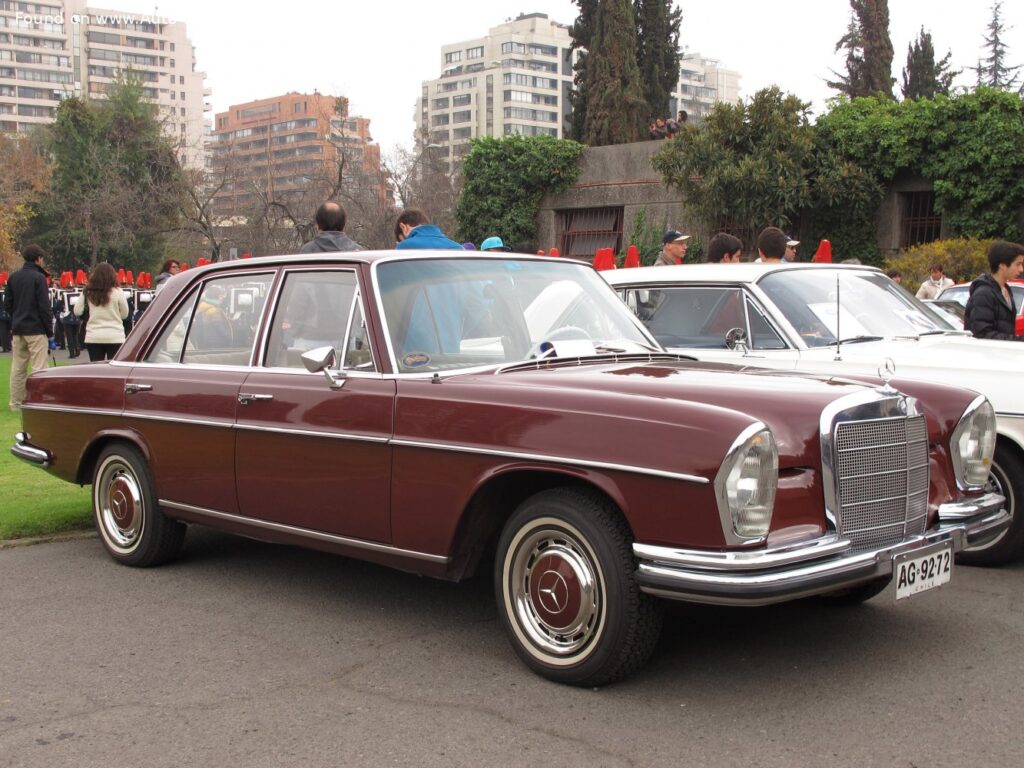
The Mercedes-Benz W108 300 SEb represents a pivotal moment in the evolution of the German luxury automaker’s flagship sedan lineup. Introduced in August 1965, this generation, internally designated W108, marked a significant departure from its predecessor, the W111/W112 “Fintail” series, ushering in a more restrained, elegant, and timeless design aesthetic that would influence Mercedes-Benz styling for decades. Positioned at the upper echelon of the luxury market, the Mercedes-Benz W108 300 SEb was engineered to appeal to discerning buyers seeking an unparalleled blend of sophisticated engineering, robust performance, and opulent comfort. Produced for a relatively short period, concluding in December 1967, the 300 SEb variant, with its advanced inline-six engine, stood as a testament to Mercedes-Benz’s commitment to innovation and prestige during the mid-20th century, cementing its legacy as a true classic. While not specifically designed for the U.S. market in the same way modern vehicles are adapted, the W108 series was highly sought after globally, including by American connoisseurs who appreciated its blend of European luxury and engineering prowess, often imported or purchased through official channels.
Engineering Excellence: The Mercedes-Benz W108 300 SEb Powertrain
The heart of the Mercedes-Benz W108 300 SEb was its highly regarded M 189 VIII / 189.989 engine, a 3.0-liter (2996 cm3 or 182.83 cu. in.) inline-six powerplant renowned for its smooth operation and robust reliability. This naturally aspirated engine, featuring a sophisticated multi-port manifold injection system – a relatively advanced technology for its era – delivered a commendable 170 horsepower at 5400 rpm. The power-per-liter figure of 56.7 Hp/l underscored its efficient design for the time. Torque was equally impressive, peaking at 249 Nm (183.65 lb.-ft.) at 4000 rpm, providing ample thrust for highway cruising and effortless acceleration. With a compression ratio of 8.8:1 and a SOHC (Single Overhead Camshaft) valvetrain with two valves per cylinder, the engine was a marvel of German engineering, balancing performance with durability. Its front, longitudinal layout contributed to the vehicle’s balanced weight distribution and handling characteristics.
Performance figures for the 300 SEb were quite respectable for a luxury sedan of its size and weight. The vehicle could accelerate from 0 to 60 mph in a brisk 10.6 seconds, with 0 to 100 km/h achieved in 11.2 seconds. Its maximum speed of 118.06 mph (190 km/h) ensured that the 300 SEb was not just a comfortable cruiser but also a capable performer on the newly developing autobahns and interstates. The engine’s power was channeled to the rear wheels via a precise 4-speed manual transmission, offering an engaging driving experience for those who preferred direct control over the powertrain. This drivetrain architecture, with the internal combustion engine driving the rear wheels, was standard for luxury vehicles of its time, providing a traditional, robust, and often more dynamic driving feel. Despite its performance capabilities, the Mercedes-Benz W108 300 SEb also offered a combined fuel economy of approximately 18.8 US mpg (12.5 l/100 km), a reasonable figure for a large displacement luxury vehicle from the 1960s, highlighting a balance between power and practical operation. The vehicle’s weight-to-power ratio of 9.2 kg/Hp (109 Hp/tonne) and weight-to-torque ratio of 6.3 kg/Nm (159.6 Nm/tonne) further illustrate its well-engineered powertrain and chassis integration, reflecting Mercedes-Benz’s meticulous approach to automotive design.
Timeless Design and Interior Refinement of the Mercedes-Benz W108 300 SEb
The design of the Mercedes-Benz W108 represented a significant stylistic evolution for the brand, moving away from the more ornate “Fintail” styling of its predecessors towards a cleaner, more understated aesthetic. This four-door, five-seat sedan exuded an air of elegant sophistication, characterized by its vertical headlights, a prominent grille, and a lower roofline that gave it a more modern and substantial presence. Measuring 192.91 inches (4900 mm) in length, 71.26 inches (1810 mm) in width, and 56.69 inches (1440 mm) in height, with a generous wheelbase of 108.27 inches (2750 mm), the W108 300 SEb offered ample interior space and a commanding road presence. The design was penned under the direction of Paul Bracq, and its timeless lines would set the standard for Mercedes-Benz luxury sedans for years to come, emphasizing a blend of classic proportions with contemporary details that resonated with a sophisticated clientele. The car’s substantial dimensions contributed to its imposing road presence and the perception of safety and solidity.
Beyond its striking exterior, the Mercedes-Benz W108 300 SEb was engineered for supreme comfort and handling, hallmarks of the Mercedes-Benz brand. The suspension system was particularly advanced for its time, featuring a double wishbone setup at the front, which provided precise steering and excellent road holding. At the rear, a sophisticated hydro-pneumatic element combined with trailing arms offered an exceptional ride quality, absorbing road imperfections with remarkable composure while maintaining precise control. This innovative rear suspension, a hallmark of Mercedes-Benz engineering in its higher-end models, provided a level of ride comfort and stability that few competitors could match. Stopping power was equally impressive, with disc brakes fitted on both the front and rear wheels, offering superior performance and fade resistance compared to the drum brakes still common on many vehicles of that era. This was a significant safety and performance advantage. Steering was managed by a cone worm system with recirculation balls, augmented by hydraulic power steering, ensuring effortless maneuverability even at low speeds and a stable feel at higher velocities. The vehicle rode on 6J x 14 wheel rims, perfectly complementing its stately posture. With a substantial curb weight of 3439.21 lbs (1560 kg) and a maximum permissible weight of 4541.52 lbs (2060 kg), the W108 300 SEb was built with a robust chassis, designed to provide both occupant safety and long-term durability, reinforcing its reputation as a premium, well-engineered automobile. The fuel tank capacity of 21.66 US gallons (82 liters) further underscored its design for long-distance touring, a practical consideration for a grand touring sedan.
Technical Specifications: Mercedes-Benz W108 300 SEb (170 Hp)
| General Information | |
| Brand | Mercedes-Benz |
| Model | W108 |
| Generation | W108 |
| Type (Engine) | 300 SEb (170 Hp) |
| Start of production | August, 1965 year |
| End of production | December, 1967 year |
| Powertrain Architecture | Internal Combustion engine |
| Body type | Sedan |
| Seats | 5 |
| Doors | 4 |
| Performance Specs | |
| Fuel consumption (combined) | 12.5 l/100 km (18.8 US mpg) |
| Fuel Type | Petrol (Gasoline) |
| Acceleration 0 – 60 mph | 10.6 sec |
| Acceleration 0 – 100 km/h | 11.2 sec |
| Maximum speed | 190 km/h (118.06 mph) |
| Weight-to-power ratio | 9.2 kg/Hp (109 Hp/tonne) |
| Weight-to-torque ratio | 6.3 kg/Nm (159.6 Nm/tonne) |
| Engine Specs | |
| Power | 170 Hp @ 5400 rpm. |
| Power per liter | 56.7 Hp/l |
| Torque | 249 Nm @ 4000 rpm (183.65 lb.-ft. @ 4000 rpm) |
| Engine layout | Front, Longitudinal |
| Engine Model/Code | M 189 VIII / 189.989 |
| Engine displacement | 2996 cm3 (3.0 liters / 182.83 cu. in.) |
| Number of cylinders | 6 |
| Engine configuration | Inline |
| Cylinder Bore | 85 mm (3.35 in.) |
| Piston Stroke | 88 mm (3.46 in.) |
| Compression ratio | 8.8:1 |
| Number of valves per cylinder | 2 |
| Fuel injection system | Multi-port manifold injection |
| Engine aspiration | Naturally aspirated engine |
| Valvetrain | SOHC |
| Space, Volume and Weights | |
| Kerb Weight | 1560 kg (3439.21 lbs) |
| Max. weight | 2060 kg (4541.52 lbs) |
| Max load | 500 kg (1102.31 lbs) |
| Fuel tank capacity | 82 l (21.66 US gal) |
| Dimensions | |
| Length | 4900 mm (192.91 in.) |
| Width | 1810 mm (71.26 in.) |
| Height | 1440 mm (56.69 in.) |
| Wheelbase | 2750 mm (108.27 in.) |
| Front track | 1482 mm (58.35 in.) |
| Rear (Back) track | 1485 mm (58.46 in.) |
| Drivetrain, Brakes and Suspension Specs | |
| Drivetrain Architecture | The Internal combustion engine (ICE) drives the rear wheels of the vehicle. |
| Drive wheel | Rear wheel drive |
| Number of gears and type of gearbox | 4 gears, manual transmission |
| Front suspension | Double wishbone |
| Rear suspension | Hydro-pneumatic element, Trailing arm |
| Front brakes | Disc |
| Rear brakes | Disc |
| Steering type | Cone worm with recirculation balls |
| Power steering | Hydraulic Steering |
| Wheel rims size | 6J x 14 |
