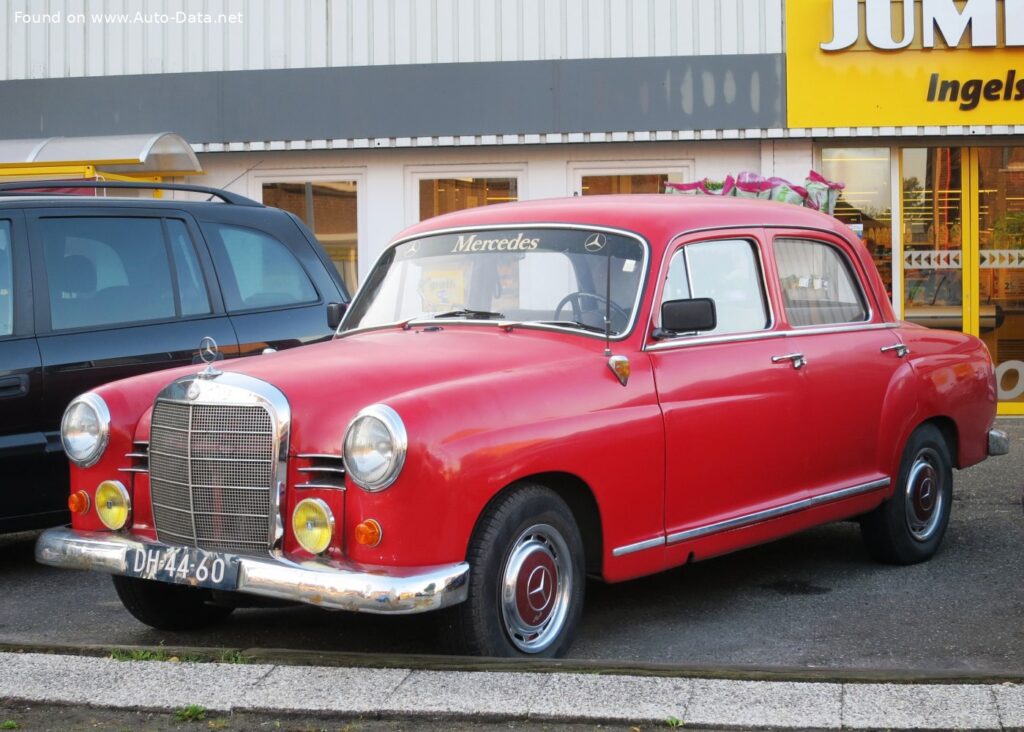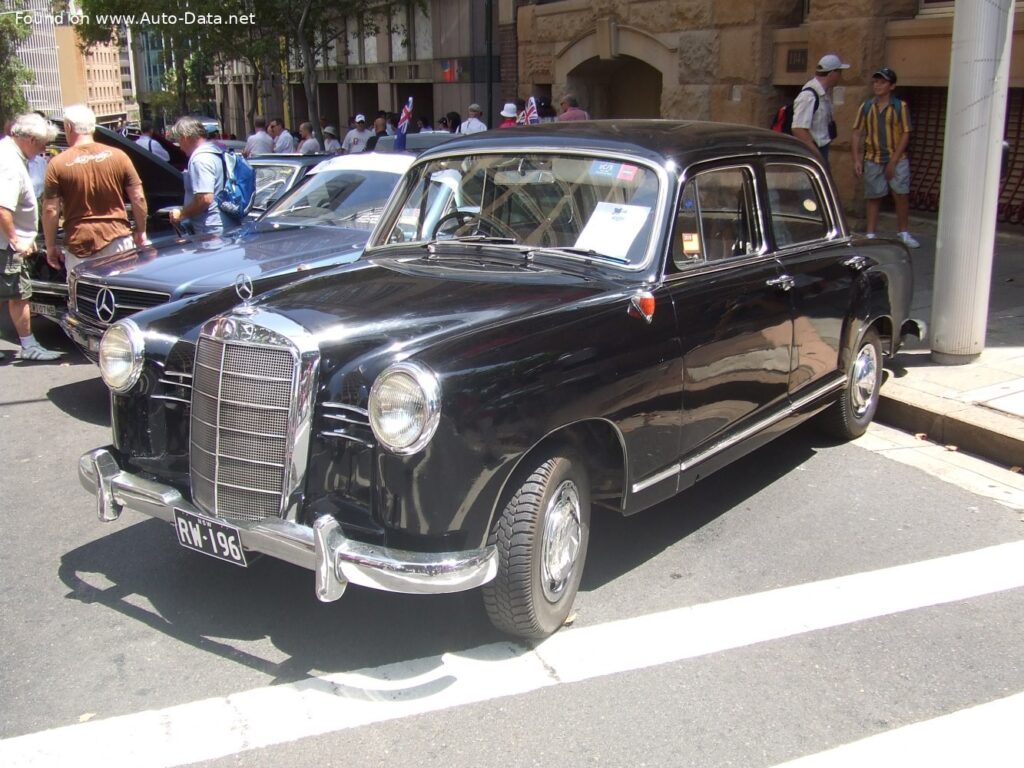
The Mercedes-Benz W121, marketed as the Mercedes-Benz 190, was a compact sedan produced between March 1956 and August 1959. Representing a significant departure for the manufacturer, the 190 was Mercedes-Benz’s first complete “family car” designed from the outset as a high-volume model. It was part of the “Ponton” series, named for its pontoon-like, unibody construction – a major advancement in automotive engineering at the time. The 190 aimed to provide comfortable, reliable transportation for the growing post-war middle class, and it established Mercedes-Benz as a producer of more accessible vehicles alongside its traditionally luxurious offerings.
Mercedes-Benz W121 Sedan 190 (75 Hp)
The W121 190 was a pivotal model for Mercedes-Benz, bridging the gap between their established luxury cars and the burgeoning demand for practical, affordable transportation. While not as opulent as its larger siblings, the 190 offered the renowned Mercedes-Benz build quality and engineering in a smaller, more economical package. It was primarily sold in Europe, where it found considerable success, and a limited number were exported to the United States, serving as an entry point into the Mercedes-Benz brand for American consumers.
Engine & Performance
The W121 190 was powered by a 1.9-liter (1897 cc) inline-four cylinder engine, designated the M121 B I. This engine produced 75 horsepower at 4600 rpm and 136 Nm (100.31 lb-ft) of torque at 2800 rpm. While not a performance powerhouse by modern standards, the engine provided adequate power for comfortable cruising and everyday driving. The engine featured a single overhead camshaft (SOHC) valvetrain and utilized a carburetor for fuel delivery. Power was transmitted to the rear wheels via a four-speed manual transmission. Acceleration from 0 to 60 mph took approximately 19.5 seconds, and the car had a top speed of 140 km/h (86.99 mph). Fuel consumption was rated at 8.9 l/100 km (26.4 US mpg), which was reasonable for the era.
Design & Features
The W121 190’s design was revolutionary for Mercedes-Benz. The “Ponton” body style featured a unibody construction, eliminating the separate chassis and body found in earlier models. This resulted in a lighter, stronger, and more rigid vehicle. The car’s styling was clean and understated, with a low-slung profile and rounded lines. It was available as a four-door sedan, offering seating for five passengers. Inside, the 190 provided a comfortable and functional cabin, though it lacked the lavish appointments of more expensive Mercedes-Benz models. Standard features included comfortable seating, a steering wheel, and basic instrumentation. Safety features were relatively rudimentary by today’s standards, consisting primarily of robust construction and reliable brakes. The car’s relatively compact size made it easy to maneuver in urban environments.
Technical Specifications
| Brand | Mercedes-Benz |
| Model | Ponton |
| Generation | W121 Sedan |
| Type (Engine) | 190 (75 Hp) |
| Start of production | March, 1956 |
| End of production | August, 1959 |
| Powertrain Architecture | Internal Combustion engine |
| Body type | Sedan |
| Seats | 5 |
| Doors | 4 |
| Fuel consumption (combined) | 8.9 l/100 km |
| Fuel consumption (US mpg) | 26.4 US mpg |
| Fuel consumption (UK mpg) | 31.7 UK mpg |
| Fuel consumption (km/l) | 11.2 km/l |
| Fuel Type | Petrol (Gasoline) |
| Acceleration 0 – 100 km/h | 20.5 sec |
| Acceleration 0 – 62 mph | 20.5 sec |
| Acceleration 0 – 60 mph | 19.5 sec |
| Maximum speed | 140 km/h |
| Maximum speed (mph) | 86.99 mph |
| Weight-to-power ratio | 16 kg/Hp |
| Hp/tonne | 62.5 Hp/tonne |
| Weight-to-torque ratio | 8.8 kg/Nm |
| Nm/tonne | 113.3 Nm/tonne |
| Power | 75 Hp @ 4600 rpm |
| Power per litre | 39.5 Hp/l |
| Torque | 136 Nm @ 2800 rpm |
| Torque (lb.-ft.) | 100.31 lb.-ft. @ 2800 rpm |
| Engine layout | Front, Longitudinal |
| Engine Model/Code | M 121 B I / 121.920 |
| Engine displacement | 1897 cm3 |
| Engine displacement (cu. in.) | 115.76 cu. in. |
| Number of cylinders | 4 |
| Engine configuration | Inline |
| Cylinder Bore | 85 mm |
| Cylinder Bore (in.) | 3.35 in. |
| Piston Stroke | 83.6 mm |
| Piston Stroke (in.) | 3.29 in. |
| Compression ratio | 7.5:1 |
| Number of valves per cylinder | 2 |
| Fuel injection system | Carburettor |
| Engine aspiration | Naturally aspirated engine |
| Valvetrain | SOHC |
| Engine oil capacity | 4 l |
| Engine oil capacity (US qt) | 4.23 US qt |
| Engine oil capacity (UK qt) | 3.52 UK qt |
| Kerb Weight | 1200 kg |
| Kerb Weight (lbs) | 2645.55 lbs. |
| Max. weight | 1650 kg |
| Max. weight (lbs) | 3637.63 lbs. |
| Max load | 450 kg |
| Max load (lbs) | 992.08 lbs. |
| Fuel tank capacity | 56 l |
| Fuel tank capacity (US gal) | 14.79 US gal |
| Fuel tank capacity (UK gal) | 12.32 UK gal |
| Length | 4485 mm |
| Length (in.) | 176.57 in. |
| Width | 1740 mm |
| Width (in.) | 68.5 in. |
| Height | 1560 mm |
| Height (in.) | 61.42 in. |
| Wheelbase | 2650 mm |
| Wheelbase (in.) | 104.33 in. |
| Front track | 1430 mm |
| Front track (in.) | 56.3 in. |
| Rear (Back) track | 1470 mm |
| Rear (Back) track (in.) | 57.87 in. |
| Drivetrain Architecture | Rear wheel drive |
| Number of gears and type of gearbox | 4 gears, manual transmission |
| Front suspension | Double wishbone, Transverse stabilizer |
| Rear suspension | Trailing arm |
| Front brakes | Drum |
| Rear brakes | Drum |
| Steering type | Cone worm with recirculation balls |
The Mercedes-Benz W121 190 played a crucial role in the company’s expansion and democratization of the brand. It demonstrated that Mercedes-Benz could produce a well-engineered, reliable, and relatively affordable car without sacrificing its reputation for quality. The W121 paved the way for future compact Mercedes-Benz models and helped establish the brand as a global automotive leader.