
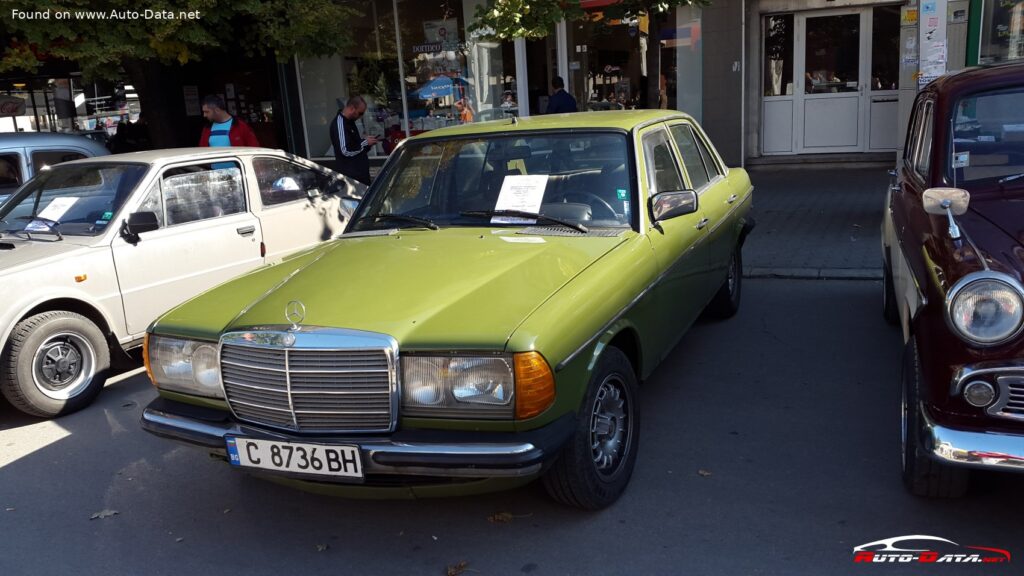
The Mercedes-Benz W123 represents a pivotal era for the German automaker, produced from January 1975 to April 1985. As the successor to the W114 and W115, the W123 established new benchmarks for safety, build quality, and comfort in the mid-size executive car segment. This generation saw significant global expansion for Mercedes-Benz, and the W123 became renowned for its durability and longevity. The 200 D Automatic, equipped with a 2.0-liter diesel engine producing 55 horsepower, was a popular variant, particularly in European markets where diesel fuel was more affordable and efficient. It offered a balance of economy and practicality for discerning buyers.
The Mercedes-Benz W123 200 D: A Legacy of Engineering
The W123 was more than just a replacement for its predecessors; it was a comprehensive redesign. Mercedes-Benz invested heavily in engineering advancements, focusing on passenger safety and a more refined driving experience. The 200 D model, while not the most powerful in the W123 lineup, exemplified the brand’s commitment to robust, reliable transportation. Its diesel engine, though modest in output by modern standards, was designed for high mileage and low running costs. The availability of an automatic transmission further enhanced its appeal for drivers seeking convenience.
Engine & Performance
The heart of the W123 200 D is its OM 615 D 20 inline-four cylinder diesel engine, displacing 1988 cubic centimeters (121.32 cubic inches). This naturally aspirated engine generates 55 horsepower at 4200 rpm and 113 Nm (83.34 lb.-ft.) of torque at 2400 rpm. While the horsepower figure seems low today, the engine’s torque characteristics provided adequate performance for everyday driving. The engine utilizes precombustion chamber injection, a common diesel technology of the era, and features a single overhead camshaft (SOHC) valvetrain with two valves per cylinder. The compression ratio is a high 21.5:1, typical for diesel engines. Performance figures reflect the engine’s limitations: acceleration from 0 to 100 km/h (0-62 mph) takes 29.4 seconds, and 0 to 60 mph is achieved in 27.9 seconds. The top speed is limited to 130 km/h (80.78 mph). Fuel economy is a strong point, achieving 9.5 l/100 km (24.8 US mpg) in urban conditions and 7.7 l/100 km (30.5 US mpg) on the open road.
Design & Features
The W123 is instantly recognizable for its clean, understated styling. The sedan body style, the most common variant, features a four-door configuration with seating for five passengers. The design prioritized functionality and aerodynamic efficiency. The W123 introduced several important safety features for its time, including crumple zones, reinforced passenger cell construction, and optional anti-lock braking systems (ABS) later in the production run. Interior appointments were typically conservative but well-executed, with a focus on durability and comfort. The 200 D Automatic model offered the convenience of an automatic transmission, a feature increasingly sought after by buyers. The vehicle’s dimensions are substantial for its era, measuring 4725 mm (186.02 in) in length, 1786 mm (70.31 in) in width, and 1438 mm (56.61 in) in height. The wheelbase is 2795 mm (110.04 in). The front and rear track widths are 1488 mm (58.58 in) and 1446 mm (56.93 in) respectively.
Technical Specifications
| Brand | Mercedes-Benz |
| Model | W123 |
| Generation | W123 |
| Type (Engine) | 200 D (55 Hp) Automatic |
| Start of production | January, 1975 |
| End of production | April, 1985 |
| Powertrain Architecture | Internal Combustion engine |
| Body type | Sedan |
| Seats | 5 |
| Doors | 4 |
| Fuel consumption (urban) | 9.5 l/100 km (24.8 US mpg) |
| Fuel consumption (extra urban) | 7.7 l/100 km (30.5 US mpg) |
| Fuel Type | Diesel |
| Acceleration 0 – 100 km/h | 29.4 sec |
| Acceleration 0 – 62 mph | 29.4 sec |
| Acceleration 0 – 60 mph | 27.9 sec |
| Maximum speed | 130 km/h (80.78 mph) |
| Weight-to-power ratio | 25.3 kg/Hp |
| Weight-to-torque ratio | 12.3 kg/Nm |
| Power | 55 Hp @ 4200 rpm |
| Torque | 113 Nm @ 2400 rpm (83.34 lb.-ft. @ 2400 rpm) |
| Engine layout | Front, Longitudinal |
| Engine Model/Code | OM 615 D 20 / 615.940 |
| Engine displacement | 1988 cm3 (121.32 cu. in.) |
| Number of cylinders | 4 |
| Engine configuration | Inline |
| Cylinder Bore | 87 mm (3.43 in.) |
| Piston Stroke | 83.6 mm (3.29 in.) |
| Compression ratio | 21.5:1 |
| Number of valves per cylinder | 2 |
| Fuel injection system | Precombustion chamber injection |
| Engine aspiration | Naturally aspirated |
| Valvetrain | SOHC |
| Engine oil capacity | 6.5 l (6.87 US qt | 5.72 UK qt) |
| Coolant capacity | 10 l (10.57 US qt | 8.8 UK qt) |
| Kerb Weight | 1390 kg (3064.43 lbs.) |
| Max. weight | 1910 kg (4210.83 lbs.) |
| Max load | 520 kg (1146.4 lbs.) |
| Fuel tank capacity | 65 l (17.17 US gal | 14.3 UK gal) |
| Length | 4725 mm (186.02 in.) |
| Width | 1786 mm (70.31 in.) |
| Height | 1438 mm (56.61 in.) |
| Wheelbase | 2795 mm (110.04 in.) |
| Front track | 1488 mm (58.58 in.) |
| Rear track | 1446 mm (56.93 in.) |
| Drivetrain Architecture | Rear wheel drive |
| Number of gears | 4 |
| Gearbox type | Automatic transmission |
| Front suspension | Double wishbone |
| Rear suspension | Trailing arm |
| Front brakes | Disc |
| Rear brakes | Disc |
| Steering type | Cone worm with recirculation balls |
| Wheel rims size | 5.5J x 14 |
The Mercedes-Benz W123 200 D Automatic remains a highly sought-after classic car, appreciated for its engineering excellence, durability, and timeless design. Its enduring popularity is a testament to the quality and foresight of Mercedes-Benz engineers in the 1970s and 80s.
