
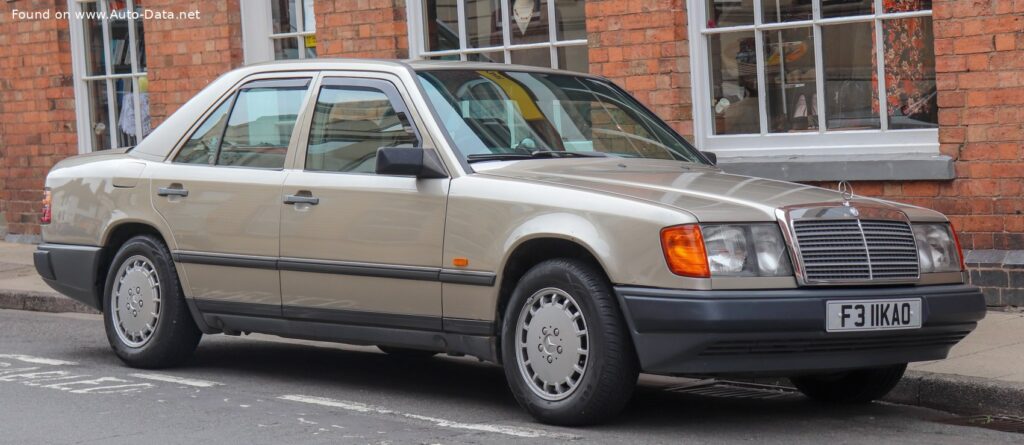
The Mercedes-Benz W124 300 E 4MATIC, produced from December 1985 to August 1989, represents a pivotal point in the evolution of the mid-size executive sedan. As part of the W124 series, it was designed to succeed the W201 (190E) and W123 models, offering a blend of luxury, performance, and advanced engineering. The 300 E 4MATIC specifically distinguished itself with its all-wheel-drive system, a relatively uncommon feature in its class at the time, and a robust inline-six engine. This model aimed to provide enhanced stability and traction, particularly in adverse weather conditions, appealing to buyers in regions with challenging climates. The W124 series, known for its build quality and longevity, established a strong reputation for reliability and remains a sought-after classic today.
The Mercedes-Benz W124 300 E 4MATIC: A Detailed Overview
The W124 series was a significant departure from its predecessors, incorporating a more modern design language and a focus on safety and comfort. The 300 E 4MATIC, with its 3.0-liter engine and all-wheel-drive capability, was positioned as a premium offering within the range. It catered to customers who desired a sophisticated and capable vehicle for both daily commuting and long-distance travel. The introduction of the 4MATIC system broadened the appeal of the W124, making it a viable option for those living in areas prone to snow or ice. The vehicle’s design prioritized passenger safety, incorporating features that were ahead of their time, and its robust construction ensured a long service life.
Engine & Performance
At the heart of the W124 300 E 4MATIC lies the M103 3.0-liter inline-six engine. This naturally aspirated powerplant delivers 188 horsepower at 5700 rpm and 255 Nm (188.08 lb.-ft.) of torque at 4400 rpm. The engine utilizes multi-port manifold fuel injection and a single overhead camshaft (SOHC) valvetrain, contributing to its smooth operation and respectable power output. The engine’s displacement of 2960 cm³ (180.63 cu. in.) and a compression ratio of 9.2:1 provide a good balance between performance and fuel efficiency. The 4MATIC all-wheel-drive system distributes power to all four wheels, enhancing traction and stability. Acceleration from 0 to 100 km/h (0-62 mph) takes 8.9 seconds, while 0 to 60 mph is achieved in approximately 8.5 seconds. The vehicle boasts a maximum speed of 220 km/h (136.7 mph). The weight-to-power ratio of 7.9 kg/Hp and a weight-to-torque ratio of 5.8 kg/Nm further highlight the engine’s capabilities within the vehicle’s overall weight.
Design & Features
The W124 300 E 4MATIC is a four-door sedan with a classic, understated design. Its body style emphasizes elegance and practicality, with a spacious interior capable of comfortably seating five passengers. The vehicle’s dimensions are 4740 mm (186.61 in.) in length, 1740 mm (68.5 in.) in width, and 1451 mm (57.13 in.) in height, with a wheelbase of 2800 mm (110.24 in.). Key features include ventilated disc brakes on the front wheels and disc brakes on the rear, providing reliable stopping power. An Anti-lock Braking System (ABS) was included as a standard safety feature, enhancing braking performance and control. The suspension system utilizes wishbones at the front and an independent multi-link setup with coil springs at the rear, offering a comfortable and controlled ride. Power steering, utilizing a cone worm and recirculation balls mechanism, provides ease of maneuverability. The vehicle rides on 195/65 R15 tires mounted on 6.5J x 15 inch wheel rims. The trunk offers a minimum capacity of 520 liters (18.36 cu. ft.), providing ample space for luggage and cargo.
Technical Specifications
| Brand | Mercedes-Benz |
| Model | W124 |
| Generation | W124 |
| Type | 300 E (188 Hp) 4MATIC Automatic |
| Start of production | December, 1985 |
| End of production | August, 1989 |
| Powertrain Architecture | Internal Combustion engine |
| Body type | Sedan |
| Seats | 5 |
| Doors | 4 |
| Fuel consumption (urban) | 13.5 l/100 km (17.4 US mpg, 20.9 UK mpg, 7.4 km/l) |
| Fuel consumption (extra urban) | 8.9 l/100 km (26.4 US mpg, 31.7 UK mpg, 11.2 km/l) |
| Fuel Type | Petrol (Gasoline) |
| Acceleration 0 – 100 km/h | 8.9 sec |
| Acceleration 0 – 62 mph | 8.9 sec |
| Acceleration 0 – 60 mph | 8.5 sec |
| Maximum speed | 220 km/h (136.7 mph) |
| Weight-to-power ratio | 7.9 kg/Hp |
| Weight-to-torque ratio | 5.8 kg/Nm |
| Power | 188 Hp @ 5700 rpm |
| Power per litre | 63.5 Hp/l |
| Torque | 255 Nm @ 4400 rpm (188.08 lb.-ft. @ 4400 rpm) |
| Engine layout | Front, Longitudinal |
| Engine Model/Code | M 103 |
| Engine displacement | 2960 cm3 (180.63 cu. in.) |
| Number of cylinders | 6 |
| Engine configuration | Inline |
| Cylinder Bore | 88.5 mm (3.48 in.) |
| Piston Stroke | 80.2 mm (3.16 in.) |
| Compression ratio | 9.2:1 |
| Number of valves per cylinder | 2 |
| Fuel injection system | Multi-port manifold injection |
| Engine aspiration | Naturally aspirated engine |
| Valvetrain | SOHC |
| Engine oil capacity | 6.5 l (6.87 US qt | 5.72 UK qt) |
| Coolant | 9 l (9.51 US qt | 7.92 UK qt) |
| Kerb Weight | 1490 kg (3284.89 lbs.) |
| Max. weight | 2030 kg (4475.38 lbs.) |
| Max load | 540 kg (1190.5 lbs.) |
| Trunk (boot) space – minimum | 520 l (18.36 cu. ft.) |
| Fuel tank capacity | 70 l (18.49 US gal | 15.4 UK gal) |
| Length | 4740 mm (186.61 in.) |
| Width | 1740 mm (68.5 in.) |
| Height | 1451 mm (57.13 in.) |
| Wheelbase | 2800 mm (110.24 in.) |
| Front track | 1501 mm (59.09 in.) |
| Rear (Back) track | 1485 mm (58.46 in.) |
| Drivetrain Architecture | All wheel drive (4×4). ICE drives rear wheels, front wheels engaged via clutch. |
| Drive wheel | All wheel drive (4×4) |
| Number of gears and type of gearbox | 4 gears, automatic transmission |
| Front suspension | Wishbone |
| Rear suspension | Independent multi-link suspension, Coil spring |
| Front brakes | Ventilated discs |
| Rear brakes | Disc |
| Assisting systems | ABS (Anti-lock braking system) |
| Steering type | Cone worm with recirculation balls |
| Power steering | Hydraulic Steering |
| Tires size | Front/Rear: 195/65 R15 |
| Wheel rims size | Front/Rear: 6.5J x 15 |
