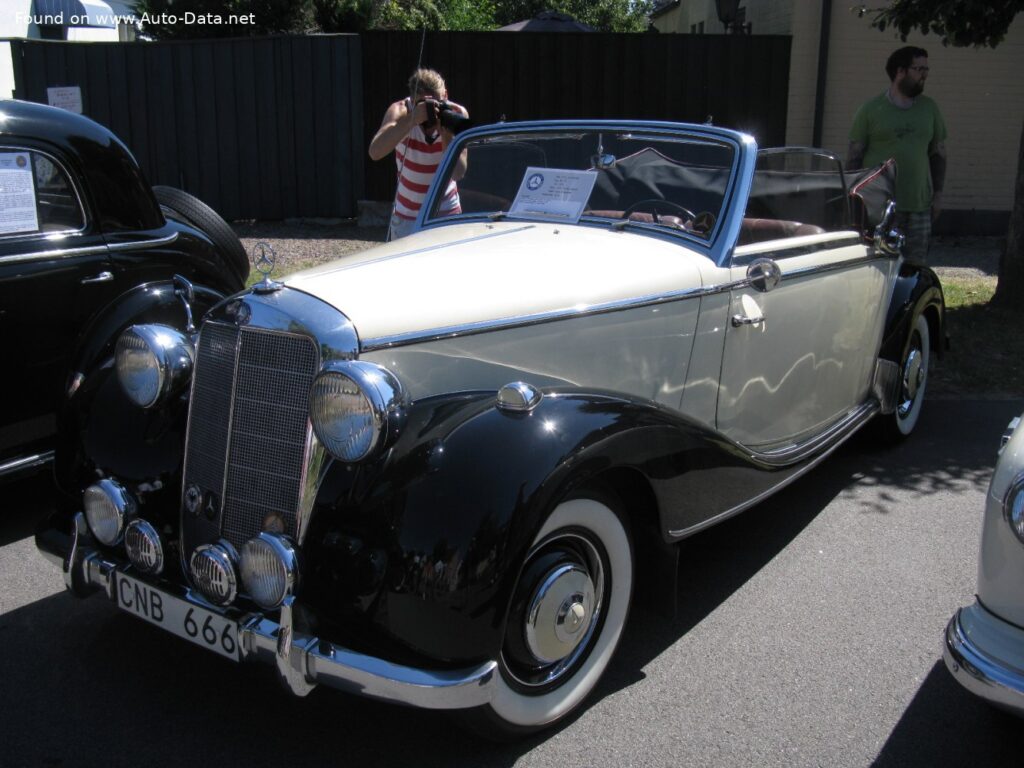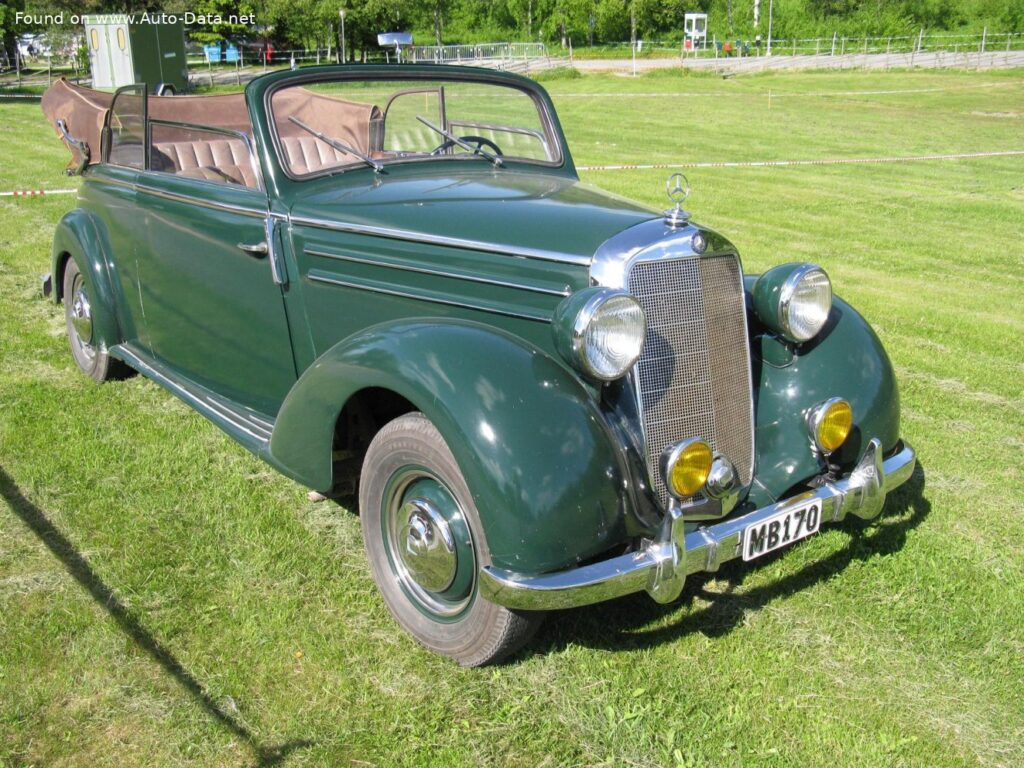
The Mercedes-Benz W136, produced from 1936 to 1955, represents a pivotal era for the German automaker. Emerging from the pre-war 170 series, the W136 was Mercedes-Benz’s entry-level offering, designed to provide comfortable and reliable transportation for the burgeoning middle class. The W136 Cabriolet B 170 S, manufactured between 1949 and 1951, was a particularly elegant iteration of this model, embodying post-war optimism and a return to civilian production. This two-door, two-seater convertible offered a taste of Mercedes-Benz luxury at a relatively accessible price point, and played a significant role in re-establishing the brand’s reputation after the devastation of World War II.
The Mercedes-Benz W136 Cabriolet B 170 S
The W136 series underwent several revisions throughout its production run. The 170 S variant, introduced in 1949, featured a more powerful engine and improved features compared to earlier models. The “S” designation denoted “Sonder,” meaning “special” in German, signifying an upgraded version. The Cabriolet B body style offered open-air motoring with a manually operated soft top, enhancing the driving experience. While not a high-performance vehicle by modern standards, the W136 Cabriolet B 170 S was appreciated for its build quality, comfortable ride, and sophisticated styling for its time.
Engine & Performance
The heart of the W136 Cabriolet B 170 S is a 1.8-liter (1767 cc) inline-four cylinder engine, designated the M 136 III / 136.922. This naturally aspirated engine produced 52 horsepower at 4000 rpm and 112 Nm (82.61 lb.-ft.) of torque at 1800 rpm. Power delivery is managed through a four-speed manual transmission, sending power to the rear wheels. The engine utilizes a carburetor fuel injection system and an OHV valvetrain with two valves per cylinder. Acceleration from 0 to 100 km/h (0-62 mph) takes approximately 32 seconds, while 0 to 60 mph is achieved in around 30.4 seconds. The top speed is rated at 120 km/h (74.56 mph). The engine’s power-to-weight ratio is 25.2 kg/Hp, and the torque-to-weight ratio is 11.7 kg/Nm. Fuel consumption is rated at 9.7 l/100 km (24.2 US mpg, 29.1 UK mpg, 10.3 km/l).
Design & Features
The W136 Cabriolet B 170 S boasts a classic pre-war aesthetic, softened with post-war design influences. Its long hood, flowing fenders, and upright grille are hallmarks of the era. The two-door cabriolet body style provides an open-air experience, with a manually operated soft top that folds down for a more engaging drive. The interior is relatively spartan by modern standards, but features comfortable seating for two passengers. The car’s design prioritized elegance and practicality over outright sportiness. Safety features were limited by the standards of the time, consisting primarily of robust construction and reliable braking. The suspension utilizes a double wishbone setup with a transverse stabilizer at the front, and a trailing arm configuration at the rear, providing a reasonably comfortable ride on the roads of the period. Braking is handled by drum brakes on all four wheels. The steering system employs a worm-reduction unit.
Technical Specifications
| Brand | Mercedes-Benz |
| Model | W136 |
| Generation | W136 Cabriolet B |
| Type (Engine) | 170 S (52 Hp) |
| Start of production | May, 1949 |
| End of production | November, 1951 |
| Powertrain Architecture | Internal Combustion engine |
| Body type | Cabriolet |
| Seats | 2 |
| Doors | 2 |
| Fuel consumption (combined) | 9.7 l/100 km |
| Fuel consumption (US mpg) | 24.2 US mpg |
| Fuel consumption (UK mpg) | 29.1 UK mpg |
| Fuel consumption (km/l) | 10.3 km/l |
| Fuel Type | Petrol (Gasoline) |
| Acceleration 0 – 100 km/h | 32 sec |
| Acceleration 0 – 62 mph | 32 sec |
| Acceleration 0 – 60 mph | 30.4 sec |
| Maximum speed | 120 km/h |
| Maximum speed (mph) | 74.56 mph |
| Weight-to-power ratio | 25.2 kg/Hp |
| Hp/tonne | 39.7 Hp/tonne |
| Weight-to-torque ratio | 11.7 kg/Nm |
| Nm/tonne | 85.5 Nm/tonne |
| Power | 52 Hp @ 4000 rpm |
| Power per litre | 29.4 Hp/l |
| Torque | 112 Nm @ 1800 rpm |
| Torque (lb.-ft.) | 82.61 lb.-ft. @ 1800 rpm |
| Engine layout | Front, Longitudinal |
| Engine Model/Code | M 136 III / 136.922 |
| Engine displacement | 1767 cm3 |
| Engine displacement (cu. in.) | 107.83 cu. in. |
| Number of cylinders | 4 |
| Engine configuration | Inline |
| Cylinder Bore | 75 mm |
| Cylinder Bore (in.) | 2.95 in. |
| Piston Stroke | 100 mm |
| Piston Stroke (in.) | 3.94 in. |
| Compression ratio | 6.5:1 |
| Number of valves per cylinder | 2 |
| Fuel injection system | Carburettor |
| Engine aspiration | Naturally aspirated engine |
| Valvetrain | OHV |
| Kerb Weight | 1310 kg |
| Kerb Weight (lbs.) | 2888.06 lbs. |
| Max. weight | 1605 kg |
| Max. weight (lbs.) | 3538.42 lbs. |
| Max load | 295 kg |
| Max load (lbs.) | 650.36 lbs. |
| Fuel tank capacity | 47 l |
| Fuel tank capacity (US gal) | 12.42 US gal |
| Fuel tank capacity (UK gal) | 10.34 UK gal |
| Length | 4455 mm |
| Length (in.) | 175.39 in. |
| Width | 1684 mm |
| Width (in.) | 66.3 in. |
| Height | 1610 mm |
| Height (in.) | 63.39 in. |
| Wheelbase | 2845 mm |
| Wheelbase (in.) | 112.01 in. |
| Front track | 1315 mm |
| Front track (in.) | 51.77 in. |
| Rear (Back) track | 1420 mm |
| Rear (Back) track (in.) | 55.91 in. |
| Drivetrain Architecture | Rear wheel drive |
| Drive wheel | Rear wheel drive |
| Number of gears and type of gearbox | 4 gears, manual transmission |
| Front suspension | Double wishbone, Transverse stabilizer |
| Rear suspension | Trailing arm |
| Front brakes | Drum |
| Rear brakes | Drum |
| Steering type | Worm-reduction unit |