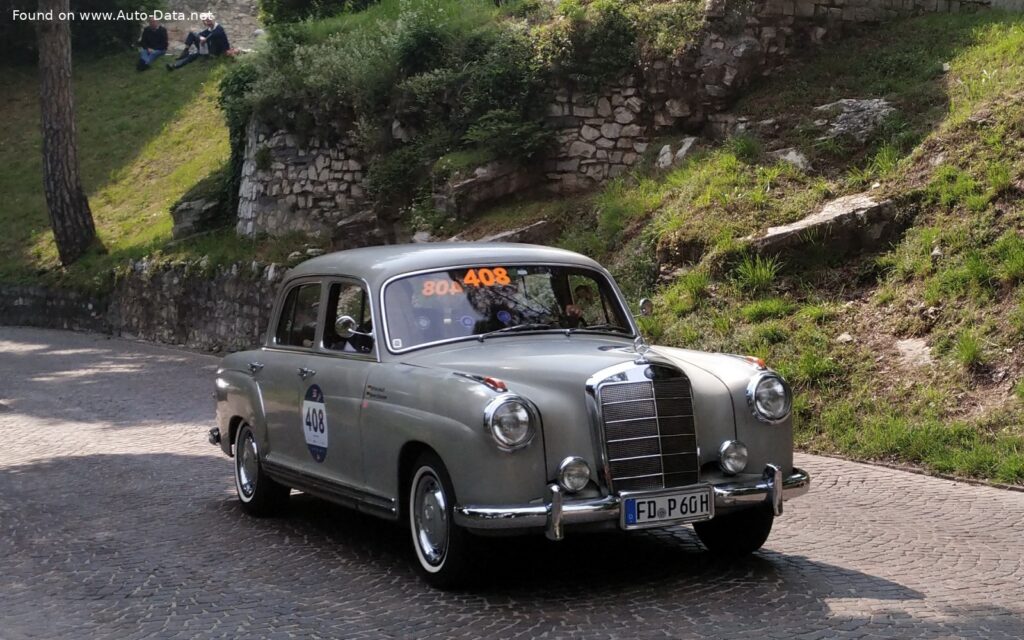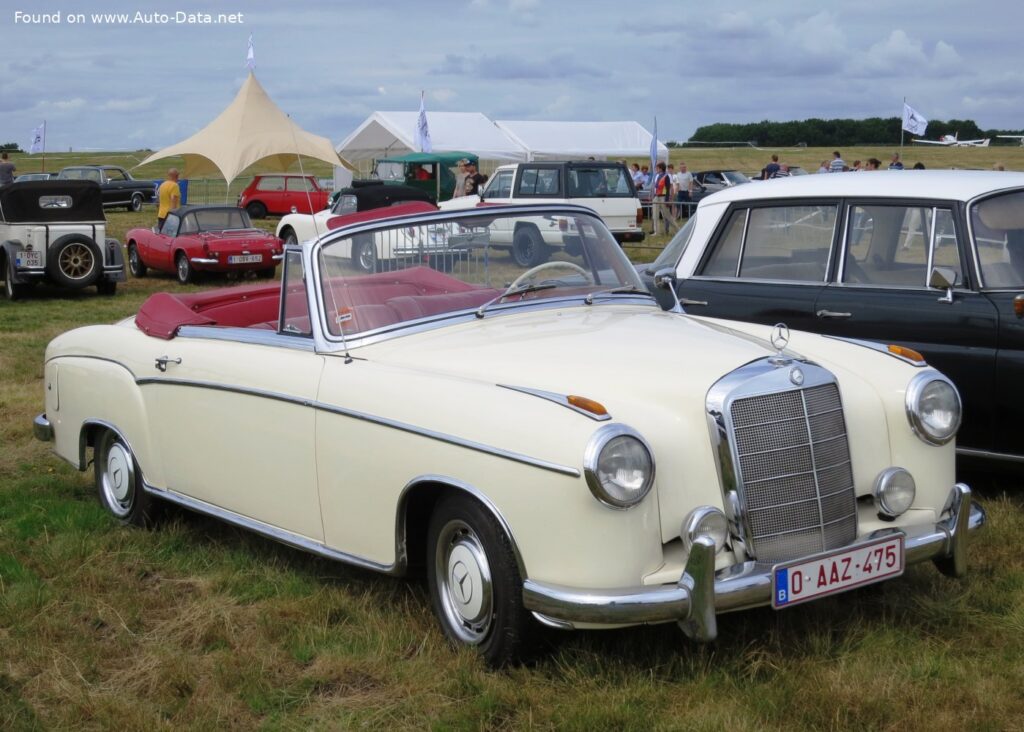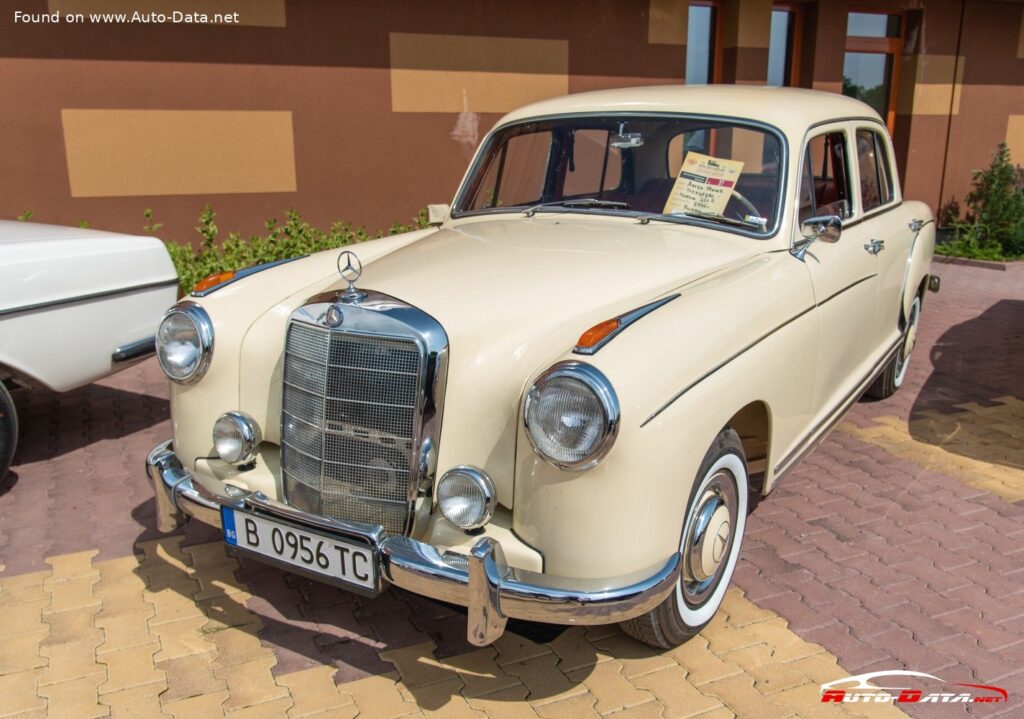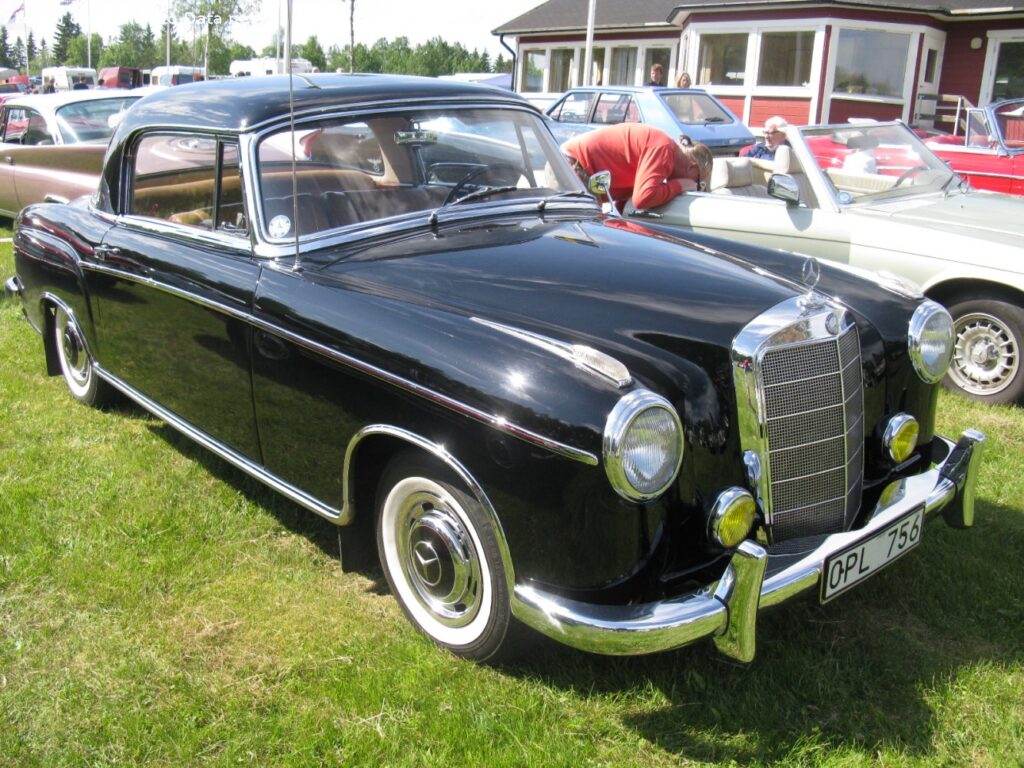
The Mercedes-Benz W180 II Coupe 220 S, produced between August 1957 and October 1959, represents a refined iteration of the “Ponton” series, a pivotal design era for the German automaker. This two-door coupe, powered by a 2.2-liter inline-six engine, offered a blend of luxury and performance aimed at the discerning European driver. While not officially exported to the United States in significant numbers during its production run, the W180 series, and particularly the 220 S coupe, is now a sought-after classic, representing a significant step forward in post-war Mercedes-Benz engineering and styling. The “Ponton” name, meaning “pontoon” in German, refers to the car’s unibody construction – a relatively new technique at the time – which gave the vehicle a lower profile and more streamlined appearance compared to its predecessors.
Mercedes-Benz W180 II Coupe 220 S: A Detailed Overview
The W180 series marked a departure from the traditionally separate chassis and body construction favored by Mercedes-Benz. The fully integrated unibody design, pioneered by other manufacturers, allowed for a lighter and more rigid structure, improving handling and passenger safety. The 220 S coupe, positioned as a more elegant and exclusive variant within the Ponton range, featured a more refined interior and a generally higher level of trim. It served as a competitor to other luxury coupes of the era, such as those offered by BMW and Alfa Romeo, primarily within the European market.
Engine & Performance
The heart of the 220 S coupe is its 2.2-liter (2195 cm3) inline-six cylinder engine, designated the M 180 III / 180.924. This naturally aspirated engine produced 106 horsepower at 5200 rpm and 172 Nm (126.86 lb.-ft.) of torque at 3500 rpm. While these figures may seem modest by modern standards, they were respectable for the late 1950s, providing adequate performance for comfortable cruising and spirited driving. The engine featured a single overhead camshaft (SOHC) valvetrain and utilized a carburetor fuel injection system. Power delivery was smooth and linear, characteristic of Mercedes-Benz engines of the period. The engine’s power-to-weight ratio was 77.7 HP per tonne, and it generated 48.3 HP per liter of displacement.
Power is delivered to the rear wheels via a four-speed manual transmission, specifically a Hydrak unit. This transmission was known for its smooth operation and durability. Acceleration from 0 to 100 km/h (0-62 mph) took approximately 17 seconds, while 0 to 60 mph was achieved in around 16.2 seconds. The vehicle’s top speed was rated at 160 km/h (99.42 mph). Fuel consumption was approximately 10.9 liters per 100 kilometers (21.6 US mpg or 25.9 UK mpg).
Design & Features
The W180 II Coupe 220 S boasts a classic coupe silhouette with a long hood, a gracefully sloping roofline, and a relatively short rear deck. The body’s design emphasized horizontal lines, contributing to the car’s elegant and understated appearance. Chrome trim was used judiciously, accentuating the vehicle’s contours without being overly ostentatious. The interior was appointed with high-quality materials, including leather upholstery and wood veneer trim, reflecting Mercedes-Benz’s commitment to luxury. The vehicle comfortably seats five passengers, although rear seat space is somewhat limited due to the coupe body style.
Safety features, while rudimentary by today’s standards, were relatively advanced for the era. The unibody construction provided inherent structural rigidity, enhancing crashworthiness. Drum brakes were fitted to all four wheels, offering adequate stopping power for the vehicle’s weight and performance. Steering was accomplished via a cone worm and recirculation balls system. The car’s suspension utilized a double wishbone setup with a transverse stabilizer at the front and a trailing arm configuration at the rear, providing a comfortable ride and reasonably precise handling.
Technical Specifications
| Brand | Mercedes-Benz |
| Model | Ponton |
| Generation | W180 II Coupe |
| Type (Engine) | 220 S (106 Hp) Hydrak |
| Start of production | August, 1957 |
| End of production | October, 1959 |
| Powertrain Architecture | Internal Combustion engine |
| Body type | Coupe |
| Seats | 5 |
| Doors | 2 |
| Fuel consumption (combined) | 10.9 l/100 km |
| Fuel consumption (US mpg) | 21.6 US mpg |
| Fuel consumption (UK mpg) | 25.9 UK mpg |
| Fuel consumption (km/l) | 9.2 km/l |
| Fuel Type | Petrol (Gasoline) |
| Acceleration 0 – 100 km/h | 17 sec |
| Acceleration 0 – 62 mph | 17 sec |
| Acceleration 0 – 60 mph | 16.2 sec |
| Maximum speed | 160 km/h (99.42 mph) |
| Weight-to-power ratio | 12.9 kg/Hp |
| Weight-to-torque ratio | 7.9 kg/Nm |
| Power | 106 Hp @ 5200 rpm |
| Power per litre | 48.3 Hp/l |
| Torque | 172 Nm @ 3500 rpm (126.86 lb.-ft. @ 3500 rpm) |
| Engine layout | Front, Longitudinal |
| Engine Model/Code | M 180 III / 180.924 |
| Engine displacement | 2195 cm3 (133.95 cu. in.) |
| Number of cylinders | 6 |
| Engine configuration | Inline |
| Cylinder Bore | 80 mm (3.15 in.) |
| Piston Stroke | 72.8 mm (2.87 in.) |
| Compression ratio | 8.7:1 |
| Number of valves per cylinder | 2 |
| Fuel injection system | Carburettor |
| Engine aspiration | Naturally aspirated engine |
| Valvetrain | SOHC |
| Engine oil capacity | 11.9 l (12.57 US qt | 10.47 UK qt) |
| Coolant capacity | 11.4 l (12.05 US qt | 10.03 UK qt) |
| Kerb Weight | 1365 kg (3009.31 lbs.) |
| Max. weight | 1790 kg (3946.27 lbs.) |
| Max load | 425 kg (936.96 lbs.) |
| Fuel tank capacity | 64 l (16.91 US gal | 14.08 UK gal) |
| Length | 4700 mm (185.04 in.) |
| Width | 1790 mm (70.47 in.) |
| Height | 1530 mm (60.24 in.) |
| Wheelbase | 2700 mm (106.3 in.) |
| Front track | 1430 mm (56.3 in.) |
| Rear track | 1470 mm (57.87 in.) |
| Drivetrain Architecture | Rear wheel drive |
| Number of gears and type of gearbox | 4 gears, manual transmission Hydrak |
| Front suspension | Double wishbone, Transverse stabilizer |
| Rear suspension | Trailing arm |
| Front brakes | Drum |
| Rear brakes | Drum |
| Steering type | Cone worm with recirculation balls |
The Mercedes-Benz W180 II Coupe 220 S remains a testament to the engineering prowess and design sensibilities of the era. Its enduring appeal lies in its elegant styling, robust construction, and the prestige associated with the Mercedes-Benz marque. Today, it is a cherished classic, representing a significant chapter in the history of the automobile.