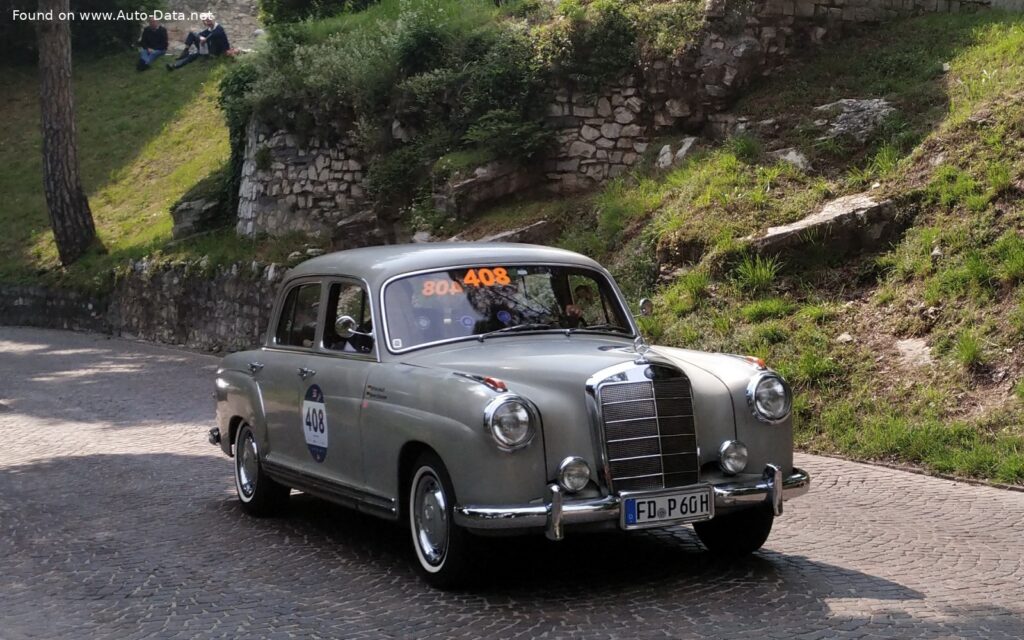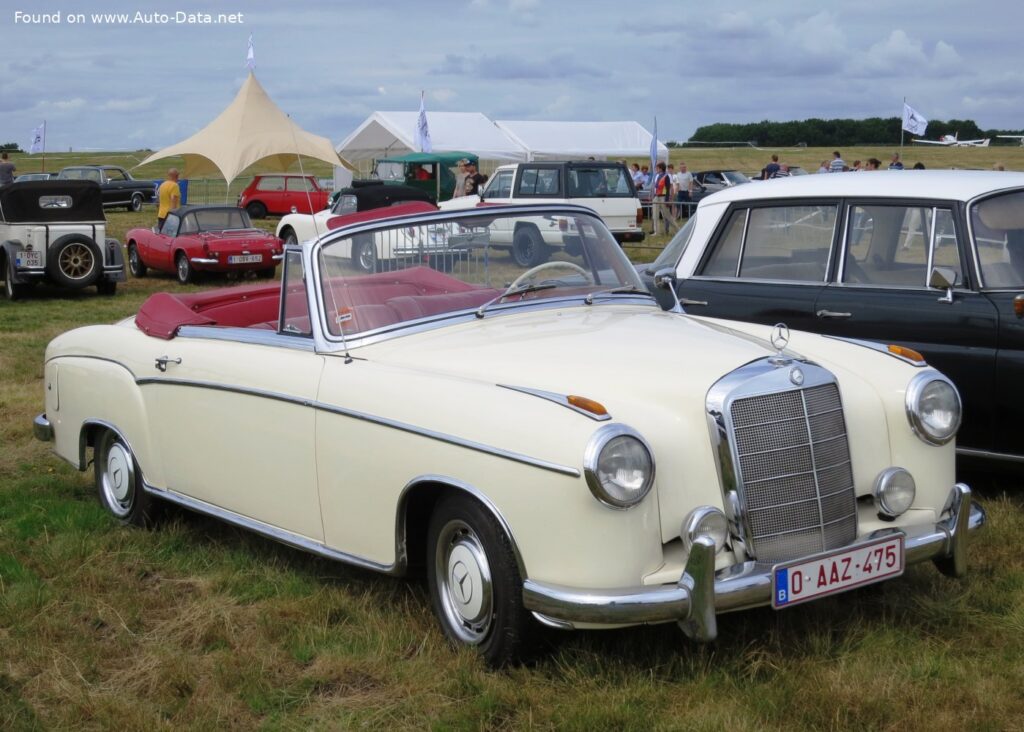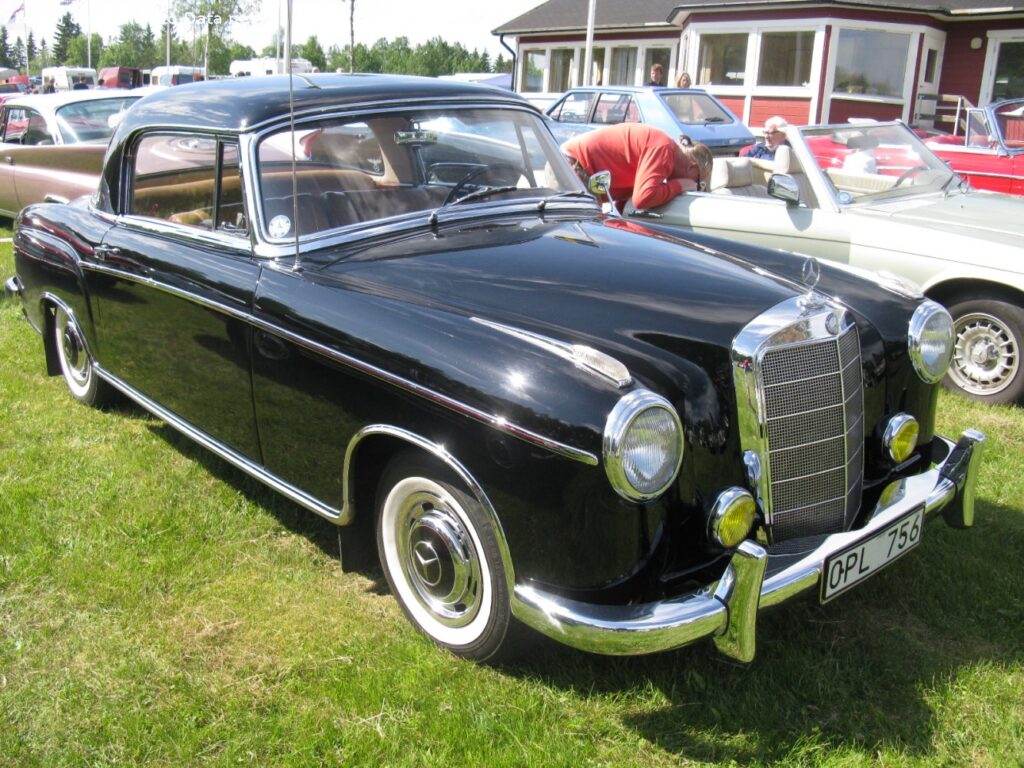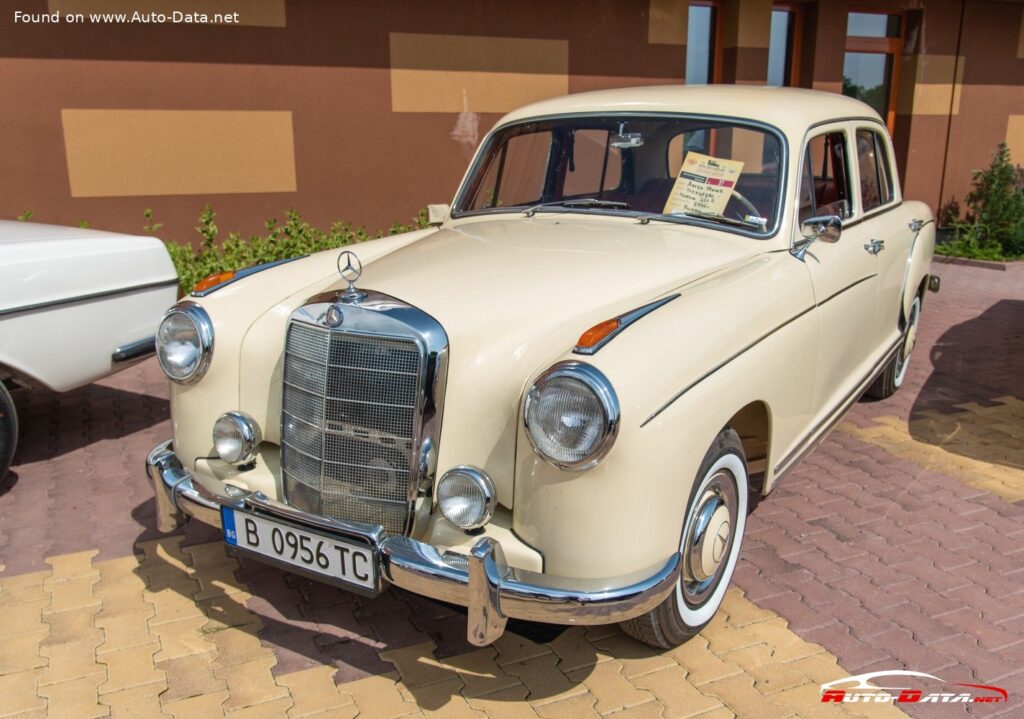
The Mercedes-Benz W180 II Sedan 220 S, produced between August 1957 and August 1959, represents a significant evolution in post-war German automotive engineering. Part of the “Ponton” series – a name derived from the car’s pontoon-like, un-fendered body style – the 220 S was positioned as a luxury sedan aimed at a discerning clientele. It built upon the foundation laid by the earlier W180 models, offering increased power and refinement. While not initially a major export to the United States, the Ponton series, and the 220 S in particular, established Mercedes-Benz as a builder of high-quality, technologically advanced automobiles, paving the way for the brand’s later success in the American market.
Mercedes-Benz W180 II Sedan 220 S: A Detailed Overview
The W180 series as a whole marked a departure from the pre-war designs still evident in some contemporary German cars. The Ponton’s monocoque construction – a relatively new technique at the time – provided increased strength and reduced weight compared to traditional body-on-frame designs. The 220 S specifically represented the top-of-the-line model within the W180 II generation, boasting a larger engine and more luxurious appointments than its siblings. It served as a crucial stepping stone in Mercedes-Benz’s development of increasingly sophisticated passenger vehicles.
Engine & Performance
The heart of the 220 S is its 2.2-liter (2195 cm3) inline-six cylinder engine, designated the M180 III / 180.924. This naturally aspirated engine produced 106 horsepower at 5200 rpm and 172 Nm (126.86 lb.-ft.) of torque at 3500 rpm. While these figures may seem modest by modern standards, they were competitive for a luxury sedan of the late 1950s. The engine featured a single overhead camshaft (SOHC) valvetrain and utilized a carburetor for fuel delivery. Power is sent to the rear wheels via a four-speed manual transmission. Performance figures indicate a 0-60 mph (0-96.6 km/h) time of approximately 16.2 seconds and a top speed of 99.42 mph (160 km/h). Fuel consumption was rated at 10.7 liters per 100 kilometers (22 US mpg / 26.4 UK mpg).
Design & Features
The 220 S’s design was characterized by its clean lines and lack of prominent fender flares – hence the “Ponton” nickname. The four-door sedan body style offered seating for five passengers. The interior was appointed with quality materials, reflecting the car’s luxury positioning. While safety features were relatively basic by today’s standards, the monocoque construction provided a degree of crash protection. The car’s suspension utilized a double wishbone setup with a transverse stabilizer at the front and a trailing arm arrangement at the rear, aiming to provide a comfortable ride. Drum brakes were employed on all four wheels. The steering system was a cone worm type with recirculation balls. The overall aesthetic of the 220 S was one of understated elegance, embodying the post-war German design philosophy of functionality and refinement.
Technical Specifications
| Brand | Mercedes-Benz |
| Model | Ponton |
| Generation | W180 II Sedan |
| Type (Engine) | 220 S (106 Hp) |
| Start of production | August, 1957 |
| End of production | August, 1959 |
| Powertrain Architecture | Internal Combustion engine |
| Body type | Sedan |
| Seats | 5 |
| Doors | 4 |
| Fuel consumption (combined) | 10.7 l/100 km |
| Fuel consumption (US mpg) | 22 US mpg |
| Fuel consumption (UK mpg) | 26.4 UK mpg |
| Fuel consumption (km/l) | 9.3 km/l |
| Fuel Type | Petrol (Gasoline) |
| Acceleration 0 – 100 km/h | 17 sec |
| Acceleration 0 – 62 mph | 17 sec |
| Acceleration 0 – 60 mph | 16.2 sec |
| Maximum speed | 160 km/h |
| Maximum speed (mph) | 99.42 mph |
| Weight-to-power ratio | 12.5 kg/Hp |
| Power per tonne | 80 Hp/tonne |
| Weight-to-torque ratio | 7.7 kg/Nm |
| Torque per tonne | 129.8 Nm/tonne |
| Power | 106 Hp @ 5200 rpm |
| Power per litre | 48.3 Hp/l |
| Torque | 172 Nm @ 3500 rpm |
| Torque (lb.-ft.) | 126.86 lb.-ft. @ 3500 rpm |
| Engine layout | Front, Longitudinal |
| Engine Model/Code | M 180 III / 180.924 |
| Engine displacement | 2195 cm3 |
| Engine displacement (cu. in.) | 133.95 cu. in. |
| Number of cylinders | 6 |
| Engine configuration | Inline |
| Cylinder Bore | 80.01 mm |
| Cylinder Bore (in.) | 3.15 in. |
| Piston Stroke | 72.8 mm |
| Piston Stroke (in.) | 2.87 in. |
| Compression ratio | 8.7:1 |
| Number of valves per cylinder | 2 |
| Fuel injection system | Carburettor |
| Engine aspiration | Naturally aspirated engine |
| Valvetrain | SOHC |
| Engine oil capacity | 11.9 l |
| Engine oil capacity (US qt) | 12.57 US qt |
| Engine oil capacity (UK qt) | 10.47 UK qt |
| Coolant capacity | 11.4 l |
| Coolant capacity (US qt) | 12.05 US qt |
| Coolant capacity (UK qt) | 10.03 UK qt |
| Kerb Weight | 1325 kg |
| Kerb Weight (lbs.) | 2921.12 lbs. |
| Max. weight | 1790 kg |
| Max. weight (lbs.) | 3946.27 lbs. |
| Max load | 465 kg |
| Max load (lbs.) | 1025.15 lbs. |
| Fuel tank capacity | 64 l |
| Fuel tank capacity (US gal) | 16.91 US gal |
| Fuel tank capacity (UK gal) | 14.08 UK gal |
| Length | 4750 mm |
| Length (in.) | 187.01 in. |
| Width | 1740 mm |
| Width (in.) | 68.5 in. |
| Height | 1560 mm |
| Height (in.) | 61.42 in. |
| Wheelbase | 2820 mm |
| Wheelbase (in.) | 111.02 in. |
| Front track | 1430 mm |
| Front track (in.) | 56.3 in. |
| Rear track | 1470 mm |
| Rear track (in.) | 57.87 in. |
| Drivetrain Architecture | Rear wheel drive |
| Number of gears | 4 |
| Type of gearbox | manual transmission |
| Front suspension | Double wishbone, Transverse stabilizer |
| Rear suspension | Trailing arm |
| Front brakes | Drum |
| Rear brakes | Drum |
| Steering type | Cone worm with recirculation balls |