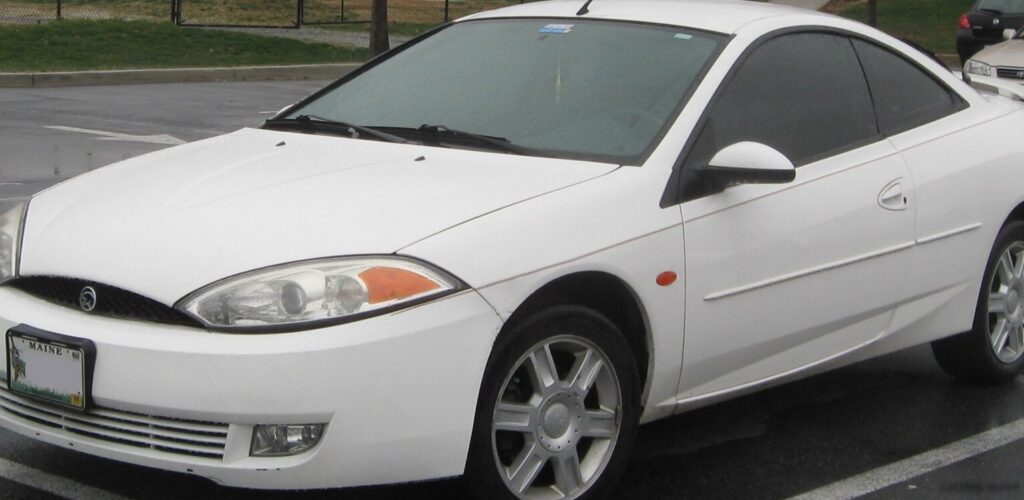
The Mercury Cougar VIII 2.5 V6 24V S, produced between 1998 and 2002, represented a significant shift for the Cougar nameplate. Moving away from the earlier, more traditionally styled Cougars, the VIII adopted a sleek, European-inspired coupe design, heavily influenced by the Ford New Edge styling language. This generation Cougar was primarily aimed at the North American market, offering a sporty alternative to more mainstream sedans and coupes. It was built on the Ford CD270 platform, shared with the Ford Contour and Mercury Mystique. The 2.5L V6 S trim occupied a mid-range position within the Cougar lineup, offering a balance of performance and features, slotting above the base 2.0L engine and below the higher-performance V8 options available in later years.
Technical Specifications
| Brand | Mercury |
| Model | Cougar |
| Generation | Cougar VIII |
| Type (Engine) | 2.5 V6 24V S (199 Hp) Automatic |
| Start of production | 1998 |
| End of production | 2002 |
| Powertrain Architecture | Internal Combustion engine |
| Body type | Coupe |
| Seats | 4 |
| Doors | 3 |
| Fuel Type | Petrol (Gasoline) |
| Weight-to-power ratio | 6.9 kg/Hp, 144.7 Hp/tonne |
| Weight-to-torque ratio | 6 kg/Nm, 165.8 Nm/tonne |
| Power | 199 Hp @ 6750 rpm |
| Power per litre | 78.2 Hp/l |
| Torque | 228 Nm @ 5500 rpm, 168.16 lb.-ft. @ 5500 rpm |
| Engine layout | Front, Transverse |
| Engine Model/Code | Duratec |
| Engine displacement | 2544 cm3, 155.24 cu. in. |
| Number of cylinders | 6 |
| Engine configuration | V-engine |
| Cylinder Bore | 82.4 mm, 3.24 in. |
| Piston Stroke | 79.5 mm, 3.13 in. |
| Compression ratio | 10:1 |
| Number of valves per cylinder | 4 |
| Fuel injection system | Multi-port manifold injection |
| Engine aspiration | Naturally aspirated engine |
| Valvetrain | DOHC |
| Engine oil capacity | 5.5 l, 5.81 US qt | 4.84 UK qt |
| Coolant | 9.5 l, 10.04 US qt | 8.36 UK qt |
| Kerb Weight | 1375 kg, 3031.36 lbs |
| Trunk (boot) space – minimum | 410 l, 14.48 cu. ft |
| Fuel tank capacity | 60 l, 15.85 US gal | 13.2 UK gal |
| Length | 4700 mm, 185.04 in |
| Width | 1770 mm, 69.69 in |
| Height | 1320 mm, 51.97 in |
| Wheelbase | 2700 mm, 106.3 in |
| Front track | 1505 mm, 59.25 in |
| Rear (Back) track | 1490 mm, 58.66 in |
| Drivetrain Architecture | The Internal combustion engine (ICE) drives the front wheels of the vehicle. |
| Drive wheel | Front wheel drive |
| Number of gears and type of gearbox | 4 gears, automatic transmission |
| Front suspension | Spring Strut |
| Rear suspension | Spring Strut |
| Front brakes | Ventilated discs |
| Rear brakes | Disc |
| Assisting systems | ABS (Anti-lock braking system) |
| Steering type | Steering rack and pinion |
| Power steering | Hydraulic Steering |
| Tires size | 205/60 R15 |
| Wheel rims size | 15 |
Powertrain & Engine Architecture
The heart of the Cougar VIII 2.5 V6 S is the Ford Duratec 2.5-liter V6 engine. This engine, part of Ford’s modular engine family, featured a 60-degree V-angle and a double overhead camshaft (DOHC) valvetrain with four valves per cylinder. The Duratec engine utilized multi-port fuel injection, delivering fuel directly into each intake port for improved combustion efficiency. The engine code for this specific variant is often found as KLDE. Paired with this engine was a four-speed automatic transmission, a common choice for buyers prioritizing ease of use over outright performance. This transmission was designed to provide smooth shifts and adequate acceleration for everyday driving. While not a particularly advanced transmission by modern standards, it was known for its reliability.
Driving Characteristics
The 199 horsepower and 228 Nm (168 lb-ft) of torque produced by the 2.5L V6, when channeled through the four-speed automatic, resulted in a comfortable and capable driving experience. Acceleration was adequate, with a 0-60 mph time estimated around 8.5-9.5 seconds. Compared to the base 2.0L engine, the 2.5L offered a noticeable improvement in power and responsiveness. However, it didn’t possess the same punch as the later V8-powered Cougars. The automatic transmission, while smooth, did contribute to some power loss and a less engaging driving experience compared to the available five-speed manual. Gear ratios were tuned for fuel efficiency and comfortable cruising, rather than aggressive acceleration. The front-wheel-drive configuration provided predictable handling, but lacked the dynamic capabilities of rear-wheel-drive alternatives.
Equipment & Trim Levels
The Cougar VIII 2.5 V6 S typically came standard with features such as air conditioning, power windows and locks, a CD player, and an adjustable steering wheel. Interior upholstery was generally cloth, though leather options were available. The dashboard featured a relatively simple layout with analog gauges. Optional extras included a premium sound system, sunroof, and upgraded interior trim. The “S” designation indicated a slightly more sporty trim level, often including unique wheel designs and minor cosmetic enhancements. Safety features included dual front airbags and ABS (Anti-lock Braking System).
Chassis & Braking
The Cougar VIII utilized a MacPherson strut front suspension and a multi-link rear suspension, providing a comfortable ride quality. The front suspension incorporated a stabilizer bar to reduce body roll during cornering. Braking duties were handled by ventilated discs at the front and solid discs at the rear. The ABS system helped to maintain steering control during hard braking. The chassis was designed to balance ride comfort with handling stability, prioritizing a smooth and predictable driving experience over outright sportiness. The relatively modest weight of the vehicle, around 1375 kg (3031 lbs), helped to mitigate the limitations of the front-wheel-drive layout.
Market Reception & Comparison
The Cougar VIII 2.5 V6 S received mixed reviews from automotive critics. It was generally praised for its stylish design and comfortable interior, but criticized for its somewhat bland driving dynamics and the lack of a truly engaging powertrain. Compared to the base 2.0L model, the 2.5L offered a significant performance upgrade, making it a more appealing option for drivers seeking a bit more power. However, it wasn’t as sporty or powerful as the V8-equipped Cougars that arrived later in the production run. Fuel economy was reasonable for its class, averaging around 20-25 mpg in combined driving. Reliability was generally good, with the Duratec engine proving to be a durable and dependable unit.
Legacy
The Mercury Cougar VIII 2.5 V6 S, while not a groundbreaking vehicle, holds a place in automotive history as a stylish and relatively affordable coupe. The Duratec 2.5L V6 engine, paired with the four-speed automatic transmission, proved to be a reliable powertrain combination. Today, these Cougars can be found on the used car market at relatively low prices. They appeal to enthusiasts seeking a unique and affordable coupe with a touch of European flair. While maintenance costs are generally reasonable, potential buyers should be aware of the age-related issues common to vehicles of this era, such as worn suspension components and potential for corrosion. The Cougar VIII represents a transitional period for Mercury, moving away from traditional designs towards a more modern and contemporary aesthetic.