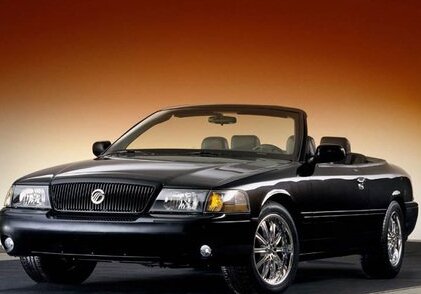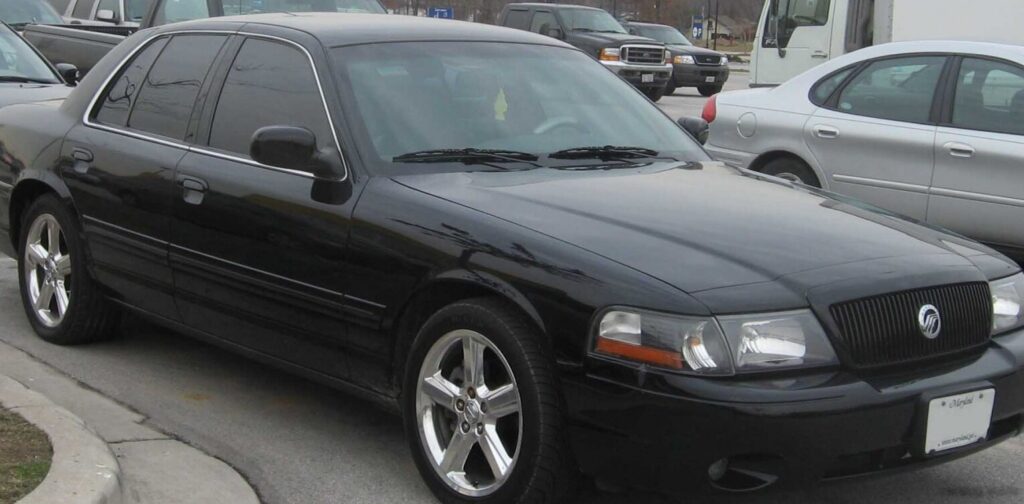
The Mercury Marauder, specifically the 4.6 V8 32V (300 Hp) variant, was a rear-wheel drive, full-size sedan produced by the Mercury division of Ford Motor Company for the 2003 and 2004 model years. Representing a revival of the Marauder nameplate – previously used on performance-oriented Mercury models in the 1960s and 70s – this iteration aimed to offer a blend of understated muscle car performance and comfortable, everyday usability. Production spanned a relatively short period, from May 2002 to June 2004, and it was built on the Ford Panther platform, shared with the Ford Crown Victoria and Mercury Grand Marquis. The Marauder occupied a unique niche, positioned as a more aggressive and performance-focused alternative to its siblings.
Technical Specifications
| Brand | Mercury |
| Model | Marauder |
| Generation | Marauder |
| Type (Engine) | 4.6 V8 32V (300 Hp) |
| Start of production | May, 2002 |
| End of production | June, 2004 |
| Powertrain Architecture | Internal Combustion engine |
| Body type | Sedan |
| Seats | 5 |
| Doors | 4 |
| Fuel consumption (urban) | 20 l/100 km (11.8 US mpg) |
| Fuel consumption (extra urban) | 10 l/100 km (23.5 US mpg) |
| Fuel Type | Petrol (Gasoline) |
| Acceleration 0 – 100 km/h | 7 sec |
| Acceleration 0 – 62 mph | 7 sec |
| Acceleration 0 – 60 mph | 6.7 sec |
| Maximum speed | 220 km/h (136.7 mph) |
| Weight-to-power ratio | 6.2 kg/Hp |
| Weight-to-torque ratio | 4.5 kg/Nm |
| Power | 300 Hp @ 6000 rpm |
| Power per litre | 65.2 Hp/l |
| Torque | 407 Nm @ 4500 rpm (300.19 lb.-ft. @ 4500 rpm) |
| Engine layout | Front, Longitudinal |
| Engine displacement | 4601 cm3 (280.77 cu. in.) |
| Number of cylinders | 8 |
| Engine configuration | V-engine |
| Cylinder Bore | 90.2 mm (3.55 in.) |
| Piston Stroke | 90 mm (3.54 in.) |
| Compression ratio | 9.8:1 |
| Number of valves per cylinder | 4 |
| Fuel injection system | Multi-port manifold injection |
| Engine aspiration | Naturally aspirated engine |
| Valvetrain | DOHC |
| Engine oil capacity | 5.7 l (6.02 US qt | 5.02 UK qt) |
| Coolant | 13.8 l (14.58 US qt | 12.14 UK qt) |
| Kerb Weight | 1850 kg (4078.55 lbs.) |
| Trunk (boot) space | 585 l (20.66 cu. ft.) |
| Fuel tank capacity | 72 l (19.02 US gal | 15.84 UK gal) |
| Length | 5380 mm (211.81 in.) |
| Width | 1980 mm (77.95 in.) |
| Height | 1440 mm (56.69 in.) |
| Wheelbase | 2910 mm (114.57 in.) |
| Front track | 1600 mm (62.99 in.) |
| Rear track | 1610 mm (63.39 in.) |
| Drivetrain Architecture | Rear wheel drive |
| Number of gears | 5 gears, manual transmission |
| Front suspension | Double wishbone |
| Rear suspension | Trailing arm |
| Front brakes | Ventilated discs |
| Rear brakes | Disc |
| Assisting systems | ABS (Anti-lock braking system) |
| Steering type | Worm-reduction unit |
| Power steering | Hydraulic Steering |
| Tires size | 235/50 R18 |
Powertrain & Engine Architecture
The heart of the 2003-2004 Mercury Marauder was the 4.6-liter Modular V8 engine, specifically the version designated as the 4.6L 32V. This engine, internally known as the Romeo engine, produced 300 horsepower at 6000 rpm and 320 lb-ft of torque at 4500 rpm. It featured a dual overhead camshaft (DOHC) cylinder head design with four valves per cylinder, contributing to its relatively high output for its displacement. Fuel delivery was handled by a multi-port fuel injection system. The engine’s architecture was a 90-degree V-configuration, known for its inherent balance and smoothness. The Marauder was exclusively offered with a 4-speed automatic transmission, a crucial element in its appeal to buyers seeking a comfortable and refined driving experience. While a manual transmission was available on other Panther-platform vehicles, Mercury opted to only offer the automatic with the Marauder.
Driving Characteristics
The Marauder’s 4.6L V8 and automatic transmission combination delivered a distinct driving experience. Acceleration to 60 mph was achieved in approximately 6.7 seconds, making it notably quicker than the standard Crown Victoria and Grand Marquis. The automatic transmission, while providing smooth shifts, was geared more towards comfortable cruising than outright performance. The gear ratios were optimized for highway driving, and the transmission didn’t offer the aggressive shift points found in some sport sedans. This resulted in a car that felt powerful and capable, but not necessarily razor-sharp in its handling. The rear-wheel-drive layout contributed to a balanced feel, although the Marauder’s substantial weight (around 4,079 pounds) was always noticeable. Compared to a manual transmission equipped Panther platform vehicle, the Marauder felt less engaging, but more accessible to a wider range of drivers.
Equipment & Trim Levels
The Marauder came standard with a relatively well-equipped interior. Standard features included leather upholstery, power-adjustable front seats, a premium audio system, and automatic climate control. The interior trim was unique to the Marauder, featuring dark charcoal colors and simulated woodgrain accents. Optional extras included a power moonroof, heated front seats, and a navigation system. The exterior styling was also distinctive, with a monochromatic paint scheme, unique 18-inch wheels, and a subtle rear spoiler. The Marauder was essentially a single, fully-equipped trim level, simplifying the buying process for customers.
Chassis & Braking
The Marauder utilized the Panther platform’s robust chassis, featuring a double-wishbone front suspension and a trailing-arm rear suspension. The suspension was tuned to provide a balance between ride comfort and handling. Compared to the standard Crown Victoria, the Marauder benefited from thicker stabilizer bars and revised shock absorbers, resulting in reduced body roll and improved cornering stability. Braking duties were handled by ventilated disc brakes on all four wheels, coupled with an Anti-lock Braking System (ABS). The rear brakes were smaller in diameter than the front brakes, a common characteristic of the Panther platform.
Market Reception & Comparison
The Mercury Marauder received generally positive reviews from automotive critics. It was praised for its understated styling, strong performance, and comfortable interior. However, some critics noted its substantial weight and lack of a manual transmission option. Compared to the Ford Crown Victoria Police Interceptor, the Marauder offered a more refined and luxurious driving experience, but lacked the Interceptor’s ultimate performance capabilities. Against the Mercury Grand Marquis, the Marauder provided a more sporty and aggressive alternative. Fuel economy was a weak point, averaging around 11.8 mpg in the city and 23.5 mpg on the highway.
Legacy
The Mercury Marauder, despite its short production run, has gained a devoted following among enthusiasts. The 4.6L V8 engine, while not known for being particularly high-strung, has proven to be relatively reliable. Common maintenance items include regular oil changes and occasional replacement of the timing chain tensioners. Today, well-maintained Marauders are sought after by collectors and enthusiasts who appreciate their unique blend of performance, comfort, and understated style. The Marauder represents a unique chapter in Mercury’s history, a final attempt to inject some excitement into the brand before its eventual discontinuation in 2011. The powertrain, while not cutting-edge by modern standards, remains a capable and enjoyable unit, and parts availability is generally good due to the shared components with other Ford and Mercury models.