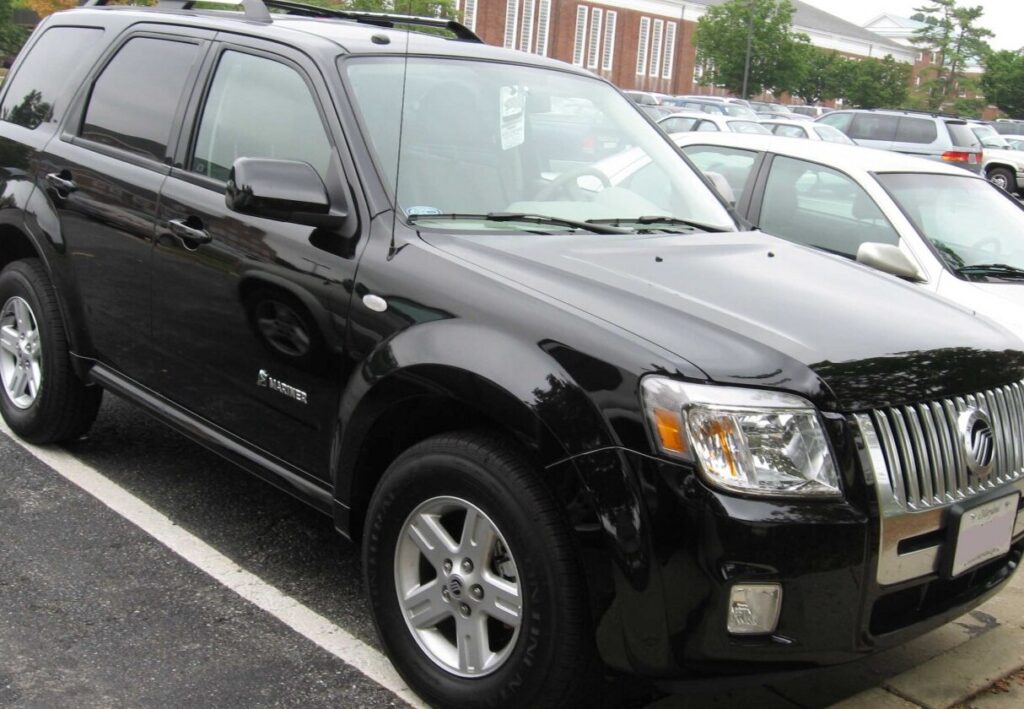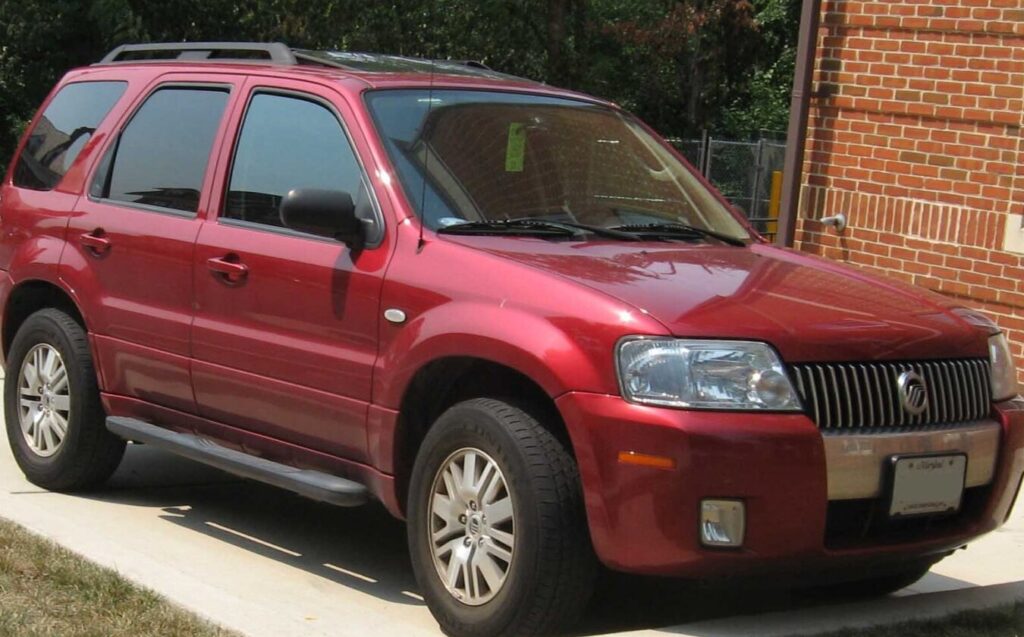
The Mercury Mariner I 3.0 i V6 24V, produced from 2005 to 2007, was a compact crossover SUV representing Mercury’s entry into the rapidly expanding crossover market. Based heavily on the Ford Escape, the Mariner aimed to provide a more upscale experience with distinctive styling and a focus on passenger comfort. This specific variant, featuring the 3.0-liter Duratec V6 engine paired with a four-speed automatic transmission, occupied a mid-range position within the Mariner lineup, positioned above the base 2.3-liter four-cylinder model and below any limited-edition or higher-trim packages offered. It was a crucial element in Mercury’s broader strategy to revitalize its brand image and attract a wider customer base.
Technical Specifications
| Brand | Mercury |
| Model | Mariner |
| Generation | Mariner I |
| Type (Engine) | 3.0 i V6 24V (203 Hp) |
| Start of production | 2005 |
| End of production | 2007 |
| Powertrain Architecture | Internal Combustion engine |
| Body type | SUV, Crossover |
| Seats | 5 |
| Doors | 5 |
| Fuel consumption (urban) | 11.8 l/100 km (19.9 US mpg) |
| Fuel consumption (extra urban) | 9.4 l/100 km (25 US mpg) |
| Fuel Type | Petrol (Gasoline) |
| Maximum speed | 175 km/h (108.74 mph) |
| Weight-to-power ratio | 7.6 kg/Hp |
| Weight-to-torque ratio | 5.7 kg/Nm |
| Power | 203 Hp @ 5750 rpm |
| Power per litre | 68.4 Hp/l |
| Torque | 271 Nm @ 4500 rpm (199.88 lb.-ft. @ 4500 rpm) |
| Engine layout | Front, Transverse |
| Engine displacement | 2967 cm3 (181.06 cu. in.) |
| Number of cylinders | 6 |
| Engine configuration | V-engine |
| Cylinder Bore | 89 mm (3.5 in.) |
| Piston Stroke | 79.5 mm (3.13 in.) |
| Compression ratio | 10:1 |
| Number of valves per cylinder | 4 |
| Fuel injection system | Multi-port manifold injection |
| Engine aspiration | Naturally aspirated engine |
| Valvetrain | DOHC |
| Engine oil capacity | 5.7 l (6.02 US qt | 5.02 UK qt) |
| Coolant | 10 l (10.57 US qt | 8.8 UK qt) |
| Kerb Weight | 1540 kg (3395.12 lbs.) |
| Max. weight | 2041 kg (4499.63 lbs.) |
| Max load | 501 kg (1104.52 lbs.) |
| Trunk (boot) space – minimum | 830 l (29.31 cu. ft.) |
| Trunk (boot) space – maximum | 1878 l (66.32 cu. ft.) |
| Fuel tank capacity | 62 l (16.38 US gal | 13.64 UK gal) |
| Length | 4427 mm (174.29 in.) |
| Width | 1781 mm (70.12 in.) |
| Height | 1795 mm (70.67 in.) |
| Wheelbase | 2620 mm (103.15 in.) |
| Front track | 1552 mm (61.1 in.) |
| Rear (Back) track | 1534 mm (60.39 in.) |
| Drivetrain Architecture | The Internal combustion engine (ICE) drives the front wheels of the vehicle. |
| Drive wheel | Front wheel drive |
| Number of gears and type of gearbox | 4 gears, automatic transmission |
| Front suspension | Spring Strut |
| Rear suspension | Coil spring |
| Front brakes | Disc |
| Rear brakes | Drum |
| Assisting systems | ABS (Anti-lock braking system) |
| Tires size | 235/70 R16 |
Powertrain & Engine Architecture
The powertrain of the Mariner I 3.0 i revolved around the Ford Duratec 30, a 3.0-liter V6 engine. This engine, belonging to Ford’s Duratec family, featured a 60-degree V-angle and a dual overhead camshaft (DOHC) valvetrain operating four valves per cylinder. The engine employed multi-port fuel injection, delivering fuel directly into the intake ports for optimized combustion. The 3.0L Duratec generated 203 horsepower at 5750 rpm and 271 Nm (199.88 lb-ft) of torque at 4500 rpm. This engine was coupled with a four-speed automatic transmission, a common choice for American market crossovers prioritizing ease of use. While providing smooth shifts, this transmission lacked the efficiency and responsiveness found in more modern automatic transmissions with additional gears.
Driving Characteristics
The combination of the 3.0-liter V6 and the four-speed automatic transmission in the Mariner I delivered adequate, but not particularly sporty, performance. Acceleration was sufficient for typical daily driving and highway merging, but it wasn’t designed for quick bursts of speed. The automatic transmission’s gear ratios were calibrated for comfort and fuel efficiency, resulting in a relaxed driving experience. Compared to the base 2.3-liter four-cylinder engine, the V6 offered a noticeable improvement in power and responsiveness. However, it didn’t quite match the performance of Mariner trims equipped with the optional all-wheel-drive system. The front-wheel-drive configuration resulted in a slight tendency towards understeer during cornering, but the vehicle remained stable and predictable in most driving situations.
Equipment & Trim Levels
The Mariner I 3.0 i generally came standard with features such as air conditioning, power windows and door locks, a CD player, and cloth upholstery. Higher trim levels, often designated as Convenience or Luxury packages, added features like leather upholstery, a sunroof, upgraded audio systems, and alloy wheels. The Mariner aimed for a slightly more premium feel than its mechanically similar Ford Escape counterpart, emphasizing interior comfort and refinement. Optional extras included a navigation system, heated front seats, and a rear cargo organizer, allowing buyers to customize their vehicle to their specific needs and preferences.
Chassis & Braking
The Mariner I utilized a front-wheel-drive platform with an independent front suspension featuring MacPherson struts and a multi-link rear suspension. This suspension setup provided a comfortable ride quality, effectively absorbing bumps and road imperfections. Braking was accomplished through disc brakes at the front and drum brakes at the rear. An Anti-lock Braking System (ABS) was standard equipment, enhancing safety and control during emergency braking maneuvers. The suspension tuning prioritized a balance between ride comfort and handling, aiming for a smooth and predictable driving experience rather than outright sporty performance.
Market Reception & Comparison
The Mercury Mariner I 3.0 i was generally well-received by automotive critics as a competent and comfortable crossover SUV. Reviewers consistently praised its spacious interior, comfortable ride, and the availability of desirable features. However, some critics noted its relatively modest performance and the somewhat dated four-speed automatic transmission. Compared to the base 2.3-liter model, the 3.0-liter V6 offered a significant improvement in power and drivability, justifying the higher price point for many buyers. Fuel economy was average for the class, aligning with other V6-powered crossovers available at the time. The Mariner competed with popular vehicles such as the Honda CR-V, Toyota RAV4, and Nissan Rogue, all of which offered similar features and capabilities.
Legacy
The Mercury Mariner I 3.0 i, while not a revolutionary vehicle, played a role in establishing Mercury as a viable competitor in the burgeoning crossover SUV segment. The Duratec 3.0-liter V6 engine proved to be reasonably reliable, with few widespread mechanical issues reported. However, as with any vehicle of this age, consistent and proper maintenance is essential for ensuring long-term reliability. Today, the Mariner I 3.0 i can be found on the used car market at affordable prices, offering a practical and comfortable transportation option for budget-conscious buyers. Its relatively simple mechanical design and readily available parts make it a potentially appealing choice for do-it-yourself mechanics and those seeking a less complex vehicle to maintain.