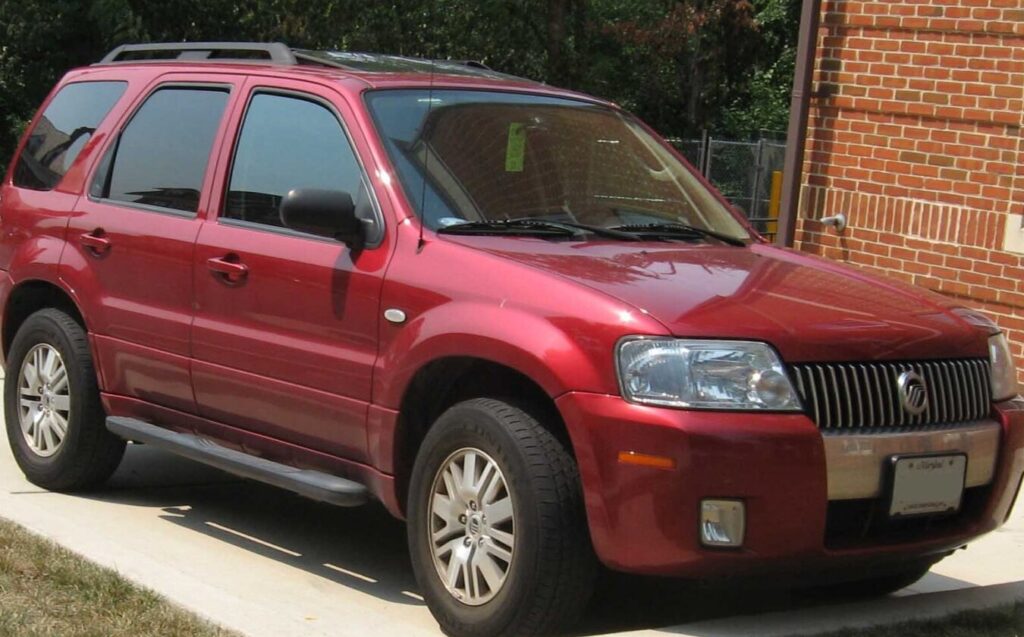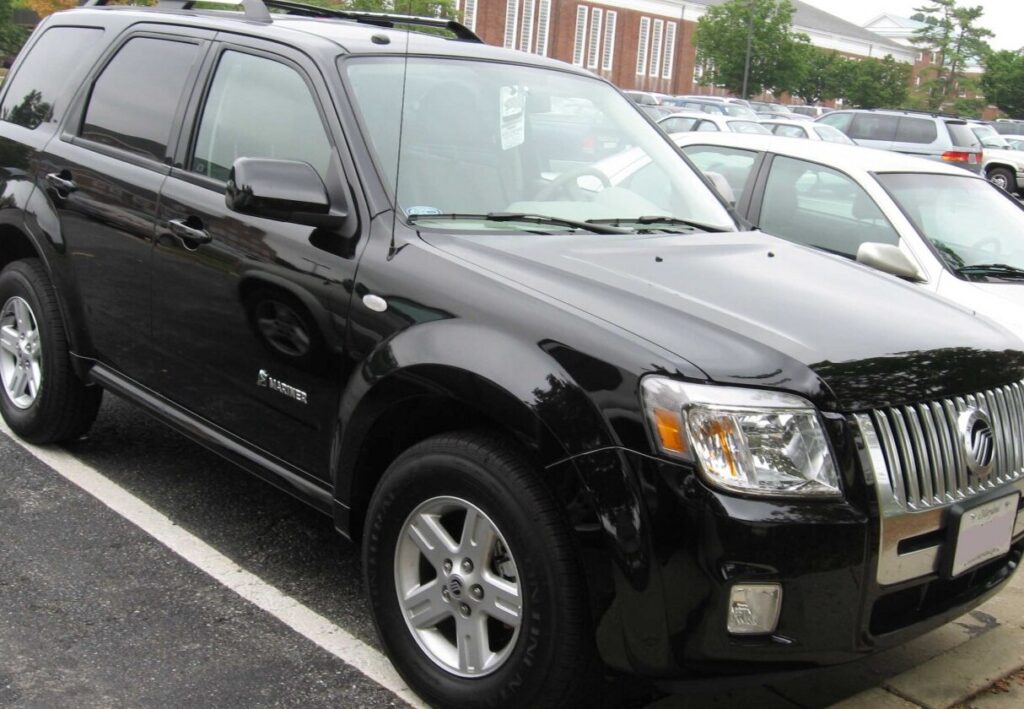
The Mercury Mariner II 2.3, equipped with a 153 horsepower engine and automatic transmission, was a compact crossover SUV produced by Mercury for the 2007 and 2008 model years. Positioned as a slightly more upscale offering compared to the Ford Escape (with which it shared a platform), the Mariner II aimed to attract buyers seeking a blend of practicality, comfort, and a more refined driving experience. It represented a mid-cycle refresh of the original Mariner, incorporating styling and feature updates. The Mariner II was built on the Ford CD2 platform, also known as the P249, which underpinned several Ford and Mazda vehicles of the era.
Technical Specifications
| Brand | Mercury |
| Model | Mariner |
| Generation | Mariner II |
| Type (Engine) | 2.3 (153 Hp) Automatic |
| Start of production | 2007 |
| End of production | 2008 |
| Powertrain Architecture | Internal Combustion engine |
| Body type | SUV, Crossover |
| Seats | 5 |
| Doors | 5 |
| Fuel consumption (economy) – urban (EPA) | 11.8 l/100 km (19.9 US mpg) |
| Fuel consumption (economy) – extra urban (EPA) | 9 l/100 km (26.1 US mpg) |
| Fuel Type | Petrol (Gasoline) |
| Weight-to-power ratio | 9.9 kg/Hp |
| Weight-to-torque ratio | 7.4 kg/Nm |
| Power | 153 Hp @ 5800 rpm |
| Power per litre | 67.7 Hp/l |
| Torque | 206 Nm @ 4250 rpm (151.94 lb.-ft. @ 4250 rpm) |
| Engine layout | Front, Transverse |
| Engine Model/Code | Duratec 23 |
| Engine displacement | 2261 cm3 (137.97 cu. in.) |
| Number of cylinders | 4 |
| Engine configuration | Inline |
| Cylinder Bore | 87.5 mm (3.44 in.) |
| Piston Stroke | 94 mm (3.7 in.) |
| Compression ratio | 9.7:1 |
| Number of valves per cylinder | 4 |
| Fuel injection system | Multi-port manifold injection |
| Engine aspiration | Naturally aspirated engine |
| Valvetrain | DOHC |
| Engine oil capacity | 4.25 l (4.49 US qt | 3.74 UK qt) |
| Coolant | 6 l (6.34 US qt | 5.28 UK qt) |
| Kerb Weight | 1515 kg (3340 lbs.) |
| Max. weight | 1996 kg (4400.43 lbs.) |
| Max load | 481 kg (1060.42 lbs.) |
| Trunk (boot) space – minimum | 830 l (29.31 cu. ft.) |
| Trunk (boot) space – maximum | 1875 l (66.22 cu. ft.) |
| Fuel tank capacity | 62 l (16.38 US gal | 13.64 UK gal) |
| Permitted trailer load with brakes (12%) | 680 kg (1499.14 lbs.) |
| Length | 4450 mm (175.2 in.) |
| Width | 1806 mm (71.1 in.) |
| Width with mirrors folded | 1979 mm (77.91 in.) |
| Width including mirrors | 2065 mm (81.3 in.) |
| Height | 1727-1778 mm (67.99 – 70 in.) |
| Wheelbase | 2619 mm (103.11 in.) |
| Front track | 1552 mm (61.1 in.) |
| Rear (Back) track | 1534 mm (60.39 in.) |
| Ride height (ground clearance) | 213 mm (8.39 in.) |
| Minimum turning circle (turning diameter) | 11.2 m (36.75 ft.) |
| Drivetrain Architecture | The Internal combustion engine (ICE) drives the front wheels of the vehicle. |
| Drive wheel | Front wheel drive |
| Number of gears and type of gearbox | 4 gears, automatic transmission |
| Front suspension | Independent, type McPherson with coil spring and anti-roll bar |
| Rear suspension | Independent multi-link spring suspension with stabilizer |
| Front brakes | Ventilated discs, 302 mm |
| Rear brakes | Drum, 254 mm |
| Assisting systems | ABS (Anti-lock braking system) |
| Steering type | Steering rack and pinion |
| Power steering | Electric Steering |
| Tires size | 235/70 R16; 225/65 R17 |
| Wheel rims size | 16; 17 |
Powertrain & Engine Architecture
The heart of the Mariner II 2.3 was the Ford Duratec 23 engine, a 2.3-liter inline-four cylinder powerplant. This engine, part of the Duratec family, featured a cast iron block and an aluminum cylinder head. It utilized multi-port fuel injection and a double overhead camshaft (DOHC) valvetrain with four valves per cylinder. The 9.7:1 compression ratio was typical for a naturally aspirated engine of this era, balancing performance and fuel efficiency. The Duratec 23 was known for its relative simplicity and durability. The engine was transversely mounted in the front of the vehicle. Paired with the 2.3L engine was a four-speed automatic transmission, a common choice for North American market crossovers prioritizing ease of use over outright performance. This transmission was designed for smooth shifts and adequate acceleration, but lacked the efficiency of more modern transmissions with additional gears.
Driving Characteristics
The 153 horsepower and 206 lb-ft of torque produced by the 2.3-liter engine, when coupled with the four-speed automatic, resulted in adequate, but not exhilarating, performance. Acceleration from 0 to 60 mph was typically in the 9-10 second range. The automatic transmission’s gear ratios were tuned for everyday driving, prioritizing fuel economy and comfortable cruising over sporty acceleration. Compared to the available 3.0-liter V6 engine option in the Mariner II, the 2.3L automatic was noticeably slower. However, the 2.3L offered better fuel economy and a lower purchase price, making it an attractive option for budget-conscious buyers. The front-wheel-drive configuration provided predictable handling, but lacked the all-weather capability of the optional four-wheel-drive system.
Equipment & Trim Levels
The Mariner II 2.3 typically came standard with features such as air conditioning, power windows and locks, a CD player, and cloth upholstery. Higher trim levels, such as the Convenience Package and the Limited trim, added features like alloy wheels, a sunroof, leather upholstery, and an upgraded audio system. Safety features included anti-lock brakes (ABS) and front airbags. Optional extras included a navigation system and a rear entertainment system. The interior design was generally functional and comfortable, with a focus on practicality rather than luxury.
Chassis & Braking
The Mariner II utilized an independent McPherson strut front suspension and an independent multi-link rear suspension. This setup provided a reasonably comfortable ride, absorbing bumps and irregularities in the road surface effectively. The front suspension incorporated a stabilizer bar to reduce body roll during cornering. Braking duties were handled by ventilated discs at the front and drum brakes at the rear. While adequate for everyday driving, the drum brakes at the rear were a cost-saving measure and didn’t offer the same stopping power as disc brakes on all four wheels. The electric power steering provided light and easy steering effort, making it convenient for maneuvering in tight spaces.
Market Reception & Comparison
The Mercury Mariner II 2.3 was generally well-received by critics as a practical and affordable crossover SUV. However, the 2.3-liter engine and four-speed automatic transmission were often criticized for being underpowered, especially when compared to competitors offering more powerful engines and more advanced transmissions. Fuel economy was considered average for the class. The Mariner II’s main competitors included the Honda CR-V, Toyota RAV4, and Ford Escape. The Mariner II offered a more upscale interior and styling than the Escape, but lacked the brand recognition and reputation for reliability of the Honda and Toyota models.
Legacy
The Duratec 23 engine, in general, proved to be a relatively reliable powerplant. Common issues with the Mariner II 2.3 powertrain were often related to routine maintenance items, such as timing belt replacement and sensor failures. The four-speed automatic transmission, while durable, is less efficient than modern transmissions. Today, the Mariner II 2.3 can be found on the used car market at relatively affordable prices. Its simplicity and relatively low maintenance costs make it an appealing option for buyers seeking a budget-friendly crossover SUV. However, potential buyers should be aware of its limited power and the age-related wear and tear that is common with older vehicles.