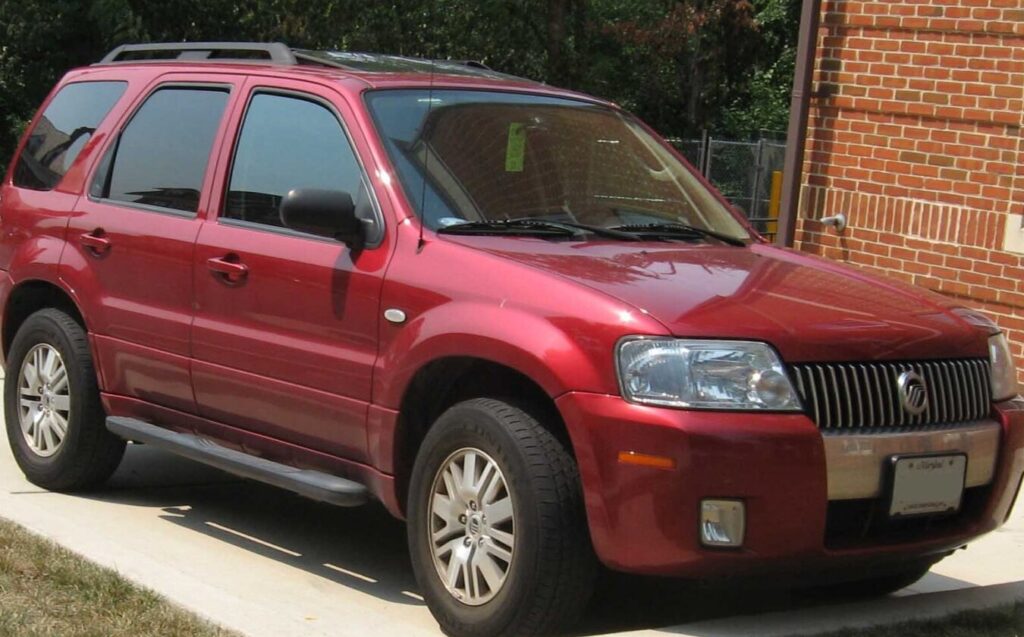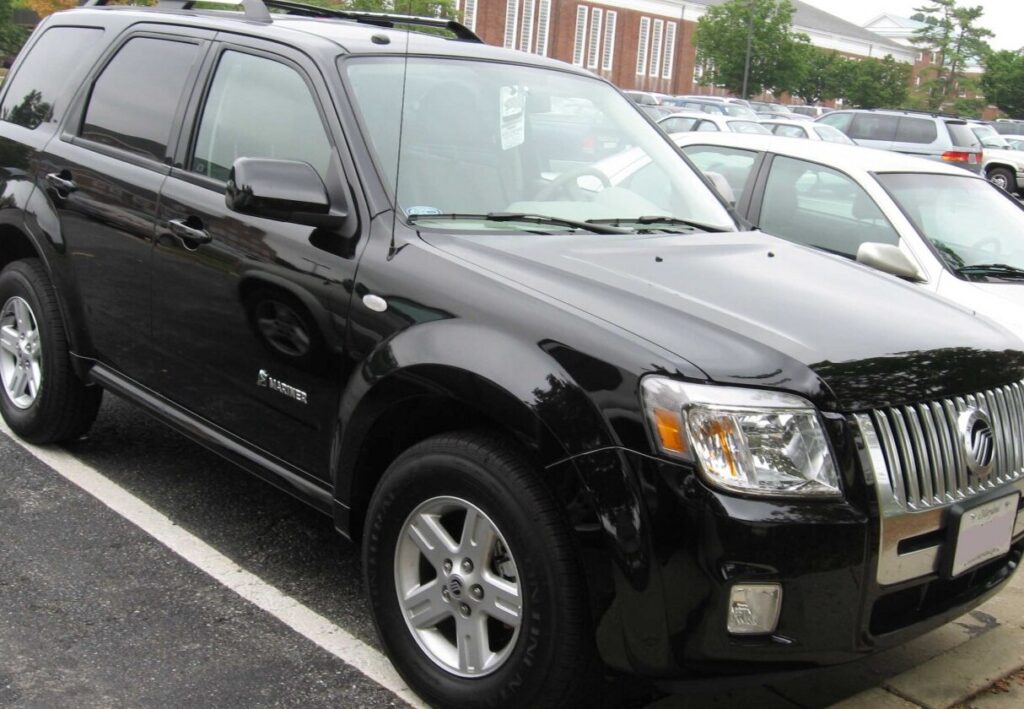
The Mercury Mariner II 2.3 Hybrid 4WD eCVT, produced for the 2007 and 2008 model years, represented Mercury’s entry into the burgeoning hybrid SUV market. Built on the Ford Escape Hybrid platform (shared with the Mazda Tribute Hybrid), the Mariner II aimed to offer fuel efficiency and all-weather capability within a compact crossover package. This variant occupied a mid-range position within the Mariner II lineup, offering a more environmentally conscious and technologically advanced option compared to the conventionally powered models. It was a relatively short-lived model, discontinued alongside the Mercury brand in 2008, but it remains a notable example of early American hybrid SUV technology.
Technical Specifications
| Brand | Mercury |
| Model | Mariner |
| Generation | Mariner II |
| Type (Engine) | 2.3 (155 Hp) Hybrid 4WD eCVT |
| Start of production | 2007 |
| End of production | 2008 |
| Powertrain Architecture | FHEV (Full Hybrid Electric Vehicle) |
| Body type | SUV, Crossover |
| Seats | 5 |
| Doors | 5 |
| Fuel consumption (urban) | 8.1 l/100 km (29 US mpg) |
| Fuel consumption (extra urban) | 8.7 l/100 km (27 US mpg) |
| Fuel Type | Petrol (Gasoline) |
| Emission standard | PZEV |
| Weight-to-power ratio | 11.2 kg/Hp |
| Weight-to-torque ratio | 10.3 kg/Nm |
| Battery voltage | 330 V |
| Battery technology | Nickel-metal hydride (NiMH) |
| Electric motor power | 94 Hp @ 5000 rpm |
| Electric motor location | Integrated into the transmission |
| Electric motor type | Synchronous |
| System power | 155 Hp |
| Internal combustion engine power | 133 Hp @ 6000 rpm |
| Power per litre | 58.8 Hp/l |
| Torque | 168 Nm @ 4250 rpm (123.91 lb.-ft. @ 4250 rpm) |
| Engine layout | Front, Transverse |
| Engine Model/Code | Duratec 23 |
| Engine displacement | 2261 cm3 (137.97 cu. in.) |
| Number of cylinders | 4 |
| Engine configuration | Inline |
| Cylinder Bore | 87.5 mm (3.44 in.) |
| Piston Stroke | 94 mm (3.7 in.) |
| Compression ratio | 12.3:1 |
| Number of valves per cylinder | 4 |
| Fuel injection system | Multi-port manifold injection |
| Engine aspiration | Naturally aspirated |
| Valvetrain | DOHC |
| Engine oil capacity | 4.25 l (4.49 US qt | 3.74 UK qt) |
| Coolant capacity | 11 l (11.62 US qt | 9.68 UK qt) |
| Kerb Weight | 1730 kg (3814 lbs.) |
| Max. weight | 2156 kg (4753.17 lbs.) |
| Max load | 426 kg (939.17 lbs.) |
| Fuel tank capacity | 57 l (15.06 US gal | 12.54 UK gal) |
| Length | 4450 mm (175.2 in.) |
| Width | 1806 mm (71.1 in.) |
| Width with mirrors folded | 1979 mm (77.91 in.) |
| Width including mirrors | 2065 mm (81.3 in.) |
| Height | 1727 mm (67.99 in.) |
| Wheelbase | 2619 mm (103.11 in.) |
| Front track | 1552 mm (61.1 in.) |
| Rear track | 1534 mm (60.39 in.) |
| Front overhang | 864 mm (34.02 in.) |
| Rear overhang | 968 mm (38.11 in.) |
| Ride height (ground clearance) | 218 mm (8.58 in.) |
| Minimum turning circle | 11.2 m (36.75 ft.) |
| Approach angle | 24.5° |
| Departure angle | 27.7° |
| Ramp-over angle | 21.3° |
| Drivetrain Architecture | ICE and electric motor drive front wheels, rear wheels driven via clutch |
| Drive wheel | All wheel drive (4×4) |
| Number of gears | automatic transmission eCVT |
| Front suspension | Independent, McPherson with coil spring and anti-roll bar |
| Rear suspension | Independent multi-link with stabilizer |
| Front brakes | Ventilated discs, 303 mm |
| Rear brakes | Disc, 302 mm |
| Assisting systems | ABS |
| Steering type | Steering rack and pinion |
| Power steering | Electric |
| Tires size | 235/70 R16 |
| Wheel rims size | 16 |
Powertrain & Engine Architecture
The heart of the Mariner II Hybrid is the Duratec 23 2.3-liter inline-four engine. This engine, part of Ford’s Duratec family, utilizes a cast iron block with an aluminum cylinder head. It features dual overhead camshafts (DOHC) and four valves per cylinder, contributing to its relatively efficient operation. The engine employs multi-port fuel injection and a compression ratio of 12.3:1. Crucially, this engine isn’t solely responsible for propulsion; it works in conjunction with a 94-horsepower electric motor. The electric motor is seamlessly integrated into the electronically controlled continuously variable transmission (eCVT). This eCVT isn’t a traditional CVT with belts and pulleys; it’s a power-split device that combines the output of the engine and motor, allowing for smooth, stepless acceleration and optimized fuel economy. The hybrid system operates in various modes – electric-only at low speeds, engine-only at cruising speeds, and a combined mode for acceleration or demanding conditions. The Nickel-metal hydride (NiMH) battery pack, operating at 330 volts, provides the energy storage for the electric motor.
Driving Characteristics
The 155 horsepower combined output of the 2.3L engine and electric motor provides adequate, though not exhilarating, performance. Acceleration is smooth and linear, thanks to the eCVT, but it lacks the responsiveness of a traditional automatic or manual transmission. The eCVT prioritizes efficiency over sporty driving dynamics. Compared to the standard 2.4L four-cylinder Mariner II, the hybrid version offers similar acceleration but with significantly improved fuel economy. The hybrid’s all-wheel-drive system provides enhanced traction in inclement weather, making it a practical choice for regions with snow or rain. The electric motor provides instant torque, which helps with initial acceleration and low-speed maneuvering. However, the overall driving experience is geared towards comfort and efficiency rather than performance.
Equipment & Trim Levels
The Mariner II 2.3 Hybrid 4WD typically came well-equipped for its time. Standard features included air conditioning, power windows and locks, a CD player with an auxiliary input jack, and keyless entry. Safety features such as anti-lock brakes (ABS) were also standard. Interior upholstery was typically cloth, with optional leather available. Higher trim levels offered features like a premium sound system, heated front seats, and a sunroof. The dashboard layout was functional and straightforward, with easy-to-read gauges and controls. The hybrid-specific instrumentation included a power flow display, showing the energy transfer between the engine, motor, and battery.
Chassis & Braking
The Mariner II Hybrid utilizes an independent front suspension with McPherson struts and a multi-link independent rear suspension, both incorporating coil springs and anti-roll bars. This suspension setup provides a comfortable ride quality, absorbing bumps and irregularities in the road surface effectively. Braking duties are handled by ventilated discs at the front and solid discs at the rear. The ABS system helps to prevent wheel lockup during hard braking, enhancing stability and control. The chassis was tuned to balance ride comfort with handling stability, prioritizing a smooth and predictable driving experience.
Market Reception & Comparison
The Mercury Mariner II Hybrid was generally well-received by critics, who praised its fuel efficiency and smooth driving experience. However, some reviewers noted its lack of outright performance compared to conventionally powered SUVs. Compared to the non-hybrid Mariner II models, the hybrid offered a significant improvement in fuel economy – achieving around 29 mpg in the city and 27 mpg on the highway. The hybrid also benefited from a PZEV (Partial Zero Emission Vehicle) rating, making it a more environmentally friendly choice. However, the hybrid version carried a higher price tag than its gasoline-powered counterparts. Compared to competitors like the Toyota RAV4 Hybrid, the Mariner II Hybrid offered a similar level of fuel efficiency but lacked the established reputation and brand recognition of the Toyota.
Legacy
The Mercury Mariner II Hybrid, while a short-lived model, played a role in popularizing hybrid technology in the SUV segment. The Duratec 23 engine and eCVT powertrain proved to be relatively reliable, with many examples still on the road today. However, like all hybrid vehicles, the high-voltage battery pack is a potential maintenance concern, and replacement can be costly. In the used car market, the Mariner II Hybrid remains an affordable and fuel-efficient option for buyers seeking a compact SUV with all-wheel drive. Its legacy lies in demonstrating the viability of hybrid technology in a practical and accessible package, paving the way for the widespread adoption of hybrid and electric SUVs in the years to come.