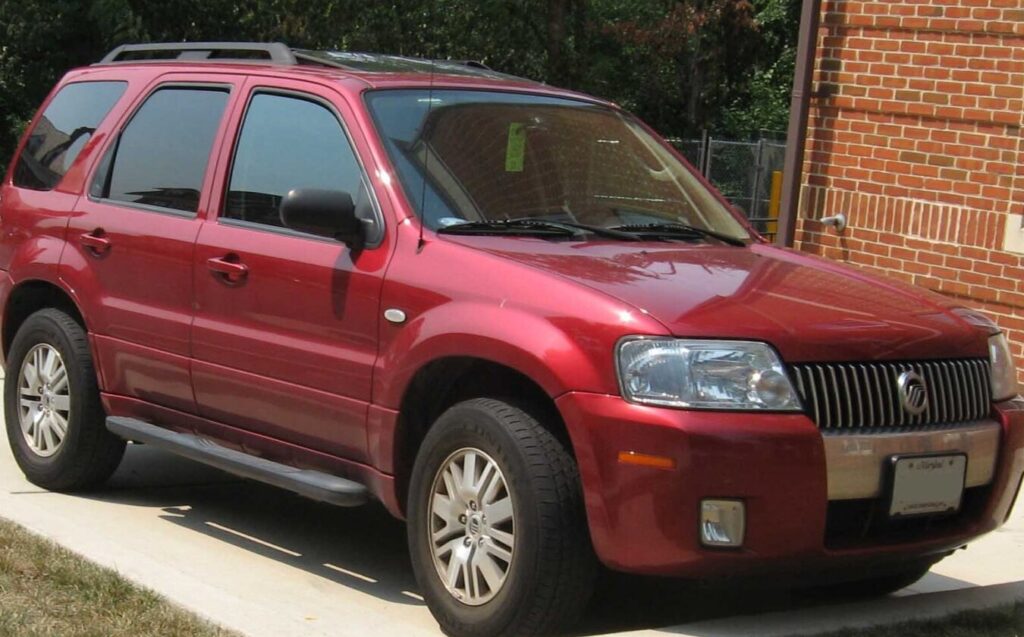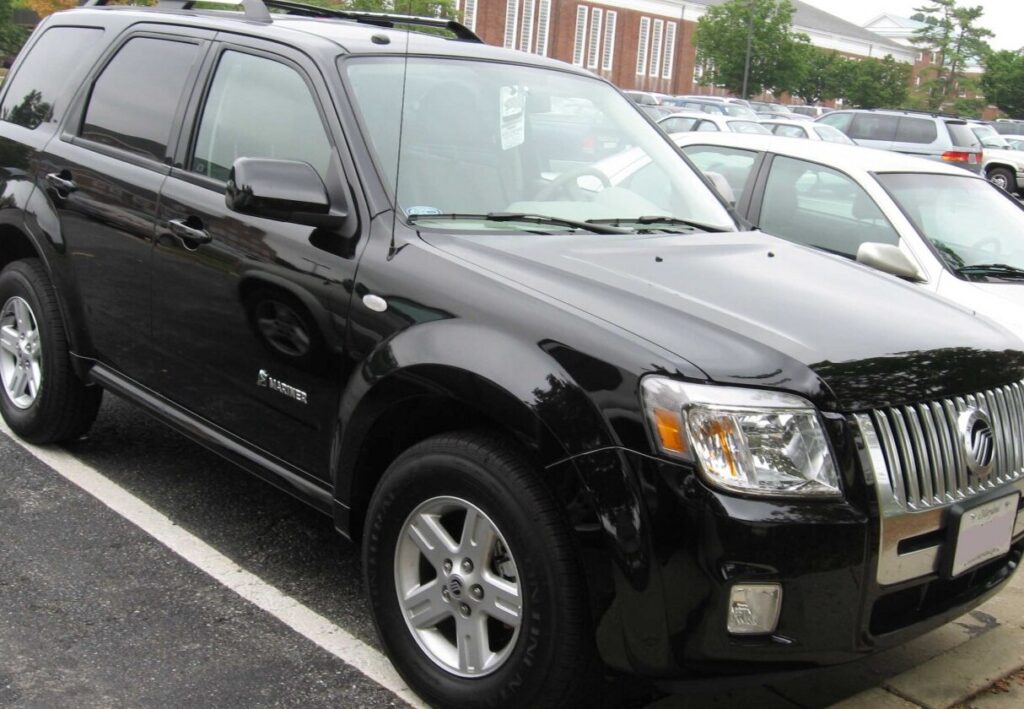
The Mercury Mariner II 2.5 Hybrid 4WD eCVT, produced from 2008 to October 2010, represented a significant step for the Mercury brand into the burgeoning hybrid SUV market. Positioned as a more fuel-efficient alternative within the Mariner lineup, it shared its platform and powertrain with the Ford Escape Hybrid and Hyundai Santa Fe Hybrid. The Mariner II, built on the P249 platform, aimed to appeal to environmentally conscious consumers seeking the practicality of a compact crossover SUV without sacrificing all-wheel-drive capability. This variant occupied a mid-range position in the Mariner lineup, offering a balance between fuel economy and performance compared to the standard gasoline-powered models.
Technical Specifications
| Brand | Mercury |
| Model | Mariner |
| Generation | Mariner II |
| Type (Engine) | 2.5 (177 Hp) Hybrid 4WD eCVT |
| Start of production | 2008 |
| End of production | October, 2010 |
| Powertrain Architecture | FHEV (Full Hybrid Electric Vehicle) |
| Body type | SUV, Crossover |
| Seats | 5 |
| Doors | 5 |
| Fuel consumption (urban) | 7.8-8.1 l/100 km (30.2 – 29 US mpg) |
| Fuel consumption (extra urban) | 8.7 l/100 km (27 US mpg) |
| Fuel consumption (combined) | 8.1 l/100 km (29 US mpg) |
| Fuel Type | Petrol (Gasoline) |
| Emission standard | PZEV |
| Weight-to-power ratio | 9.8 kg/Hp |
| Weight-to-torque ratio | 9.4 kg/Nm |
| Battery voltage | 330 V |
| Battery technology | Nickel-metal hydride (NiMH) |
| Max speed (electric) | 71 km/h (44.12 mph) |
| Electric motor power | 94 Hp @ 5000 rpm |
| System power | 177 Hp |
| Engine Power | 155 Hp @ 6000 rpm |
| Torque | 184 Nm @ 4500 rpm (135.71 lb.-ft. @ 4500 rpm) |
| Engine layout | Front, Transverse |
| Engine Model/Code | Duratec 25 |
| Engine displacement | 2488 cm3 (151.83 cu. in.) |
| Number of cylinders | 4 |
| Engine configuration | Inline |
| Cylinder Bore | 89 mm (3.5 in.) |
| Piston Stroke | 100 mm (3.94 in.) |
| Compression ratio | 12.3:1 |
| Number of valves per cylinder | 4 |
| Fuel injection system | Multi-port manifold injection |
| Engine aspiration | Naturally aspirated |
| Valvetrain | DOHC, iVCT |
| Engine oil capacity | 4.7 l (4.97 US qt | 4.14 UK qt) |
| Coolant capacity | 8 l (8.45 US qt | 7.04 UK qt) |
| Kerb Weight | 1737 kg (3829.43 lbs.) |
| Trunk (boot) space – minimum | 875 l (30.9 cu. ft.) |
| Trunk (boot) space – maximum | 1880 l (66.39 cu. ft.) |
| Fuel tank capacity | 57 l (15.06 US gal | 12.54 UK gal) |
| Permitted trailer load with brakes (12%) | 454 kg (1000.9 lbs.) |
| Length | 4448 mm (175.12 in.) |
| Width | 1806 mm (71.1 in.) |
| Width with mirrors folded | 1979 mm (77.91 in.) |
| Width including mirrors | 2065 mm (81.3 in.) |
| Height | 1720 mm (67.72 in.) |
| Wheelbase | 2619 mm (103.11 in.) |
| Front track | 1542 mm (60.71 in.) |
| Rear track | 1529 mm (60.2 in.) |
| Ride height (ground clearance) | 211 mm (8.31 in.) |
| Minimum turning circle | 11.2 m (36.75 ft.) |
| Drivetrain Architecture | All wheel drive (4×4). FHEV. ICE and electric motor drive front wheels, rear wheels engaged as needed. |
| Number of gears | eCVT (automatic transmission) |
| Front suspension | Independent, McPherson with coil spring and anti-roll bar |
| Rear suspension | Independent multi-link with stabilizer |
| Front brakes | Ventilated discs, 303 mm |
| Rear brakes | Drum, 254 mm |
| Steering type | Steering rack and pinion, Electric Power Steering |
| Tires size | 235/70 R16 |
| Wheel rims size | 16 |
Powertrain & Engine Architecture
The heart of the Mariner II Hybrid is the Duratec 25 2.5-liter inline-four cylinder gasoline engine. This engine, designated as the 302A, produces 155 horsepower at 6000 rpm and 184 lb-ft of torque at 4500 rpm. It features multi-port fuel injection and double overhead camshafts (DOHC) with intake variable camshaft timing (iVCT) for improved efficiency and responsiveness. The engine is paired with a 94-horsepower electric motor, integrated into the electronically controlled continuously variable transmission (eCVT). The combined system output is 177 horsepower. The nickel-metal hydride (NiMH) battery pack, with a voltage of 330V, is located under the trunk floor. The hybrid system allows for electric-only driving at lower speeds and assists the gasoline engine during acceleration, maximizing fuel economy.
Driving Characteristics
The 2.5L Hybrid eCVT powertrain delivers a noticeably different driving experience compared to the standard gasoline-powered Mariner variants. The eCVT, while providing smooth and seamless acceleration, lacks the direct feel of a traditional automatic transmission. The electric motor provides instant torque, contributing to brisk acceleration from a standstill. However, the overall performance is geared more towards efficiency than outright speed. The hybrid system prioritizes fuel economy, and the engine often operates in a lower RPM range. The all-wheel-drive system provides enhanced traction in various weather conditions, making it a capable vehicle for year-round use. Compared to the V6 models, the hybrid offered less overall power, but significantly better fuel economy.
Equipment & Trim Levels
The Mariner II 2.5 Hybrid typically came well-equipped, reflecting its position as a more premium offering. Standard features included air conditioning, power windows and locks, a CD player with an auxiliary input, and keyless entry. Higher trim levels added features such as leather upholstery, a sunroof, and a premium audio system. Safety features included anti-lock brakes (ABS) and side curtain airbags. Optional extras included a navigation system and a rear-view camera.
Chassis & Braking
The Mariner II Hybrid utilizes an independent front suspension with McPherson struts and a multi-link independent rear suspension, both incorporating coil springs and anti-roll bars. This setup provides a comfortable ride and predictable handling. The braking system consists of ventilated discs on the front wheels and drum brakes on the rear. ABS is standard, enhancing braking performance and stability. The suspension was tuned to balance ride comfort with handling, considering the added weight of the hybrid components.
Market Reception & Comparison
The Mercury Mariner II Hybrid was generally well-received by critics, who praised its fuel efficiency and comfortable ride. However, some reviewers noted the lack of a sporty driving experience and the somewhat unrefined feel of the eCVT. Compared to the standard gasoline-powered Mariner, the hybrid offered significantly better fuel economy – around 29 mpg combined versus 22-24 mpg for the gasoline models. The hybrid also benefited from a PZEV (Partial Zero Emission Vehicle) rating, appealing to environmentally conscious buyers. Against competitors like the Toyota RAV4 Hybrid and Honda CR-V, the Mariner Hybrid offered a competitive fuel economy and feature set, but lacked the brand recognition of its Japanese rivals.
Legacy
The Mercury Mariner II Hybrid, while a relatively short-lived model, played a role in demonstrating Mercury’s commitment to fuel efficiency and hybrid technology. The Duratec 25 engine and eCVT powertrain proved to be generally reliable, although, like any hybrid vehicle, the battery pack is a potential long-term maintenance item. On the used car market, these models are often sought after by buyers looking for a fuel-efficient and practical SUV. The hybrid system’s longevity is dependent on proper maintenance and battery care, but many examples remain on the road today, offering a testament to the durability of the powertrain.