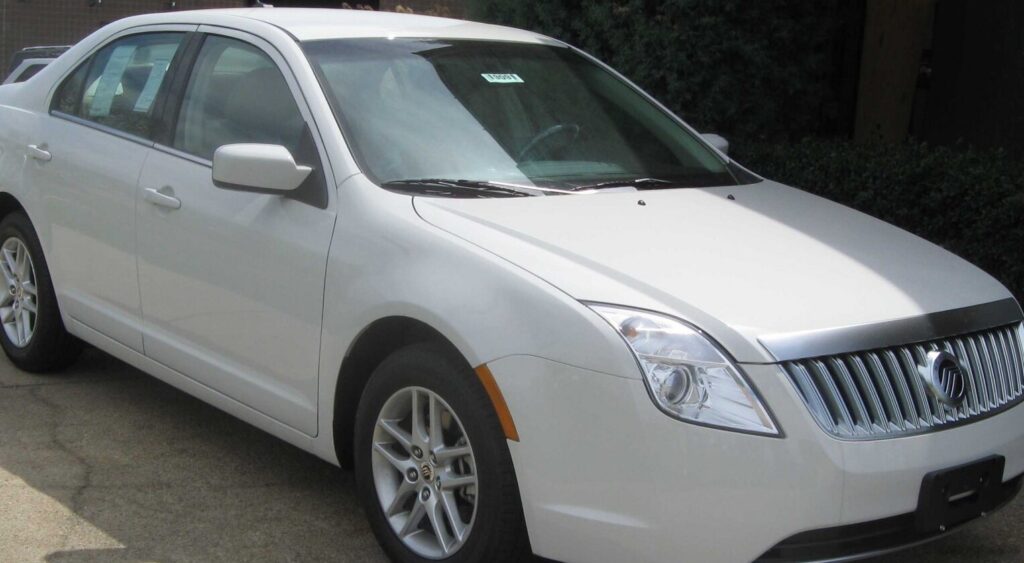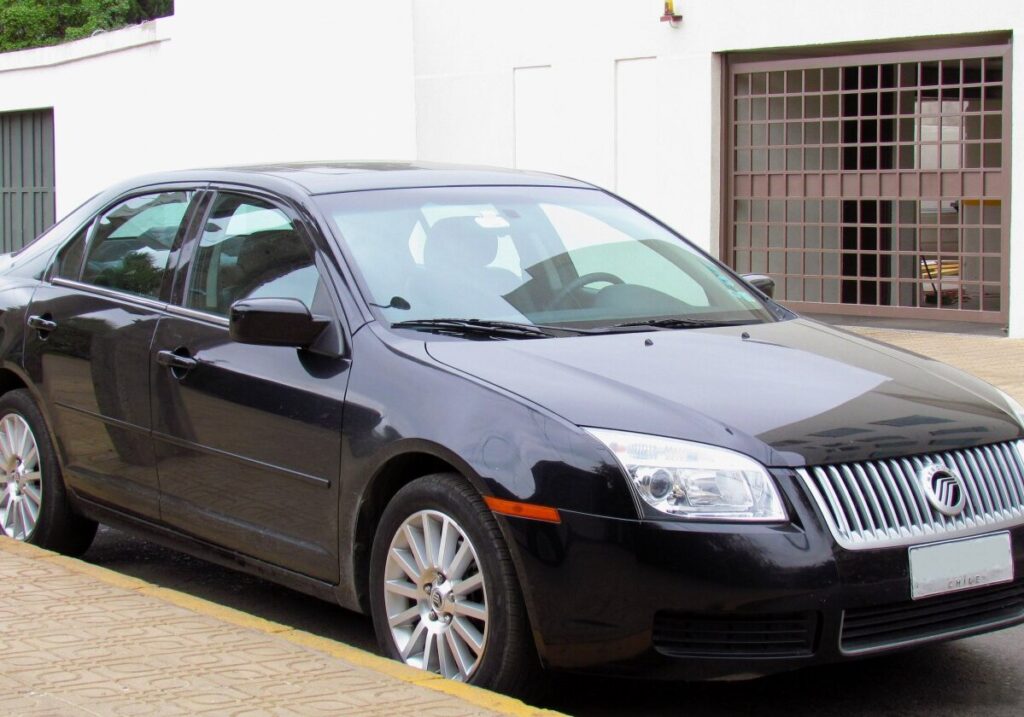
The Mercury Milan 2.3i 16V, produced from 2006 to 2009, represented Mercury’s entry into the mid-size sedan segment, aiming to offer a blend of American comfort and European-inspired styling. Positioned as the base model within the Milan lineup, the 2.3-liter engine and five-speed manual transmission combination provided a more affordable and fuel-conscious alternative to the higher-trim V6 options. The Milan itself was a significant model for Mercury, representing a move towards more contemporary designs and a broader appeal within the Ford Motor Company portfolio, sharing its platform with the Ford Fusion and Lincoln MKZ.
Technical Specifications
| Brand | Mercury |
| Model | Milan |
| Generation | Milan |
| Type (Engine) | 2.3 i 16V (162 Hp) |
| Start of production | 2006 |
| End of production | 2009 |
| Powertrain Architecture | Internal Combustion engine |
| Body type | Sedan |
| Seats | 5 |
| Doors | 4 |
| Fuel consumption (urban) | 9.8 l/100 km (24 US mpg) |
| Fuel consumption (extra urban) | 7.4 l/100 km (31.8 US mpg) |
| Fuel Type | Petrol (Gasoline) |
| Maximum speed | 188 km/h (116.82 mph) |
| Weight-to-power ratio | 9 kg/Hp |
| Weight-to-torque ratio | 7.1 kg/Nm |
| Power | 162 Hp @ 6500 rpm |
| Power per litre | 71.6 Hp/l |
| Torque | 203 Nm @ 4000 rpm (149.73 lb.-ft. @ 4000 rpm) |
| Engine layout | Front, Transverse |
| Engine displacement | 2261 cm3 (137.97 cu. in.) |
| Number of cylinders | 4 |
| Engine configuration | Inline |
| Cylinder Bore | 87.5 mm (3.44 in.) |
| Piston Stroke | 94 mm (3.7 in.) |
| Compression ratio | 9.7:1 |
| Number of valves per cylinder | 4 |
| Fuel injection system | Multi-port manifold injection |
| Engine aspiration | Naturally aspirated engine |
| Engine oil capacity | 4.25 l (4.49 US qt | 3.74 UK qt) |
| Coolant | 8.1 l (8.56 US qt | 7.13 UK qt) |
| Kerb Weight | 1450 kg (3196.7 lbs.) |
| Trunk (boot) space – minimum | 442 l (15.61 cu. ft.) |
| Fuel tank capacity | 68 l (17.96 US gal | 14.96 UK gal) |
| Length | 4862 mm (191.42 in.) |
| Width | 1834 mm (72.2 in.) |
| Height | 1417 mm (55.79 in.) |
| Wheelbase | 2728 mm (107.4 in.) |
| Front track | 1565 mm (61.61 in.) |
| Rear (Back) track | 1557 mm (61.3 in.) |
| Drivetrain Architecture | Front wheel drive |
| Number of gears and type of gearbox | 5 gears, manual transmission |
| Front suspension | Spring Strut |
| Rear suspension | Spring Strut |
| Front brakes | Disc |
| Rear brakes | Disc |
| Assisting systems | ABS (Anti-lock braking system) |
| Steering type | Steering rack and pinion |
| Tires size | 205/50 R16 |
Powertrain & Engine Architecture
The heart of the Milan 2.3i was the 2.3-liter inline-four cylinder engine, internally designated as the 2.3L Duratec. This engine was part of Ford’s Duratec family, known for its relatively simple design and focus on reliability. It featured a single overhead camshaft (SOHC) design with four valves per cylinder, controlled by hydraulic lifters. Fuel delivery was handled by a multi-port fuel injection system, providing adequate atomization for efficient combustion. The engine produced 162 horsepower at 6,500 rpm and 203 Nm (149.73 lb-ft) of torque at 4,000 rpm. The five-speed manual transmission was a standard offering, providing a direct connection between the engine and the front wheels. The transmission’s gear ratios were tuned for a balance of fuel economy and acceptable acceleration.
Driving Characteristics
The Milan 2.3i with the manual transmission offered a reasonably engaging driving experience, though it wasn’t intended to be a performance leader. Acceleration was adequate for everyday driving, with the engine providing sufficient power for merging onto highways and passing slower vehicles. The five-speed manual allowed drivers to keep the engine in its optimal power band, enhancing responsiveness. Compared to the optional 3.0-liter V6, the 2.3-liter engine felt noticeably less powerful, but it also offered better fuel economy. The manual transmission provided more driver control than the available automatic option, which could sometimes feel sluggish due to its four-speed configuration. The steering was light and precise, making the Milan easy to maneuver in urban environments.
Equipment & Trim Levels
The base Milan 2.3i came standard with a respectable array of features for its price point. These included air conditioning, power windows and locks, a CD player with an auxiliary audio input, and cloth upholstery. Safety features such as anti-lock brakes (ABS) and front airbags were also standard. Optional extras included a sunroof, upgraded audio system, and alloy wheels. The interior design was functional and comfortable, though it lacked the premium materials found in higher-trim models. The dashboard layout was straightforward and easy to use, with clearly labeled controls.
Chassis & Braking
The Milan 2.3i utilized a typical front-wheel-drive chassis configuration with an independent front suspension and a multi-link rear suspension. The suspension was tuned for a comfortable ride, absorbing bumps and imperfections in the road surface effectively. The front brakes were ventilated discs, while the rear brakes were solid discs, providing adequate stopping power for the vehicle’s weight. The ABS system helped to prevent wheel lockup during hard braking, enhancing stability and control. The steering system employed a rack-and-pinion design, offering precise and responsive steering feel.
Market Reception & Comparison
The Mercury Milan 2.3i was generally well-received by automotive critics as a practical and affordable mid-size sedan. However, it was often criticized for its lack of power compared to its V6-powered siblings and competitors. Fuel economy was a strong point, with the 2.3-liter engine achieving respectable gas mileage for its class. Reliability was generally good, with few reported issues with the engine or transmission. Compared to the Ford Fusion, which shared the same platform, the Milan offered a slightly more upscale interior and a more refined driving experience. However, the Fusion was typically more affordable.
Legacy
The Mercury Milan 2.3i, while not a standout performer, remains a reasonably reliable and affordable used car option today. The 2.3-liter Duratec engine is known for its durability and relatively low maintenance costs. Parts availability is generally good, as the engine was used in a variety of Ford and Mazda vehicles. While the manual transmission is preferred by enthusiasts for its engaging driving experience, the automatic transmission is more common in the used car market. The Milan 2.3i represents a solid choice for buyers seeking a practical and economical mid-size sedan with a proven track record.