
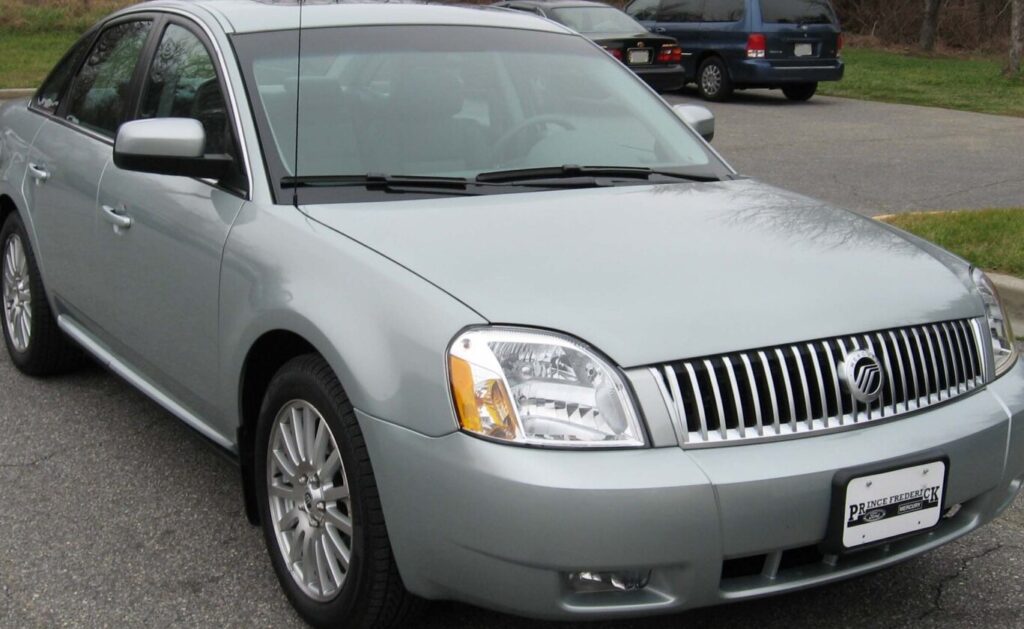
The Mercury Montego 3.0 i V6 24V, produced from 2004 to 2007, represented Mercury’s entry into the mid-size sedan segment, aiming to offer a more upscale alternative to the Ford Fusion with which it shared a platform. Positioned as a slightly more premium offering within the Ford Motor Company lineup, the Montego sought to recapture some of the Mercury brand’s former prestige. This particular variant, powered by the 3.0-liter Duratec V6 engine producing 203 horsepower, was a key offering during its production run. It was designed to balance performance with reasonable fuel economy, appealing to buyers seeking a comfortable and capable family sedan.
Technical Specifications
| Brand | Mercury |
| Model | Montego |
| Generation | Montego |
| Type (Engine) | 3.0 i V6 24V (203 Hp) |
| Start of production | July, 2004 |
| End of production | April, 2007 |
| Powertrain Architecture | Internal Combustion engine |
| Body type | Sedan |
| Seats | 5 |
| Doors | 4 |
| Fuel consumption (urban) | 13 l/100 km (18.1 US mpg, 21.7 UK mpg, 7.7 km/l) |
| Fuel consumption (extra urban) | 9 l/100 km (26.1 US mpg, 31.4 UK mpg, 11.1 km/l) |
| Fuel Type | Petrol (Gasoline) |
| Maximum speed | 200 km/h (124.27 mph) |
| Weight-to-power ratio | 8.2 kg/Hp, 122.7 Hp/tonne |
| Weight-to-torque ratio | 6.1 kg/Nm, 163.7 Nm/tonne |
| Power | 203 Hp @ 5750 rpm |
| Power per litre | 68.4 Hp/l |
| Torque | 271 Nm @ 4500 rpm (199.88 lb.-ft. @ 4500 rpm) |
| Engine layout | Front, Transverse |
| Engine displacement | 2967 cm3 (181.06 cu. in.) |
| Number of cylinders | 6 |
| Engine configuration | V-engine |
| Cylinder Bore | 89 mm (3.5 in.) |
| Piston Stroke | 79.5 mm (3.13 in.) |
| Compression ratio | 10:1 |
| Number of valves per cylinder | 4 |
| Fuel injection system | Multi-port manifold injection |
| Engine aspiration | Naturally aspirated engine |
| Valvetrain | DOHC |
| Engine oil capacity | 5.7 l (6.02 US qt | 5.02 UK qt) |
| Coolant | 11 l (11.62 US qt | 9.68 UK qt) |
| Kerb Weight | 1655 kg (3648.65 lbs.) |
| Trunk (boot) space (minimum) | 595 l (21.01 cu. ft.) |
| Fuel tank capacity | 72 l (19.02 US gal | 15.84 UK gal) |
| Length | 5100 mm (200.79 in.) |
| Width | 1870 mm (73.62 in.) |
| Height | 1530 mm (60.24 in.) |
| Wheelbase | 2870 mm (112.99 in.) |
| Front track | 1640 mm (64.57 in.) |
| Rear track | 1650 mm (64.96 in.) |
| Drivetrain Architecture | The Internal combustion engine (ICE) drives the front wheels of the vehicle. |
| Drive wheel | Front wheel drive |
| Number of gears and type of gearbox | 6 gears, manual transmission |
| Front suspension | Spring Strut |
| Rear suspension | Transverse stabilizer |
| Front brakes | Ventilated discs |
| Rear brakes | Disc |
| Assisting systems | ABS (Anti-lock braking system) |
| Steering type | Steering rack and pinion |
| Tires size | 225/60 R16 |
| Wheel rims size | 7J x 16 |
Powertrain & Engine Architecture
The heart of the Montego 3.0 i was the Ford Duratec 30 V6 engine. This engine, part of Ford’s modular engine family, featured a 60-degree V-angle and a double overhead camshaft (DOHC) valvetrain with four valves per cylinder. The 3.0-liter displacement was achieved with a 89 mm bore and a 79.5 mm stroke. Fuel delivery was handled by a multi-port fuel injection system, providing precise fuel metering for optimal combustion. The engine produced 203 horsepower at 5750 rpm and 271 Nm (199.88 lb-ft) of torque at 4500 rpm. The engine’s design prioritized smoothness and refinement over outright performance. The 6-speed manual transmission was the only transmission option available with this engine, offering drivers a more engaging driving experience compared to the automatic transmissions offered with other engine options.
Driving Characteristics
The Montego 3.0 i with the 6-speed manual transmission offered a reasonably spirited driving experience for a mid-size sedan. While not a sports car, the engine’s torque output provided adequate acceleration for everyday driving and highway merging. The 6-speed manual allowed drivers to keep the engine in its optimal power band, enhancing responsiveness. The gear ratios were tuned for a balance of acceleration and fuel efficiency. Compared to the base 3.0-liter engine paired with an automatic transmission, the manual version felt noticeably more engaging and offered better control. However, it lacked the outright punch of higher-performance options available in other vehicles.
Equipment & Trim Levels
The Montego 3.0 i typically came standard with features such as air conditioning, power windows and locks, a CD player, and cloth upholstery. Higher trim levels added features like leather upholstery, a sunroof, upgraded audio systems, and alloy wheels. Safety features included anti-lock brakes (ABS) and front airbags. Optional extras included a navigation system and premium sound systems. The interior design was generally conservative, focusing on comfort and practicality rather than cutting-edge styling.
Chassis & Braking
The Montego utilized a front-wheel-drive layout with an independent front suspension featuring MacPherson struts and a multi-link rear suspension. This setup aimed to provide a comfortable ride while maintaining reasonable handling characteristics. The braking system consisted of ventilated discs at the front and solid discs at the rear, providing adequate stopping power for the vehicle’s weight. ABS was standard, enhancing braking performance in emergency situations. The suspension tuning was geared towards comfort, resulting in a relatively soft ride quality.
Market Reception & Comparison
The Mercury Montego received mixed reviews from automotive critics. While praised for its comfortable ride and spacious interior, it was often criticized for its bland styling and unremarkable handling. The 3.0-liter V6 engine was considered adequate but not particularly exciting. Fuel economy was average for its class. Compared to competitors like the Toyota Camry and Honda Accord, the Montego often fell short in terms of overall refinement and driving dynamics. The manual transmission version was appreciated by enthusiasts for offering a more engaging driving experience, but it wasn’t a significant selling point for the broader market.
Legacy
The Mercury Montego, and particularly the 3.0 i variant with the 6-speed manual transmission, hasn’t achieved significant collector status. However, well-maintained examples are becoming increasingly sought after by enthusiasts who appreciate its relative rarity and the engaging driving experience offered by the manual gearbox. The Duratec 3.0 V6 engine is generally considered reliable, although routine maintenance is essential to prevent issues. The Montego represents a transitional period for Mercury, as the brand struggled to define its identity in a competitive market. Today, it serves as a reminder of a time when Mercury attempted to offer a more upscale alternative to Ford’s mainstream offerings.
