
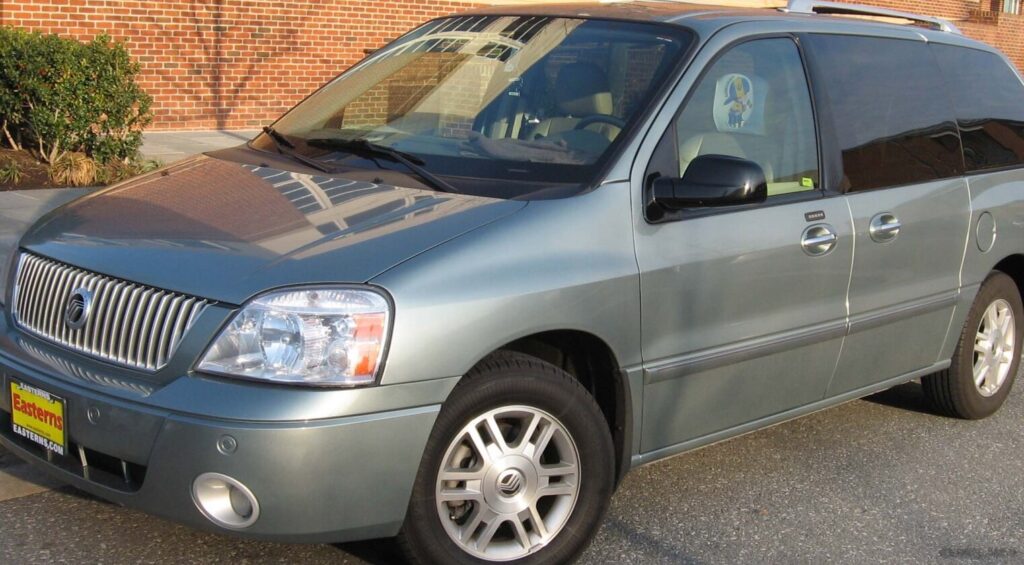
The Mercury Monterey 4.2i V6 12V (204 hp) was a front-wheel drive minivan produced by Mercury between 2004 and 2006. It represented Mercury’s entry into the increasingly popular minivan segment, sharing its platform and many components with the Ford Freestar. Positioned as a family-oriented vehicle, the Monterey aimed to provide comfortable transportation for up to seven passengers. This particular variant, equipped with the 4.2-liter V6 engine and a four-speed automatic transmission, was a mainstay of the Monterey lineup, offering a balance between performance and fuel efficiency for the average consumer.
Technical Specifications
| Brand | Mercury |
| Model | Monterey |
| Generation | Monterey |
| Type (Engine) | 4.2 i V6 12V (204 Hp) |
| Start of production | 2004 |
| End of production | 2006 |
| Powertrain Architecture | Internal Combustion engine |
| Body type | Minivan |
| Seats | 7 |
| Doors | 5 |
| Fuel consumption (urban) | 14 l/100 km (16.8 US mpg, 20.2 UK mpg, 7.1 km/l) |
| Fuel consumption (extra urban) | 10 l/100 km (23.5 US mpg, 28.2 UK mpg, 10 km/l) |
| Fuel Type | Petrol (Gasoline) |
| Maximum speed | 177 km/h (109.98 mph) |
| Weight-to-power ratio | 10.1 kg/Hp, 99.3 Hp/tonne |
| Weight-to-torque ratio | 5.7 kg/Nm, 176.2 Nm/tonne |
| Power | 204 Hp @ 4250 rpm |
| Power per litre | 48.6 Hp/l |
| Torque | 362 Nm @ 3750 rpm (267 lb.-ft. @ 3750 rpm) |
| Engine layout | Front, Transverse |
| Engine displacement | 4195 cm3 (255.99 cu. in.) |
| Number of cylinders | 6 |
| Engine configuration | V-engine |
| Cylinder Bore | 96.8 mm (3.81 in.) |
| Piston Stroke | 95 mm (3.74 in.) |
| Compression ratio | 9.3:1 |
| Number of valves per cylinder | 2 |
| Fuel injection system | Multi-port manifold injection |
| Engine aspiration | Naturally aspirated engine |
| Engine oil capacity | 4.7 l (4.97 US qt | 4.14 UK qt) |
| Coolant | 14 l (14.79 US qt | 12.32 UK qt) |
| Kerb Weight | 2055 kg (4530.5 lbs.) |
| Trunk (boot) space – minimum | 733 l (25.89 cu. ft.) |
| Trunk (boot) space – maximum | 3831 l (135.29 cu. ft.) |
| Fuel tank capacity | 98 l (25.89 US gal | 21.56 UK gal) |
| Length | 5105 mm (200.98 in.) |
| Width | 1946 mm (76.61 in.) |
| Height | 1745 mm (68.7 in.) |
| Wheelbase | 3068 mm (120.79 in.) |
| Front track | 1633 mm (64.29 in.) |
| Rear (Back) track | 1600 mm (62.99 in.) |
| Drivetrain Architecture | The Internal combustion engine (ICE) drives the front wheels of the vehicle. |
| Drive wheel | Front wheel drive |
| Number of gears and type of gearbox | 4 gears, automatic transmission |
| Front suspension | Spring Strut |
| Rear suspension | Transverse stabilizer |
| Front brakes | Ventilated discs |
| Rear brakes | Disc |
| Assisting systems | ABS (Anti-lock braking system) |
| Steering type | Steering rack and pinion |
| Tires size | 235/60 R16 |
Powertrain & Engine Architecture
The heart of the Monterey 4.2i was the 4.2-liter (4195 cc) overhead valve (OHV) V6 engine. This engine, designated within Ford as the 4.2L Vulcan V6, featured a 90-degree V-configuration and utilized a cast iron block with aluminum cylinder heads. The engine employed a multi-port fuel injection system, delivering fuel directly to each intake port for improved combustion efficiency. With 12 valves (two per cylinder), the engine prioritized low-end torque over high-revving horsepower. The four-speed automatic transmission, a 4F50E unit, was chosen for its smooth operation and suitability for family hauling. This transmission featured electronic control and overdrive for improved fuel economy at highway speeds. The transmission’s gear ratios were tuned for comfortable cruising and adequate acceleration, though it wasn’t designed for sporty performance.
Driving Characteristics
The 204 horsepower and 267 lb-ft of torque produced by the 4.2-liter V6 and four-speed automatic combination provided adequate, but not exhilarating, performance. Acceleration from 0 to 60 mph typically took around 9-10 seconds. The automatic transmission, while smooth, could feel somewhat sluggish during quick acceleration maneuvers. Compared to the higher-output engine options available in other minivans, or even the potential of a manual transmission, the Monterey 4.2i felt less responsive. However, for everyday driving and family transportation, the power delivery was generally sufficient. The focus was on providing a comfortable and relaxed driving experience rather than sporty handling.
Equipment & Trim Levels
The Monterey 4.2i typically came standard with features such as air conditioning, power windows and locks, a CD player, and cloth upholstery. Higher trim levels offered upgrades like leather seats, a premium sound system, power-adjustable pedals, and a rear entertainment system. Safety features included anti-lock brakes (ABS) and front airbags. The Monterey’s interior was designed with practicality in mind, offering ample storage space and comfortable seating for seven passengers. The second-row seats could be configured as captain’s chairs or a bench seat, providing flexibility for different passenger needs.
Chassis & Braking
The Monterey utilized a front-wheel-drive layout with an independent front suspension featuring MacPherson struts and a multi-link rear suspension. This suspension setup aimed to provide a comfortable ride quality, absorbing bumps and irregularities in the road surface. The braking system consisted of ventilated discs at the front and solid discs at the rear. ABS was standard, helping to maintain steering control during emergency braking situations. The steering was rack-and-pinion, providing reasonably precise steering feel.
Market Reception & Comparison
The Mercury Monterey, particularly the 4.2i variant, received mixed reviews from automotive critics. While praised for its spacious interior and comfortable ride, it was often criticized for its lack of performance compared to competitors like the Honda Odyssey or Toyota Sienna. Fuel economy was also considered average for the segment. The 4.2-liter V6, while reliable, wasn’t as fuel-efficient as some of the V6 engines offered by competitors. Compared to the Freestar, the Monterey benefited from a slightly more upscale interior and a more refined driving experience, but the core mechanical components remained largely the same.
Legacy
The Mercury Monterey was discontinued after the 2006 model year, along with the entire Mercury brand. The 4.2-liter V6 engine, while generally reliable, is known to be susceptible to timing chain issues if maintenance is neglected. In the used car market, the Monterey 4.2i represents an affordable option for families seeking a spacious and comfortable minivan. However, potential buyers should be aware of the potential for timing chain problems and ensure that the vehicle has been properly maintained. The Monterey, while not a standout performer, provided a practical and reasonably reliable transportation solution for many families during its short production run.
