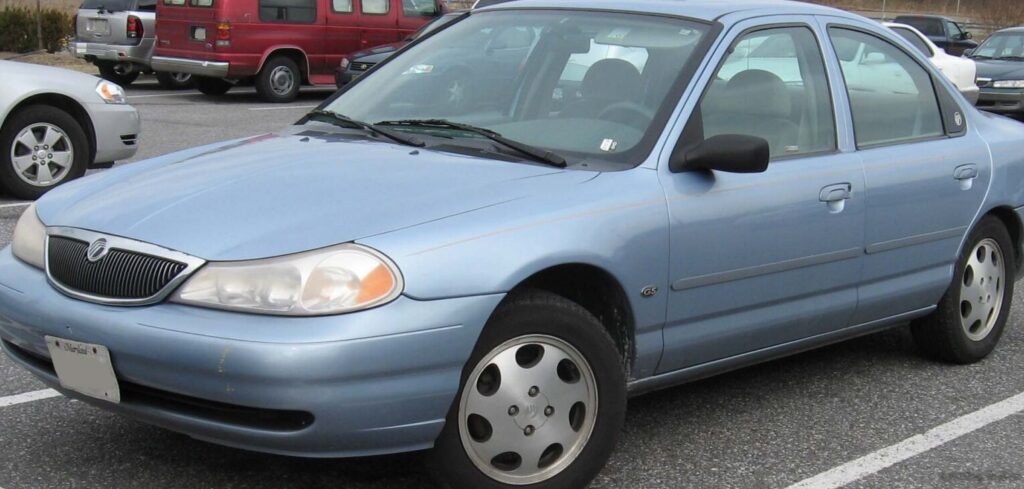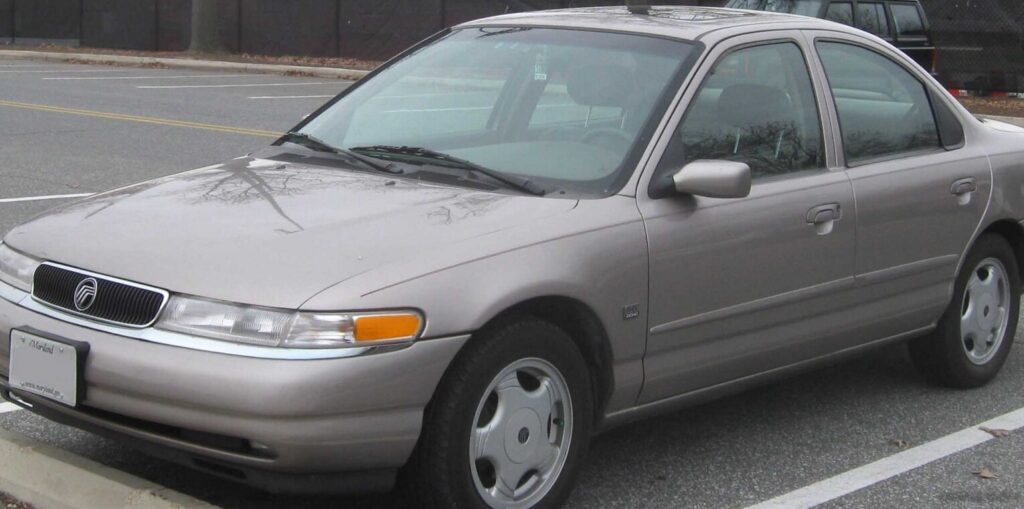
The Mercury Mystique 2.0 16V Automatic, produced between 1994 and 1997, represented Mercury’s entry into the mid-size sedan market, positioned as a more upscale alternative to the Ford Taurus with which it shared its platform. Part of the first generation Mystique (1994-1997), this variant utilized the Zetec 2.0-liter engine paired with a four-speed automatic transmission. It aimed to provide a balance of comfort, fuel efficiency, and reasonable performance for family buyers. The Mystique, along with the Ford Contour, were significant departures for Ford, representing an attempt to compete more directly with European and Japanese sedans in terms of design and driving dynamics.
Technical Specifications
| Brand | Mercury |
| Model | Mystique |
| Type (Engine) | 2.0 16V (126 Hp) Automatic |
| Start of production | 1994 |
| End of production | 1997 |
| Powertrain Architecture | Internal Combustion engine |
| Body type | Sedan |
| Seats | 5 |
| Doors | 4 |
| Fuel consumption (urban) | 10.2 l/100 km (23.1 US mpg) |
| Fuel consumption (extra urban) | 7.4 l/100 km (31.8 US mpg) |
| Fuel Type | Petrol (Gasoline) |
| Maximum speed | 195 km/h (121.17 mph) |
| Weight-to-power ratio | 10.2 kg/Hp |
| Weight-to-torque ratio | 7.3 kg/Nm |
| Power | 126 Hp @ 5500 rpm |
| Power per litre | 63.4 Hp/l |
| Torque | 177 Nm @ 4000 rpm (130.55 lb.-ft. @ 4000 rpm) |
| Engine layout | Front, Transverse |
| Engine Model/Code | Zetec |
| Engine displacement | 1988 cm3 (121.32 cu. in.) |
| Number of cylinders | 4 |
| Engine configuration | Inline |
| Cylinder Bore | 84.8 mm (3.34 in.) |
| Piston Stroke | 88 mm (3.46 in.) |
| Compression ratio | 9.6:1 |
| Number of valves per cylinder | 4 |
| Fuel injection system | Multi-port manifold injection |
| Engine aspiration | Naturally aspirated |
| Engine oil capacity | 4.3 l (4.54 US qt | 3.78 UK qt) |
| Coolant capacity | 7.1 l (7.5 US qt | 6.25 UK qt) |
| Kerb Weight | 1285 kg (2832.94 lbs.) |
| Trunk (boot) space | 395 l (13.95 cu. ft.) |
| Fuel tank capacity | 57 l (15.06 US gal | 12.54 UK gal) |
| Length | 4660 mm (183.46 in.) |
| Width | 1760 mm (69.29 in.) |
| Height | 1380 mm (54.33 in.) |
| Wheelbase | 2710 mm (106.69 in.) |
| Front track | 1500 mm (59.06 in.) |
| Rear track | 1490 mm (58.66 in.) |
| Drivetrain | Front wheel drive |
| Number of gears | 4 |
| Gearbox type | Automatic transmission |
| Front suspension | Spring Strut |
| Rear suspension | Transverse stabilizer |
| Front brakes | Ventilated discs |
| Rear brakes | Drum |
| Assisting systems | ABS (Anti-lock braking system) |
| Steering type | Steering rack and pinion |
| Power steering | Hydraulic |
| Tires size | 185/70 R14 |
| Wheel rims size | 14 |
Powertrain & Engine Architecture
The heart of the Mystique 2.0 Automatic was the Zetec engine, a 1.998-liter (2.0L) inline-four cylinder powerplant. This engine, part of Ford’s Zetec family, featured a double overhead camshaft (DOHC) valvetrain with four valves per cylinder, contributing to its relatively high output for its displacement. The engine utilized multi-port fuel injection for precise fuel delivery. The 126 horsepower and 130.55 lb-ft of torque were respectable for the time, but not class-leading. The four-speed automatic transmission, while providing convenience, was a key differentiator from the available five-speed manual. This automatic was a Ford-sourced unit, designed for smooth operation but not particularly sporty shifts. The transmission’s gear ratios were tuned for fuel economy and comfortable cruising rather than aggressive acceleration.
Driving Characteristics
The Mystique 2.0 Automatic offered a comfortable, if not particularly exciting, driving experience. Acceleration was adequate for everyday driving, with 0-60 mph times estimated around 10-11 seconds. The automatic transmission, while smooth, did detract from the engine’s potential, resulting in a noticeable difference in responsiveness compared to the manual transmission versions. The gear ratios were spaced to prioritize fuel efficiency, meaning the engine often felt strained during quick overtaking maneuvers. Handling was generally secure, but the suspension was tuned for comfort, resulting in some body roll during cornering. Compared to the higher-output V6 versions of the Mystique, the 2.0L automatic was noticeably slower and less engaging.
Equipment & Trim Levels
The Mystique 2.0 Automatic typically came standard with features such as air conditioning, power windows and locks, and an AM/FM stereo. Higher trim levels offered options like a CD player, upgraded upholstery (cloth or optional leather), and a power sunroof. Interior appointments were generally functional and well-built for the price point, though not as luxurious as some competitors. The dashboard layout was straightforward and easy to use. Safety features included standard anti-lock brakes (ABS), which were becoming increasingly common in the mid-size segment.
Chassis & Braking
The Mystique utilized a MacPherson strut front suspension and a semi-independent rear suspension with a transverse stabilizer bar. This setup provided a comfortable ride, but wasn’t particularly sporty. The front brakes were ventilated discs, offering good stopping power, while the rear brakes were drums, a cost-saving measure common in this class. The steering was rack-and-pinion with hydraulic power assist, providing light and easy steering feel. The 185/70 R14 tires were a compromise between ride comfort and handling.
Market Reception & Comparison
The Mystique 2.0 Automatic was generally well-received by critics as a competent and comfortable mid-size sedan. However, it wasn’t considered a standout performer in its class. The automatic transmission was often criticized for its lack of responsiveness. Fuel economy was a strong point, with the 2.0L engine offering better mileage than the V6 options. Compared to the V6 Mystique, the 2.0L automatic was more affordable and fuel-efficient, but significantly slower. It competed with vehicles like the Honda Accord, Toyota Camry, and Nissan Sentra, all of which offered similar levels of comfort and reliability.
Legacy
The Mercury Mystique, particularly the 2.0L automatic variant, has proven to be a relatively reliable vehicle in the used car market. The Zetec engine is known for its durability, and the automatic transmission, while not sporty, is generally dependable. However, like many vehicles of this era, they are susceptible to age-related issues such as rust and wear on suspension components. Today, the Mystique is often sought after by those looking for an affordable and practical classic car, offering a glimpse into Ford’s attempt to create a more refined and European-inspired mid-size sedan.