
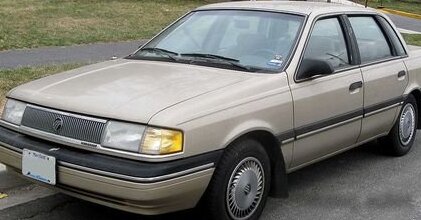
The Mercury Topaz 2.3i (2-door) with the automatic transmission, produced between 1983 and 1993, represented a key offering in Mercury’s compact car lineup. Positioned as a more upscale alternative to the Ford Tempo – with which it shared its platform – the Topaz aimed to provide a comfortable and relatively affordable driving experience. This particular variant, equipped with the 2.3-liter inline-four engine producing 97 horsepower, served as the entry-level engine option when paired with the three-speed automatic transmission. It was designed to appeal to buyers prioritizing ease of use and fuel economy over outright performance. The Topaz was part of the first generation of front-wheel drive cars from Mercury, marking a significant shift in the brand’s engineering approach.
Technical Specifications
| Brand | Mercury |
| Model | Topaz |
| Generation | Topaz |
| Type | 2.3 i (2 dr) (97 Hp) Automatic |
| Start of production | 1983 |
| End of production | 1993 |
| Powertrain Architecture | Internal Combustion engine |
| Body type | Sedan |
| Seats | 5 |
| Doors | 2 |
| Fuel Type | Petrol (Gasoline) |
| Maximum speed | 155 km/h (96.31 mph) |
| Weight-to-power ratio | 11.9 kg/Hp, 84.3 Hp/tonne |
| Weight-to-torque ratio | 6.6 kg/Nm, 151.3 Nm/tonne |
| Power | 97 Hp @ 4400 rpm |
| Power per litre | 42 Hp/l |
| Torque | 174 Nm @ 2600 rpm (128.34 lb.-ft. @ 2600 rpm) |
| Engine layout | Front, Transverse |
| Engine displacement | 2307 cm3 (140.78 cu. in.) |
| Number of cylinders | 4 |
| Engine configuration | Inline |
| Cylinder Bore | 93.5 mm (3.68 in.) |
| Piston Stroke | 84 mm (3.31 in.) |
| Compression ratio | 9:1 |
| Number of valves per cylinder | 2 |
| Fuel injection system | Multi-port manifold injection |
| Engine aspiration | Naturally aspirated engine |
| Engine oil capacity | 4.7 l (4.97 US qt | 4.14 UK qt) |
| Coolant | 7 l (7.4 US qt | 6.16 UK qt) |
| Kerb Weight | 1150 kg (2535.32 lbs.) |
| Trunk (boot) space – minimum | 375 l (13.24 cu. ft.) |
| Fuel tank capacity | 60 l (15.85 US gal | 13.2 UK gal) |
| Length | 4490 mm (176.77 in.) |
| Width | 1735 mm (68.31 in.) |
| Height | 1340 mm (52.76 in.) |
| Wheelbase | 2540 mm (100 in.) |
| Front track | 1395 mm (54.92 in.) |
| Rear (Back) track | 1460 mm (57.48 in.) |
| Drivetrain Architecture | The Internal combustion engine (ICE) drives the front wheels of the vehicle. |
| Drive wheel | Front wheel drive |
| Number of gears and type of gearbox | 3 gears, automatic transmission |
| Front suspension | Coil spring |
| Rear suspension | Coil spring |
| Front brakes | Ventilated discs |
| Rear brakes | Drum |
| Assisting systems | ABS (Anti-lock braking system) |
| Steering type | Steering rack and pinion |
| Power steering | Hydraulic Steering |
| Tires size | 185/70 R14 |
| Wheel rims size | 14 |
Powertrain & Engine Architecture
The heart of the Topaz 2.3i Automatic was the Ford-derived 2.3-liter inline-four cylinder engine. This engine, internally designated as the 2.3L, was a relatively simple design featuring a cast iron block and an aluminum cylinder head. It utilized a multi-port fuel injection system, which improved fuel efficiency and responsiveness compared to earlier carbureted designs. The engine’s 97 horsepower output at 4400 rpm and 128.34 lb-ft of torque at 2600 rpm were considered adequate for everyday driving, but not particularly sporty. The three-speed automatic transmission was a Ford unit, designed for smooth and reliable operation. It wasn’t known for quick shifts, prioritizing comfort over performance. The transmission’s gear ratios were optimized for fuel economy and relaxed cruising, rather than rapid acceleration.
Driving Characteristics
Behind the wheel, the Topaz 2.3i Automatic offered a comfortable, if unremarkable, driving experience. Acceleration was modest, with 0-60 mph times estimated around 11-12 seconds. The automatic transmission contributed to a smooth ride, but also resulted in a noticeable lack of engine braking. Compared to the five-speed manual transmission available with the same engine, the automatic version felt significantly slower and less engaging. The suspension, tuned for comfort, absorbed bumps reasonably well, but didn’t offer particularly sharp handling. Steering was light and easy, making it well-suited for city driving.
Equipment & Trim Levels
The 2.3i Automatic trim typically included features such as cloth upholstery, an AM/FM radio, and basic instrumentation. Power steering was standard, but air conditioning and power windows were often optional extras. Higher trim levels, such as the LX, added features like upgraded interior trim, a better sound system, and alloy wheels. The two-door body style was generally considered more sporty than the four-door sedan, appealing to a slightly younger demographic. Interior space was adequate for five passengers, but rear seat legroom was somewhat limited.
Chassis & Braking
The Topaz utilized a front-wheel drive chassis with independent coil spring suspension at the front and a semi-independent coil spring suspension at the rear. The front brakes were ventilated discs, providing adequate stopping power, while the rear brakes were drums. An anti-lock braking system (ABS) was available as an option, enhancing safety. The chassis was relatively lightweight, contributing to the car’s fuel efficiency. The steering system employed a rack-and-pinion setup, providing precise and responsive steering feel.
Market Reception & Comparison
The Mercury Topaz 2.3i Automatic received mixed reviews from automotive critics. While praised for its comfortable ride and fuel efficiency, it was often criticized for its lack of performance and somewhat bland styling. Compared to the Ford Tempo, the Topaz offered a slightly more refined interior and a more upscale image. However, it was generally considered less sporty than some of its competitors, such as the Chevrolet Cavalier or the Dodge Shadow. Fuel economy was a strong point, with the 2.3-liter engine achieving around 21 mpg city and 29 mpg highway.
Legacy
The Mercury Topaz, particularly the 2.3i Automatic variant, has become a relatively affordable and accessible classic car. The 2.3-liter engine is known for its durability and reliability, although regular maintenance is essential. Parts availability is generally good, as many components are shared with the Ford Tempo and other Ford models of the era. While not a particularly collectible car, the Topaz represents an important chapter in Mercury’s history, marking its transition to front-wheel drive and a more modern engineering approach. Today, well-maintained examples are often sought after by enthusiasts looking for a simple, reliable, and affordable classic car.
