
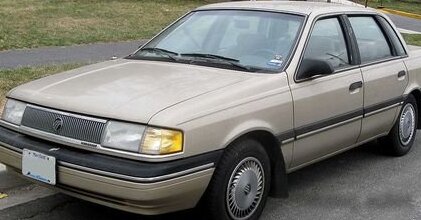
The Mercury Topaz 2.3i, produced from 1983 to 1993, represented Mercury’s entry into the compact sedan market, aiming to offer a more upscale alternative to the Ford Tempo with which it shared a platform. This particular variant, equipped with the 2.3-liter inline-four engine producing 97 horsepower, was a mainstay of the Topaz lineup throughout much of its production run. Positioned as a mid-range offering, it provided a balance between affordability and features, appealing to buyers seeking a practical and reasonably comfortable family car. The Topaz, and its Ford Tempo sibling, were key components of Ford’s restructuring efforts in the early 1980s, designed to replace the aging Ford Fairmont and Mercury Zephyr models.
Technical Specifications
| Brand | Mercury |
| Model | Topaz |
| Generation | Topaz |
| Type (Engine) | 2.3 i (4 dr) (97 Hp) |
| Start of production | 1983 year |
| End of production | 1993 year |
| Powertrain Architecture | Internal Combustion engine |
| Body type | Sedan |
| Seats | 5 |
| Doors | 4 |
| Fuel consumption (urban) | 12 l/100 km (19.6 US mpg) |
| Fuel consumption (extra urban) | 7 l/100 km (33.6 US mpg) |
| Fuel Type | Petrol (Gasoline) |
| Maximum speed | 155 km/h (96.31 mph) |
| Weight-to-power ratio | 12.1 kg/Hp |
| Weight-to-torque ratio | 6.8 kg/Nm |
| Power | 97 Hp @ 4400 rpm |
| Power per litre | 42 Hp/l |
| Torque | 174 Nm @ 2600 rpm (128.34 lb.-ft. @ 2600 rpm) |
| Engine layout | Front, Transverse |
| Engine displacement | 2307 cm3 (140.78 cu. in.) |
| Number of cylinders | 4 |
| Engine configuration | Inline |
| Cylinder Bore | 93.5 mm (3.68 in.) |
| Piston Stroke | 84 mm (3.31 in.) |
| Compression ratio | 9:1 |
| Number of valves per cylinder | 2 |
| Fuel injection system | Multi-port manifold injection |
| Engine aspiration | Naturally aspirated engine |
| Engine oil capacity | 4.7 l (4.97 US qt | 4.14 UK qt) |
| Coolant | 7 l (7.4 US qt | 6.16 UK qt) |
| Kerb Weight | 1175 kg (2590.43 lbs.) |
| Trunk (boot) space – minimum | 365 l (12.89 cu. ft.) |
| Fuel tank capacity | 60 l (15.85 US gal | 13.2 UK gal) |
| Length | 4490 mm (176.77 in.) |
| Width | 1735 mm (68.31 in.) |
| Height | 1340 mm (52.76 in.) |
| Wheelbase | 2540 mm (100 in.) |
| Front track | 1395 mm (54.92 in.) |
| Rear (Back) track | 1460 mm (57.48 in.) |
| Drivetrain Architecture | The Internal combustion engine (ICE) drives the front wheels of the vehicle. |
| Drive wheel | Front wheel drive |
| Number of gears and type of gearbox | 5 gears, manual transmission |
| Front suspension | Coil spring |
| Rear suspension | Coil spring |
| Front brakes | Ventilated discs |
| Rear brakes | Drum |
| Assisting systems | ABS (Anti-lock braking system) |
| Steering type | Steering rack and pinion |
| Power steering | Hydraulic Steering |
| Tires size | 185/70 R14 |
Powertrain & Engine Architecture
The heart of the Topaz 2.3i was the Ford 2.3-liter inline-four cylinder engine. This engine, internally designated as the 2.3L, was a relatively simple and robust design. It featured a cast iron block and an aluminum cylinder head, utilizing a single overhead camshaft (SOHC) design with two valves per cylinder. Fuel delivery was handled by a multi-port fuel injection system, a significant upgrade over the carbureted engines found in earlier Ford models. This system improved fuel efficiency and reduced emissions. The 97 horsepower output was achieved at 4400 rpm, while peak torque of 128.34 lb.-ft. arrived at 2600 rpm. The engine’s 9:1 compression ratio was typical for the era. The standard transmission was a five-speed manual, though a three-speed automatic transmission was also available, impacting performance and fuel economy.
Driving Characteristics
The Topaz 2.3i with the five-speed manual transmission offered adequate, though not exhilarating, performance. Acceleration was modest, with a 0-60 mph time estimated around 11-12 seconds. The engine felt relatively smooth at cruising speeds, but could become noisy under hard acceleration. The five-speed manual allowed drivers to keep the engine in its optimal power band, improving responsiveness. The automatic transmission, while providing convenience, noticeably reduced acceleration and increased fuel consumption. The gear ratios were tuned for fuel economy rather than performance. Handling was typical for a front-wheel-drive sedan of the era – safe and predictable, but not particularly sporty. The suspension provided a comfortable ride, absorbing most road imperfections.
Equipment & Trim Levels
The Topaz 2.3i typically came standard with features considered essential for the time, including cloth upholstery, a basic AM/FM radio, and manual windows and locks. Air conditioning was a popular option. Higher trim levels, such as the LX, added features like upgraded interior trim, power windows and locks, and a better sound system. Optional extras included a sunroof, cruise control, and upgraded wheels. The interior design was functional and straightforward, prioritizing practicality over luxury. The dashboard layout was simple and easy to use, with clearly marked controls.
Chassis & Braking
The Topaz utilized a front-wheel-drive chassis with independent front suspension using coil springs and a twist-beam rear suspension, also with coil springs. The front brakes were ventilated discs, providing adequate stopping power, while the rear brakes were drums. An anti-lock braking system (ABS) was available as an option, enhancing safety. Steering was handled by a rack-and-pinion system with hydraulic power assist, providing light and easy steering. Tire size was typically 185/70 R14. The suspension was tuned for comfort, prioritizing a smooth ride over sporty handling.
Market Reception & Comparison
The Mercury Topaz 2.3i was generally well-received by critics as a practical and affordable family sedan. It was praised for its comfortable ride, spacious interior, and reasonable fuel economy. However, it was often criticized for its lack of excitement and its somewhat bland styling. Compared to the Ford Tempo, the Topaz offered a slightly more refined interior and a more upscale image. Compared to higher-performance versions of the Topaz, such as those equipped with the V6 engine, the 2.3i offered significantly lower performance but better fuel economy and lower maintenance costs. The 2.3L engine proved to be reliable, but the automatic transmission was sometimes prone to issues.
Legacy
The Mercury Topaz, particularly the 2.3i variant, remains a relatively common sight in the used car market, though finding well-maintained examples is becoming increasingly difficult. The 2.3-liter engine is known for its durability and relatively low maintenance requirements. While not a particularly collectible car, the Topaz represents a significant chapter in Ford’s history, demonstrating the company’s efforts to modernize its lineup and compete in the increasingly competitive compact sedan segment. Its simple design and readily available parts make it a popular choice for budget-minded drivers and those seeking a classic 1980s/early 1990s American sedan.
