
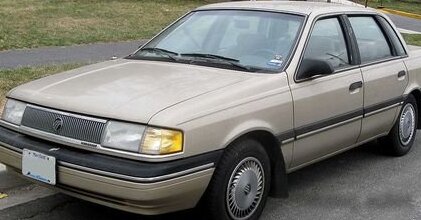
The Mercury Topaz 2.3i, produced from 1983 to 1993, represented Mercury’s entry into the compact sedan market, aiming to offer a more upscale alternative to the Ford Tempo with which it shared a platform. This particular variant, equipped with the 2.3-liter inline-four engine and a three-speed automatic transmission, was a mainstay of the Topaz lineup throughout much of its production run. It served as a popular choice for buyers seeking a comfortable, reliable, and reasonably priced family sedan. The Topaz, built on Ford’s FN10 platform (later designated as the 1HX0/A3 platform), was a significant vehicle for Mercury, attempting to broaden the brand’s appeal beyond larger, more luxurious models.
Technical Specifications
| Brand | Mercury |
| Model | Topaz |
| Type | 2.3 i (4 dr) (97 Hp) Automatic |
| Start of production | 1983 |
| End of production | 1993 |
| Powertrain Architecture | Internal Combustion engine |
| Body type | Sedan |
| Seats | 5 |
| Doors | 4 |
| Fuel Type | Petrol (Gasoline) |
| Maximum speed | 155 km/h (96.31 mph) |
| Weight-to-power ratio | 12.1 kg/Hp, 82.6 Hp/tonne |
| Weight-to-torque ratio | 6.8 kg/Nm, 148.1 Nm/tonne |
| Power | 97 Hp @ 4400 rpm |
| Power per litre | 42 Hp/l |
| Torque | 174 Nm @ 2600 rpm (128.34 lb.-ft. @ 2600 rpm) |
| Engine layout | Front, Transverse |
| Engine displacement | 2307 cm3 (140.78 cu. in.) |
| Number of cylinders | 4 |
| Engine configuration | Inline |
| Cylinder Bore | 93.5 mm (3.68 in.) |
| Piston Stroke | 84 mm (3.31 in.) |
| Compression ratio | 9:1 |
| Number of valves per cylinder | 2 |
| Fuel injection system | Multi-port manifold injection |
| Engine aspiration | Naturally aspirated engine |
| Engine oil capacity | 4.7 l (4.97 US qt | 4.14 UK qt) |
| Coolant | 7 l (7.4 US qt | 6.16 UK qt) |
| Kerb Weight | 1175 kg (2590.43 lbs.) |
| Trunk (boot) space – minimum | 365 l (12.89 cu. ft.) |
| Fuel tank capacity | 60 l (15.85 US gal | 13.2 UK gal) |
| Length | 4490 mm (176.77 in.) |
| Width | 1735 mm (68.31 in.) |
| Height | 1340 mm (52.76 in.) |
| Wheelbase | 2540 mm (100 in.) |
| Front track | 1395 mm (54.92 in.) |
| Rear (Back) track | 1460 mm (57.48 in.) |
| Drivetrain Architecture | The Internal combustion engine (ICE) drives the front wheels of the vehicle. |
| Drive wheel | Front wheel drive |
| Number of gears and type of gearbox | 3 gears, automatic transmission |
| Front suspension | Coil spring |
| Rear suspension | Coil spring |
| Front brakes | Ventilated discs |
| Rear brakes | Drum |
| Assisting systems | ABS (Anti-lock braking system) |
| Steering type | Steering rack and pinion |
| Power steering | Hydraulic Steering |
| Tires size | 185/70 R14 |
| Wheel rims size | 14 |
Powertrain & Engine Architecture
The heart of the Topaz 2.3i was the Ford 2.3-liter inline-four engine. This engine, known internally as the 2.3L Lima engine, was a relatively simple and robust design. It featured a cast iron block and an aluminum cylinder head, utilizing a two-valve-per-cylinder configuration. Fuel delivery was handled by a multi-port fuel injection system, a significant upgrade over the carburetors used in earlier models. The engine produced 97 horsepower at 4400 rpm and 128.34 lb-ft of torque at 2600 rpm. The three-speed automatic transmission, a Ford C3 variant, was chosen for its smoothness and ease of use, catering to a broader audience than the available five-speed manual. While not a performance-oriented transmission, it was well-suited to the engine’s torque curve and provided adequate acceleration for everyday driving.
Driving Characteristics
The Topaz 2.3i Automatic offered a comfortable, if not particularly exciting, driving experience. Acceleration was adequate for merging onto highways and navigating city streets, but it wasn’t a car designed for spirited driving. The automatic transmission’s gear ratios were optimized for fuel economy and smooth cruising, rather than quick shifts. Compared to the five-speed manual version, the automatic felt noticeably slower, especially during overtaking maneuvers. The suspension, tuned for comfort, provided a relatively soft ride, absorbing bumps and imperfections in the road well. However, this came at the expense of handling precision; the Topaz wasn’t a car that inspired confidence in corners.
Equipment & Trim Levels
The 2.3i Automatic typically came standard with features like air conditioning, an AM/FM stereo, cloth upholstery, and power steering. Higher trim levels, such as the LX, added features like upgraded interior trim, cruise control, and power windows and locks. Optional extras included a sunroof, upgraded sound systems, and alloy wheels. The interior design was functional and straightforward, prioritizing practicality over luxury. The dashboard layout was simple and easy to use, with clearly labeled controls.
Chassis & Braking
The Topaz utilized a front-wheel-drive layout with independent coil spring suspension in the front and a solid axle with coil springs in the rear. The front brakes were ventilated discs, providing adequate stopping power, while the rear brakes were drums. An anti-lock braking system (ABS) was available as an option, enhancing safety. The steering was rack-and-pinion, providing reasonably precise steering feel. The 185/70 R14 tires offered a good balance of ride comfort and handling.
Market Reception & Comparison
The Mercury Topaz 2.3i Automatic was generally well-received by critics as a practical and affordable family sedan. It was praised for its comfortable ride, spacious interior, and reasonable fuel economy. However, it was often criticized for its lack of performance and somewhat bland styling. Compared to the Ford Tempo, the Topaz offered a slightly more refined interior and a more upscale image. Compared to other compact sedans of the era, such as the Chevrolet Cavalier and the Dodge Aries, the Topaz offered a competitive level of features and reliability. Fuel economy was respectable for the time, averaging around 21 mpg city and 29 mpg highway.
Legacy
The Mercury Topaz, while not a groundbreaking vehicle, played an important role in Mercury’s attempt to compete in the growing compact sedan market. The 2.3-liter engine and three-speed automatic transmission proved to be a reliable combination, and many Topaz models are still on the road today. While not highly sought after by collectors, well-maintained examples are appreciated by enthusiasts for their simplicity and affordability. The Topaz’s legacy lies in its practicality and dependability, offering a comfortable and reliable transportation option for a generation of families.
