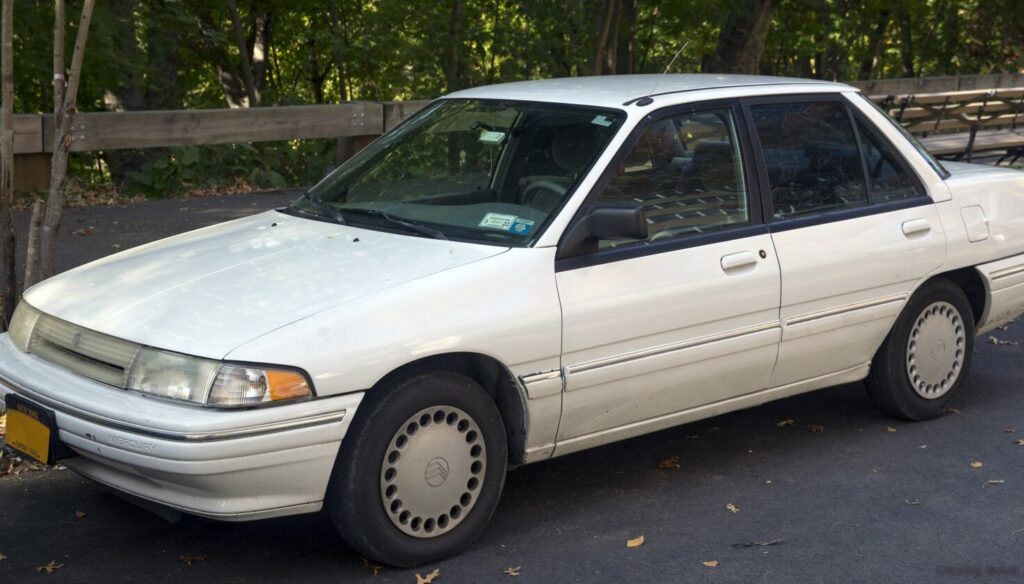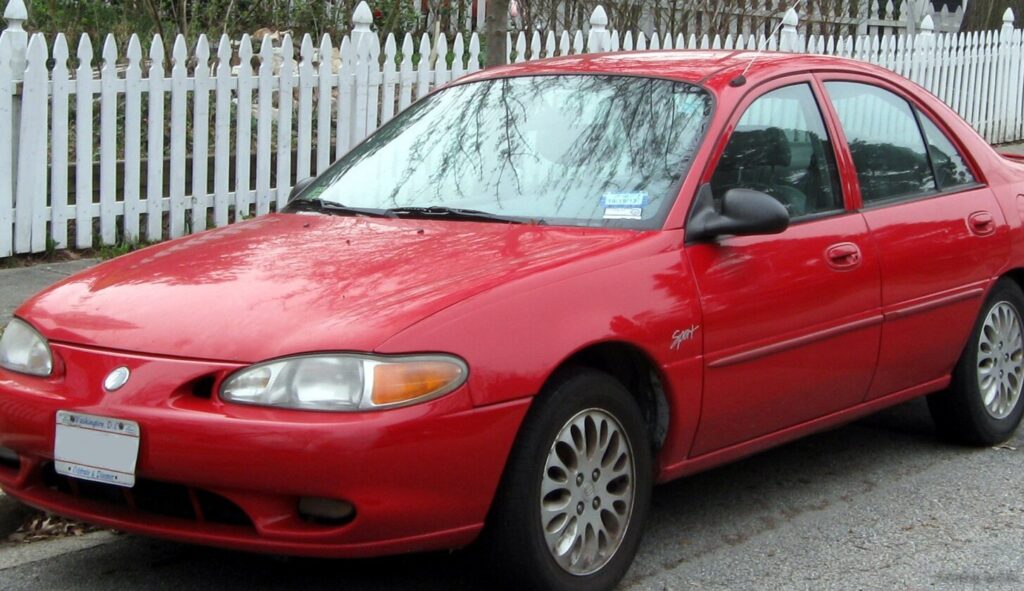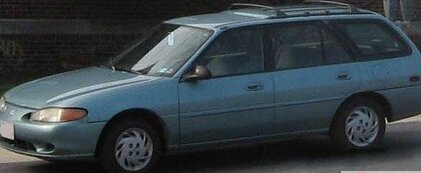
The Mercury Tracer Station Wagon, specifically the 1.9-liter (88 hp) variant, was produced from 1988 to 1997. This model represented Mercury’s entry into the compact station wagon market, offering a practical and affordable option for families. It was based on the Ford Escort platform, sharing many components and mechanicals. The Tracer occupied a middle ground within the Mercury lineup, positioned as a more upscale alternative to the Ford Escort wagon, but below the larger Sable and Villager models. This particular 1.9L engine and 5-speed manual transmission combination was a mainstay of the Tracer lineup for several years, offering a balance of fuel economy and usability.
Technical Specifications
| Brand | Mercury |
| Model | Tracer |
| Generation | Tracer Station Wagon |
| Type (Engine) | 1.9 (88 Hp) |
| Start of production | 1988 |
| End of production | 1997 |
| Powertrain Architecture | Internal Combustion engine |
| Body type | Station wagon (estate) |
| Seats | 5 |
| Doors | 5 |
| Fuel Type | Petrol (Gasoline) |
| Maximum speed | 170 km/h (105.63 mph) |
| Weight-to-power ratio | 12.7 kg/Hp, 78.6 Hp/tonne |
| Weight-to-torque ratio | 7.7 kg/Nm, 130.4 Nm/tonne |
| Power | 88 Hp @ 4400 rpm |
| Power per litre | 47.3 Hp/l |
| Torque | 146 Nm @ 3800 rpm (107.68 lb.-ft. @ 3800 rpm) |
| Engine layout | Front, Transverse |
| Engine displacement | 1859 cm3 (113.44 cu. in.) |
| Number of cylinders | 4 |
| Engine configuration | Inline |
| Cylinder Bore | 82 mm (3.23 in.) |
| Piston Stroke | 88 mm (3.46 in.) |
| Compression ratio | 9:1 |
| Number of valves per cylinder | 2 |
| Fuel injection system | Multi-port manifold injection |
| Engine aspiration | Naturally aspirated engine |
| Valvetrain | OHC |
| Engine oil capacity | 3.8 l (4.02 US qt | 3.34 UK qt) |
| Coolant | 6 l (6.34 US qt | 5.28 UK qt) |
| Kerb Weight | 1120 kg (2469.18 lbs.) |
| Trunk (boot) space – minimum | 865 l (30.55 cu. ft.) |
| Fuel tank capacity | 48 l (12.68 US gal | 10.56 UK gal) |
| Length | 4352 mm (171.34 in.) |
| Width | 1695 mm (66.73 in.) |
| Height | 1361 mm (53.58 in.) |
| Wheelbase | 2500 mm (98.43 in.) |
| Front track | 1435 mm (56.5 in.) |
| Rear (Back) track | 1435 mm (56.5 in.) |
| Drivetrain Architecture | The Internal combustion engine (ICE) drives the front wheels of the vehicle. |
| Drive wheel | Front wheel drive |
| Number of gears and type of gearbox | 5 gears, manual transmission |
| Front suspension | Wishbone |
| Rear suspension | Spring Strut |
| Front brakes | Ventilated discs |
| Rear brakes | Drum |
| Assisting systems | ABS (Anti-lock braking system) |
| Steering type | Steering rack and pinion |
| Power steering | Hydraulic Steering |
| Tires size | 175/65 R14 |
Powertrain & Engine Architecture
The 1.9-liter inline-four engine, often identified by engine codes like those found in related Ford Escort models, was a relatively simple and robust design. It featured a single overhead camshaft (OHC) operating two valves per cylinder. The multi-port fuel injection system, a common feature for the time, helped improve fuel efficiency and throttle response compared to earlier carbureted designs. The engine’s 9:1 compression ratio was a compromise between performance and the ability to run on readily available gasoline grades. The 5-speed manual transmission was a standard offering, providing drivers with good control over the engine’s power band. This transmission was known for its durability and relatively smooth shifting.
Driving Characteristics
The 88 horsepower output of the 1.9-liter engine in the Tracer Station Wagon translated to adequate, but not exhilarating, performance. Acceleration was modest, with a 0-60 mph time estimated around 11-12 seconds. The engine felt most comfortable in the mid-range, providing sufficient power for everyday driving and highway cruising. The 5-speed manual transmission allowed drivers to keep the engine in its optimal power band, improving responsiveness. Compared to the later, more powerful 2.0-liter engines offered in the Tracer, this 1.9L version prioritized fuel economy and ease of driving over outright performance. The gear ratios were tuned for efficiency, rather than rapid acceleration.
Equipment & Trim Levels
The 1.9-liter Tracer Station Wagon typically came with a fairly basic level of standard equipment. This included features like cloth upholstery, a basic AM/FM radio, and manual windows and locks. Air conditioning was often an optional extra. Higher trim levels, if selected, could add features like upgraded sound systems, power windows and locks, and a sunroof. Interior color schemes were generally conservative, with options typically limited to shades of gray or blue. The dashboard layout was functional and straightforward, prioritizing usability over aesthetics.
Chassis & Braking
The Tracer Station Wagon utilized a front-wheel-drive chassis with independent front suspension (wishbone) and a semi-independent rear suspension (spring strut). This setup provided a reasonable balance of ride comfort and handling. The front brakes were ventilated discs, offering good stopping power, while the rear brakes were drums, a cost-saving measure common in this class of vehicle. Anti-lock braking system (ABS) was available as an option, enhancing safety. Steering was provided by a hydraulic power steering system, making the vehicle easy to maneuver at low speeds.
Market Reception & Comparison
The Mercury Tracer Station Wagon, particularly the 1.9-liter variant, was generally well-received as a practical and affordable family vehicle. Critics praised its spacious interior, good fuel economy, and relatively comfortable ride. However, some reviewers noted its lack of power and somewhat bland styling. Compared to other compact wagons of the time, such as the Toyota Corolla Wagon or the Honda Civic Wagon, the Tracer offered a competitive price point and a larger cargo area. The 1.9L engine offered better fuel economy than the larger 2.0L options, making it a popular choice for budget-conscious buyers.
Legacy
The Mercury Tracer Station Wagon, while not a particularly iconic vehicle, served as a reliable and practical option for many families in the 1990s. The 1.9-liter engine and 5-speed manual transmission proved to be durable and relatively trouble-free. Today, these vehicles are relatively rare, but well-maintained examples can still be found. They are often sought after by enthusiasts looking for a simple, affordable, and easy-to-repair classic car. Parts availability can be a challenge, but many components are interchangeable with those from the Ford Escort. The Tracer’s legacy lies in its practicality and affordability, representing a solid, if unspectacular, entry in the compact station wagon segment.