
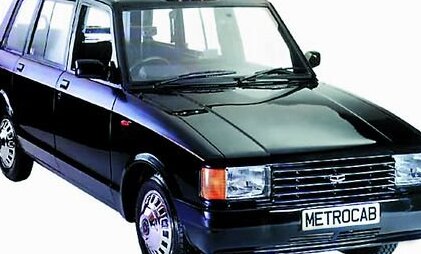
The Metrocab Taxi TTT 2.5 D (75 hp) Automatic, produced between 1991 and 2000, represents a significant chapter in the history of London’s iconic black cabs. This variant, powered by a 2.5-liter diesel engine paired with a four-speed automatic transmission, was designed specifically for the demanding requirements of professional taxi operation. It was built upon the TTT platform, a dedicated design for purpose-built taxis, and served as a workhorse for urban transportation during its production run. The TTT aimed to modernize the traditional London cab while retaining its core functionality and spacious interior.
Technical Specifications
| Brand | Metrocab |
| Model | Taxi |
| Generation | Taxi TTT |
| Type (Engine) | 2.5 D (75 Hp) Automatic |
| Start of production | 1991 |
| End of production | 2000 |
| Powertrain Architecture | Internal Combustion engine |
| Body type | Hatchback |
| Seats | 5 |
| Doors | 4 |
| Fuel Type | Diesel |
| Maximum speed | 125 km/h (77.67 mph) |
| Weight-to-power ratio | 23.5 kg/Hp, 42.5 Hp/tonne |
| Weight-to-torque ratio | 10.5 kg/Nm, 95.2 Nm/tonne |
| Power | 75 Hp @ 4000 rpm |
| Power per litre | 30 Hp/l |
| Torque | 168 Nm @ 2500 rpm (123.91 lb.-ft. @ 2500 rpm) |
| Engine layout | Front, Longitudinal |
| Engine displacement | 2496 cm3 (152.32 cu. in.) |
| Number of cylinders | 4 |
| Engine configuration | Inline |
| Cylinder Bore | 93.7 mm (3.69 in.) |
| Piston Stroke | 90.5 mm (3.56 in.) |
| Compression ratio | 20.6:1 |
| Number of valves per cylinder | 2 |
| Fuel injection system | Precombustion chamber injection |
| Engine aspiration | Naturally aspirated engine |
| Kerb Weight | 1765 kg (3891.16 lbs.) |
| Max. weight | 2220 kg (4894.26 lbs.) |
| Max load | 455 kg (1003.1 lbs.) |
| Fuel tank capacity | 64 l (16.91 US gal | 14.08 UK gal) |
| Length | 4505 mm (177.36 in.) |
| Width | 1760 mm (69.29 in.) |
| Height | 1750 mm (68.9 in.) |
| Wheelbase | 2900 mm (114.17 in.) |
| Front track | 1420 mm (55.91 in.) |
| Rear (Back) track | 1470 mm (57.87 in.) |
| Minimum turning circle | 8.5 m (27.89 ft.) |
| Drivetrain Architecture | The Internal combustion engine (ICE) drives the rear wheels of the vehicle. |
| Drive wheel | Rear wheel drive |
| Number of gears and type of gearbox | 4 gears, automatic transmission |
| Front suspension | Coil spring |
| Rear suspension | Leaf spring |
| Front brakes | Disc |
| Rear brakes | Drum |
| Assisting systems | ABS (Anti-lock braking system) |
| Tires size | 175/80 R16 |
| Wheel rims size | 5J x 16 |
Powertrain & Engine Architecture
The heart of the Metrocab TTT 2.5 D Automatic is a 2.5-liter inline-four cylinder diesel engine. This engine, while relatively modest in output at 75 horsepower, was engineered for durability and low-end torque – crucial characteristics for a vehicle subjected to constant stop-and-go driving. The engine utilized a precombustion chamber injection system, a common diesel technology of the era, which improved combustion efficiency and reduced engine noise compared to direct injection systems. The four-speed automatic transmission was selected for ease of use, particularly appealing to drivers unfamiliar with manual gearboxes. The longitudinal engine placement, coupled with rear-wheel drive, was a traditional layout for taxis, offering a balance of stability and maneuverability.
Driving Characteristics
The 75 hp output and automatic transmission resulted in a driving experience focused on practicality rather than performance. Acceleration was deliberately unhurried, prioritizing smooth operation and fuel efficiency. The automatic gearbox, while convenient, lacked the responsiveness of a manual transmission, and gear changes were noticeable. The rear-wheel drive configuration provided decent handling, but the vehicle’s high center of gravity and substantial weight limited cornering ability. Compared to potential higher-output diesel variants (which were not commonly offered in the Metrocab), this version prioritized fuel economy and reduced stress on the drivetrain, making it ideal for high-mileage taxi work.
Equipment & Trim Levels
The Metrocab TTT 2.5 D Automatic was not offered with extensive trim levels. Its design was fundamentally utilitarian. Standard features included basic cloth upholstery, a simple dashboard layout with essential gauges, and a large passenger compartment designed to accommodate multiple passengers and luggage. Air conditioning was often an optional extra, as were power windows and central locking. The focus was on providing a functional and durable vehicle, rather than luxurious amenities. The interior was designed for easy cleaning and maintenance, essential for a vehicle in constant public use.
Chassis & Braking
The Metrocab TTT featured a robust chassis designed to withstand the rigors of taxi service. Front suspension utilized coil springs, while the rear employed a traditional leaf spring setup, chosen for its durability and load-carrying capacity. Braking was accomplished via disc brakes on the front wheels and drum brakes on the rear. An Anti-lock Braking System (ABS) was included as a safety feature, improving braking performance in slippery conditions. The relatively narrow 175/80 R16 tires were selected for a balance of ride comfort and fuel efficiency.
Market Reception & Comparison
The Metrocab TTT 2.5 D Automatic was generally well-received by taxi operators in London and other cities. Critics praised its spacious interior, durability, and relatively low running costs. However, the engine’s modest power output and the automatic transmission’s lack of responsiveness were points of criticism. Compared to other vehicles used as taxis during the period, such as the Austin FX4, the Metrocab offered a more modern design and improved fuel economy. However, the FX4 retained a strong following due to its iconic status and perceived reliability. The 2.5 D Automatic variant represented a compromise between performance and economy, appealing to operators prioritizing fuel efficiency and ease of use.
Legacy
The Metrocab TTT 2.5 D Automatic played a significant role in modernizing London’s taxi fleet. While it has since been superseded by newer models, including those with more powerful engines and advanced technologies, the TTT remains a recognizable sight on the streets of London. The 2.5-liter diesel engine and automatic transmission combination proved to be reasonably reliable, with many examples remaining in service for extended periods. In the used car market, these Metrocabs are sought after by enthusiasts and collectors, representing a unique piece of British automotive history. The TTT’s design principles – spaciousness, durability, and practicality – continue to influence the design of modern London taxis.

