
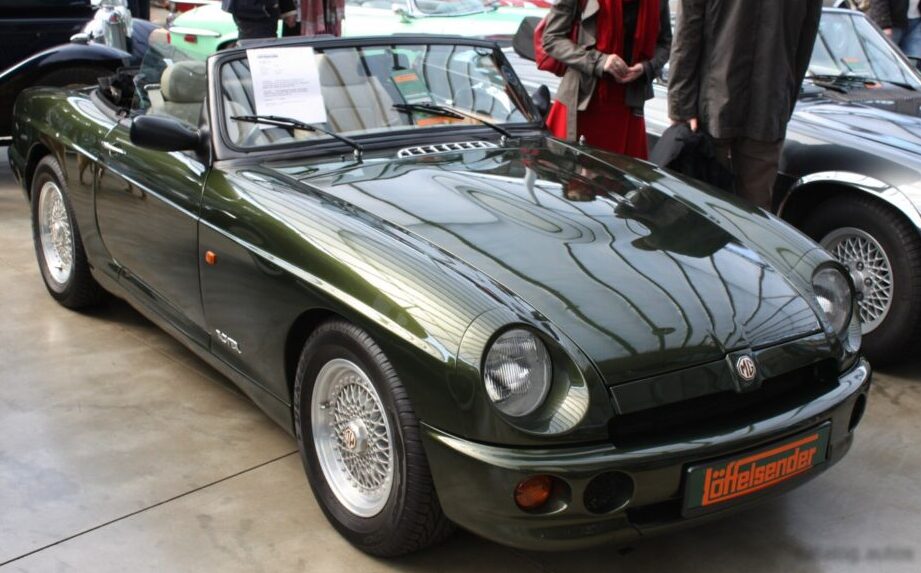
The MG MGR V8 3.9 i, produced between 1992 and 1995, was a significant undertaking by British Leyland (later Rover Group) to recapture the essence of classic MG sports cars. This rear-wheel-drive, V8-powered roadster enjoyed a limited production run and was positioned as a premium offering within the MG range. Constructed on a shortened Rover 800 platform, it aimed to blend traditional British motoring with contemporary engineering. The MGR V8 was primarily sold in the United Kingdom and Europe, representing a niche product in a market increasingly dominated by Japanese and German sports cars.
Technical Specifications
| Brand | MG |
| Model | MGR |
| Generation | MGR V8 |
| Type (Engine) | 3.9 i V8 (190 Hp) |
| Start of production | 1992 |
| End of production | 1995 |
| Powertrain Architecture | Internal Combustion engine |
| Body type | Cabriolet |
| Seats | 4 |
| Doors | 2 |
| Fuel consumption (urban) | 14 l/100 km (16.8 US mpg) |
| Fuel consumption (extra urban) | 9 l/100 km (26.1 US mpg) |
| Fuel Type | Petrol (Gasoline) |
| Acceleration 0 – 100 km/h | 6 sec |
| Acceleration 0 – 62 mph | 6 sec |
| Acceleration 0 – 60 mph | 5.7 sec |
| Maximum speed | 217 km/h (134.84 mph) |
| Weight-to-power ratio | 5.8 kg/Hp |
| Weight-to-torque ratio | 3.5 kg/Nm |
| Power | 190 Hp @ 4750 rpm |
| Torque | 318 Nm @ 3200 rpm (234.54 lb.-ft. @ 3200 rpm) |
| Engine displacement | 3947 cm3 (240.86 cu. in.) |
| Number of cylinders | 8 |
| Engine configuration | V-engine |
| Cylinder Bore | 94 mm (3.7 in.) |
| Piston Stroke | 71.12 mm (2.8 in.) |
| Compression ratio | 9.35:1 |
| Number of valves per cylinder | 2 |
| Fuel injection system | Multi-port manifold injection |
| Engine aspiration | Naturally aspirated engine |
| Kerb Weight | 1100 kg (2425.08 lbs.) |
| Max. weight | 1280 kg (2821.92 lbs.) |
| Max load | 180 kg (396.83 lbs.) |
| Trunk (boot) space – minimum | 250 l (8.83 cu. ft.) |
| Fuel tank capacity | 51 l (13.47 US gal | 11.22 UK gal) |
| Length | 4010 mm (157.87 in.) |
| Width | 1690 mm (66.54 in.) |
| Height | 1320 mm (51.97 in.) |
| Wheelbase | 2330 mm (91.73 in.) |
| Front track | 1260 mm (49.61 in.) |
| Rear (Back) track | 1330 mm (52.36 in.) |
| Number of gears and type of gearbox | 5 gears, manual transmission |
| Front suspension | Coil spring |
| Rear suspension | Coil spring |
| Front brakes | Ventilated discs |
| Rear brakes | Disc |
| Assisting systems | ABS (Anti-lock braking system) |
| Power steering | Hydraulic Steering |
| Tires size | 205/65 R15 |
Powertrain & Engine Architecture
The MGR V8’s defining feature was the Rover V8 engine, a 3.9-liter naturally aspirated powerplant generating 190 horsepower and 234.54 lb-ft of torque. This engine was a descendant of the original Buick-Oldsmobile-Rover V8 design from the 1960s, having undergone substantial revisions over the decades. The 3.9-liter iteration incorporated multi-port fuel injection and a relatively high 9.35:1 compression ratio. The engine’s architecture was a 90-degree V8, renowned for its inherent smoothness and balance. A five-speed manual transmission was the sole gearbox option, delivering power directly to the rear wheels. This transmission, sourced from Rover, was specifically chosen to complement the V8’s power delivery characteristics.
Driving Characteristics
The MGR V8 offered a markedly different driving experience compared to its four-cylinder MG counterparts. The V8 provided abundant torque across the rev range, making it a comfortable cruiser and a capable performer. Acceleration to 60 mph was achievable in approximately 5.7 seconds, a respectable figure for the early 1990s. The rear-wheel-drive configuration contributed to a balanced feel, although the car’s weight (around 2425 lbs) was noticeable during cornering. The five-speed manual transmission allowed drivers to fully utilize the engine’s power, while the hydraulic power steering provided a direct connection to the road. While an automatic transmission was technically feasible, it wasn’t widely offered, and the manual gearbox significantly enhanced the driving experience, offering greater control and engagement.
Equipment & Trim Levels
The MGR V8 was positioned as the flagship MG model, and consequently, came generously equipped. Standard features included leather upholstery, power windows, central locking, and an upgraded audio system. The interior was generally well-appointed, though it retained some of the functional aspects of the underlying Rover 800 platform. Optional extras encompassed a sunroof, enhanced audio systems, and bespoke paint colors. The trim level was largely standardized, prioritizing a luxurious and sporty ambiance. The interior design blended classic British styling cues with modern conveniences.
Chassis & Braking
The MGR V8’s chassis was derived from a shortened version of the Rover 800 platform, featuring independent suspension on all four wheels with coil springs. The front suspension utilized MacPherson struts, while the rear employed a semi-trailing arm setup. Braking duties were handled by ventilated discs at the front and solid discs at the rear, with ABS (Anti-lock Braking System) included as standard. The suspension was tuned to deliver a comfortable ride while maintaining reasonable handling capabilities. The car’s weight distribution was relatively balanced, contributing to its overall stability.
Market Reception & Comparison
The MG MGR V8 received a mixed reception from automotive critics. While the V8 engine and rear-wheel-drive layout were lauded, the car’s weight and somewhat dated platform drew criticism. Compared to its siblings, such as the MG RV8 (which shared the same V8 engine but featured a different body style), the MGR V8 offered a more refined and luxurious experience. Fuel economy was relatively poor, averaging around 16.8 US mpg in city driving and 26.1 US mpg on the highway. Reliability was generally good, although the V8 engine could be susceptible to overheating if not properly maintained. The MGR V8 competed with vehicles like the Mazda MX-5 and the BMW Z3, but it lacked the brand recognition and sporting heritage of its rivals.
Legacy
The MG MGR V8 was a short-lived model, but it remains a cherished vehicle among enthusiasts. The V8 engine is known for its durability and potential for tuning, and many examples are still in operation today. The car’s rarity and unique character have made it a sought-after collectible. Although the MGR V8 didn’t achieve substantial sales success, it represented a bold attempt by MG to revive its sporting legacy. In the used car market, well-maintained examples command a premium, appealing to collectors and enthusiasts seeking a classic British roadster with a potent V8 engine. The powertrain, while requiring consistent maintenance, is generally considered robust and capable of providing years of dependable service.
