
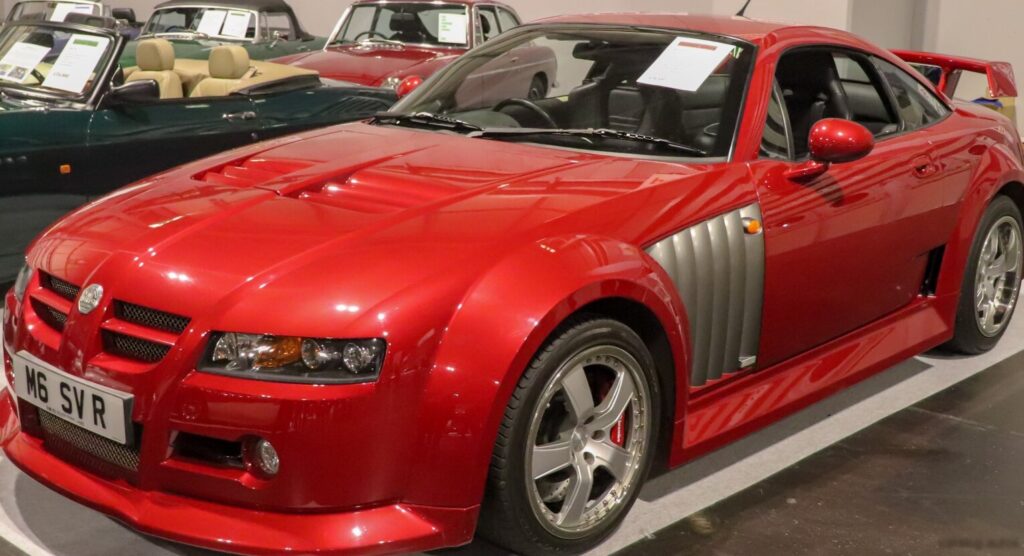
The MG Xpower SV 4.6i V8 32V, produced between 2003 and 2005, represents a unique and somewhat controversial chapter in the history of the British MG marque. Revived under the ownership of the MG Rover Group (and later Nanjing Automobile), the Xpower SV was intended as a halo car – a high-performance coupe designed to re-establish MG’s sporting credentials. Built in limited numbers, the 4.6i V8 variant was the flagship model, offering a substantial leap in performance over the earlier 2.5-liter V6 versions. The Xpower SV was based on the De Tomaso Mangusta platform, acquired after the Italian firm went bankrupt, and while it aimed for the prestige market, its production coincided with the financial difficulties of MG Rover, ultimately contributing to the brand’s demise.
Technical Specifications
| Brand | MG |
| Model | Xpower SV |
| Generation | Xpower SV |
| Type (Engine) | 4.6 i V8 32V (320 Hp) |
| Start of production | 2003 |
| End of production | 2005 |
| Powertrain Architecture | Internal Combustion engine |
| Body type | Coupe |
| Seats | 2 |
| Doors | 2 |
| Fuel consumption (urban) | 16 l/100 km (14.7 US mpg) |
| Fuel consumption (extra urban) | 11 l/100 km (21.4 US mpg) |
| Fuel Type | Petrol (Gasoline) |
| Acceleration 0 – 100 km/h | 5.4 sec |
| Acceleration 0 – 62 mph | 5.4 sec |
| Acceleration 0 – 60 mph | 5.1 sec |
| Maximum speed | 254 km/h (157.83 mph) |
| Weight-to-power ratio | 4.8 kg/Hp |
| Weight-to-torque ratio | 3.8 kg/Nm |
| Power | 320 Hp @ 6000 rpm |
| Power per litre | 69.6 Hp/l |
| Torque | 410 Nm @ 4750 rpm (302.4 lb.-ft. @ 4750 rpm) |
| Engine layout | Front, Longitudinal |
| Engine displacement | 4600 cm3 (280.71 cu. in.) |
| Number of cylinders | 8 |
| Engine configuration | V-engine |
| Cylinder Bore | 90.2 mm (3.55 in.) |
| Piston Stroke | 90 mm (3.54 in.) |
| Compression ratio | 10:1 |
| Number of valves per cylinder | 4 |
| Fuel injection system | Multi-port manifold injection |
| Engine aspiration | Naturally aspirated engine |
| Valvetrain | DOHC |
| Kerb Weight | 1540 kg (3395.12 lbs.) |
| Trunk (boot) space | 250 l (8.83 cu. ft.) |
| Fuel tank capacity | 80 l (21.13 US gal) |
| Length | 4480 mm (176.38 in.) |
| Width | 1900 mm (74.8 in.) |
| Height | 1320 mm (51.97 in.) |
| Wheelbase | 2670 mm (105.12 in.) |
| Front track | 1678 mm (66.06 in.) |
| Rear track | 1626 mm (64.02 in.) |
| Drivetrain Architecture | Internal Combustion engine (ICE) – Front Wheel Drive |
| Drive wheel | Front wheel drive |
| Number of gears | 5 gears, manual transmission |
| Front suspension | Double wishbone |
| Rear suspension | Double wishbone |
| Front brakes | Ventilated discs |
| Rear brakes | Ventilated discs |
| Assisting systems | ABS (Anti-lock braking system) |
| Steering type | Steering rack and pinion |
| Power steering | Hydraulic Steering |
| Tires size | 225/40 ZR18; 265/40 ZR18 |
| Wheel rims size | 8JX18; 10JX18 |
Powertrain & Engine Architecture
The heart of the Xpower SV 4.6i is a 4.6-liter (4600 cc) naturally aspirated V8 engine. This engine, sourced from Ford, is based on the modular engine family and features a 90-degree V-angle. It’s equipped with a dual overhead camshaft (DOHC) valvetrain with four valves per cylinder, and utilizes multi-port fuel injection. The engine produces 320 horsepower at 6000 rpm and 410 Nm (302.4 lb-ft) of torque at 4750 rpm. The engine’s longitudinal mounting and front-wheel drive configuration were unusual for a V8-powered sports car, a consequence of the underlying De Tomaso Mangusta chassis. The transmission is a five-speed manual gearbox, providing the only transmission option for this model.
Driving Characteristics
The Xpower SV 4.6i delivers a distinctly raw and engaging driving experience. The V8 engine provides strong acceleration, achieving 0-60 mph in approximately 5.1 seconds and a top speed of 157.83 mph. However, the front-wheel drive layout, combined with the engine’s substantial torque, can lead to torque steer, particularly during hard acceleration. The chassis, while offering decent handling, doesn’t quite match the refinement of contemporary sports cars. The suspension, utilizing double wishbones at both the front and rear, provides a firm ride, prioritizing handling over comfort. The five-speed manual gearbox offers a direct and engaging shift feel, though the gear ratios are spaced to favor acceleration rather than fuel economy.
Equipment & Trim Levels
The Xpower SV 4.6i was relatively well-equipped, though the interior quality was often criticized as being somewhat dated and lacking the premium feel expected in a car of this price point. Standard features included leather upholstery, air conditioning, power windows and locks, and an aftermarket stereo system. Optional extras included upgraded audio systems, satellite navigation, and various cosmetic enhancements. The interior design was minimalist, focusing on functionality rather than luxury. The car featured a two-seat configuration, emphasizing its sporting intent.
Chassis & Braking
The Xpower SV utilizes a steel spaceframe chassis derived from the De Tomaso Mangusta. The suspension consists of independent double wishbones at both the front and rear, with coil springs and anti-roll bars. Braking is provided by ventilated discs on all four wheels, assisted by an Anti-lock Braking System (ABS). The steering is a rack and pinion system with hydraulic power assistance. The car rides on 18-inch alloy wheels, with 225/40 ZR18 tires at the front and 265/40 ZR18 tires at the rear.
Market Reception & Comparison
The MG Xpower SV received a mixed reception from automotive critics. While the V8 engine and performance were generally praised, the car was often criticized for its dated interior, torque steer, and somewhat unrefined handling. Compared to its rivals, such as the Porsche 911 and BMW M3, the Xpower SV offered a more raw and visceral driving experience, but lacked the overall sophistication and build quality. Fuel economy was also relatively poor, with combined fuel consumption of around 13.5 mpg. The car’s limited production run and the financial instability of MG Rover further hampered its market success.
Legacy
The MG Xpower SV 4.6i remains a relatively rare and unusual car. Its limited production numbers and the demise of MG Rover have made it a sought-after vehicle among collectors and enthusiasts. While the car is not without its flaws, it represents a bold attempt to revive the MG brand’s sporting heritage. The powertrain, while not particularly fuel-efficient, has proven to be reasonably reliable, provided it is properly maintained. Today, the Xpower SV is viewed as a flawed but fascinating piece of automotive history, a testament to the ambition and ultimately, the challenges faced by MG Rover in the early 2000s. Finding parts can be challenging, relying on Ford components and specialist suppliers.
