
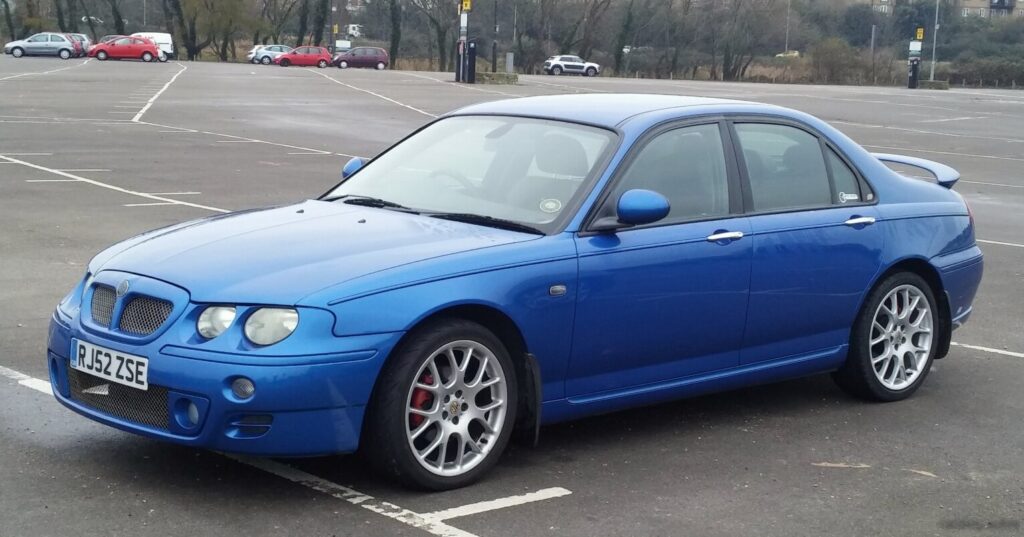
The MG ZT 2.5 i V6 24V, produced between 2001 and 2005, represents a somewhat unexpected chapter in the history of the British marque. Built under BMW ownership (following their acquisition of Rover in 1994), the ZT was essentially a heavily revised Rover 75, aimed at injecting some sporting character into the traditionally conservative Rover lineup. The 2.5-liter V6 variant, producing 190 horsepower, occupied a mid-range position within the ZT family, offering a balance between performance and relative affordability. It was positioned above the four-cylinder models and below the high-performance 3.8-liter V8 option, appealing to buyers seeking a more refined and powerful driving experience than the base models could provide.
Technical Specifications
| Brand | MG |
| Model | ZT |
| Generation | ZT |
| Type (Engine) | 2.5 i V6 24V (190 Hp) |
| Start of production | 2001 |
| End of production | 2005 |
| Powertrain Architecture | Internal Combustion engine |
| Body type | Sedan |
| Seats | 5 |
| Doors | 4 |
| Fuel consumption (urban) | 14.3 l/100 km (16.4 US mpg) |
| Fuel consumption (extra urban) | 7.3 l/100 km (32.2 US mpg) |
| Fuel Type | Petrol (Gasoline) |
| Acceleration 0 – 100 km/h | 8.3 sec |
| Acceleration 0 – 62 mph | 8.3 sec |
| Acceleration 0 – 60 mph | 7.9 sec |
| Maximum speed | 227 km/h (141.05 mph) |
| Weight-to-power ratio | 7.8 kg/Hp |
| Weight-to-torque ratio | 6.1 kg/Nm |
| Power | 190 Hp @ 6500 rpm |
| Power per litre | 76.1 Hp/l |
| Torque | 245 Nm @ 4000 rpm (180.7 lb.-ft. @ 4000 rpm) |
| Engine layout | Front, Transverse |
| Engine Model/Code | 25K4F |
| Engine displacement | 2497 cm3 (152.38 cu. in.) |
| Number of cylinders | 6 |
| Engine configuration | V-engine |
| Cylinder Bore | 80 mm (3.15 in.) |
| Piston Stroke | 82.8 mm (3.26 in.) |
| Compression ratio | 10.5:1 |
| Number of valves per cylinder | 4 |
| Fuel injection system | Multi-port manifold injection |
| Engine aspiration | Naturally aspirated engine |
| Engine oil capacity | 5.2 l (5.49 US qt | 4.58 UK qt) |
| Coolant | 7.5 l (7.93 US qt | 6.6 UK qt) |
| Kerb Weight | 1485 kg (3273.86 lbs.) |
| Max. weight | 2000 kg (4409.25 lbs.) |
| Max load | 515 kg (1135.38 lbs.) |
| Trunk (boot) space – minimum | 432 l (15.26 cu. ft.) |
| Fuel tank capacity | 65 l (17.17 US gal | 14.3 UK gal) |
| Length | 4740 mm (186.61 in.) |
| Width | 1780 mm (70.08 in.) |
| Height | 1410 mm (55.51 in.) |
| Wheelbase | 2746 mm (108.11 in.) |
| Front track | 1505 mm (59.25 in.) |
| Rear (Back) track | 1505 mm (59.25 in.) |
| Drivetrain Architecture | The Internal combustion engine (ICE) drives the front wheels of the vehicle. |
| Drive wheel | Front wheel drive |
| Number of gears and type of gearbox | 5 gears, manual transmission |
| Front suspension | Spring Strut |
| Rear suspension | Coil spring |
| Front brakes | Ventilated discs |
| Rear brakes | Disc |
| Assisting systems | ABS (Anti-lock braking system) |
| Steering type | Steering rack and pinion |
| Power steering | Hydraulic Steering |
| Tires size | 225/45 R18 |
Powertrain & Engine Architecture
The heart of the ZT 2.5 i is the 2.5-liter KV6 engine, a 60-degree V6 designed and built by Rover’s Powertrain division. The ‘K’ series engine family was well-regarded, and the KV6 represented a significant evolution, adding two cylinders and a more sophisticated engine management system. The 25K4F engine code designates this specific 190 horsepower variant. It utilizes multi-port fuel injection and a relatively high 10.5:1 compression ratio. The engine’s valvetrain features four valves per cylinder, contributing to its respectable power output. The ZT 2.5 i was typically equipped with a five-speed manual transmission, although an automatic option was also available. The automatic transmission, a Jatco unit, was known for its smooth operation but wasn’t particularly sporty or fuel-efficient compared to the manual.
Driving Characteristics
The 2.5-liter V6 in the ZT provided a noticeable step up in performance compared to the four-cylinder options. Acceleration to 60 mph took around 7.9 seconds, making it a reasonably quick car for its time. The engine delivered a smooth and refined power delivery, with peak torque arriving at 4000 rpm. While not a particularly high-revving engine, it offered sufficient power for comfortable cruising and overtaking. The automatic transmission, while convenient, did detract somewhat from the driving experience. Gear changes weren’t as crisp or responsive as those of the manual gearbox, and the overall feel was more geared towards comfort than outright performance. The front-wheel-drive layout, while common for cars in this class, meant that traction could be a limitation under hard acceleration.
Equipment & Trim Levels
The ZT 2.5 i typically came with a fairly generous level of standard equipment. This included air conditioning, power steering, electric windows, central locking, and an RDS stereo. Higher trim levels, such as the SE, added features like leather upholstery, alloy wheels, and a sunroof. Optional extras included satellite navigation, heated seats, and upgraded audio systems. Interior appointments were generally well-made, reflecting the Rover’s commitment to comfort and refinement. The dashboard layout was functional and easy to use, although some materials felt a little dated even at the time of production.
Chassis & Braking
The ZT utilized a MacPherson strut front suspension and a coil spring rear suspension. The suspension was tuned to provide a balance between comfort and handling. The ZT 2.5 i featured ventilated disc brakes at the front and solid discs at the rear. Anti-lock braking system (ABS) was standard. The steering was a hydraulic rack and pinion system, providing a reasonably direct and responsive feel. The car rode on 225/45 R18 tires, which offered good grip in most conditions.
Market Reception & Comparison
The MG ZT 2.5 i was generally well-received by automotive critics, who praised its comfortable ride, refined engine, and spacious interior. However, it was also criticized for its somewhat bland styling and its lack of a truly sporty driving experience. Compared to the four-cylinder ZT models, the 2.5 i offered a significant performance upgrade, but it came at a higher price. The V8-powered ZT 260 provided even more performance, but was considerably more expensive and less fuel-efficient. Fuel economy for the 2.5 i was reasonable for a V6 engine of its size, averaging around 19.8 mpg in the UK and 16.4 mpg in the US for urban driving.
Legacy
The MG ZT, and the 2.5 i variant specifically, represents a fascinating footnote in automotive history. It was a product of a transitional period for MG and Rover, caught between BMW ownership and eventual collapse. While the ZT didn’t achieve significant sales success, it has gained a loyal following among enthusiasts who appreciate its unique blend of British style, German engineering, and V6 power. The KV6 engine, while not without its quirks, is generally considered to be a reliable unit when properly maintained. Today, well-maintained ZT 2.5 i models are becoming increasingly collectible, offering a relatively affordable way to experience a unique and characterful British sports sedan. Parts availability can be a challenge, but a dedicated community of owners and specialists helps to keep these cars on the road.
