
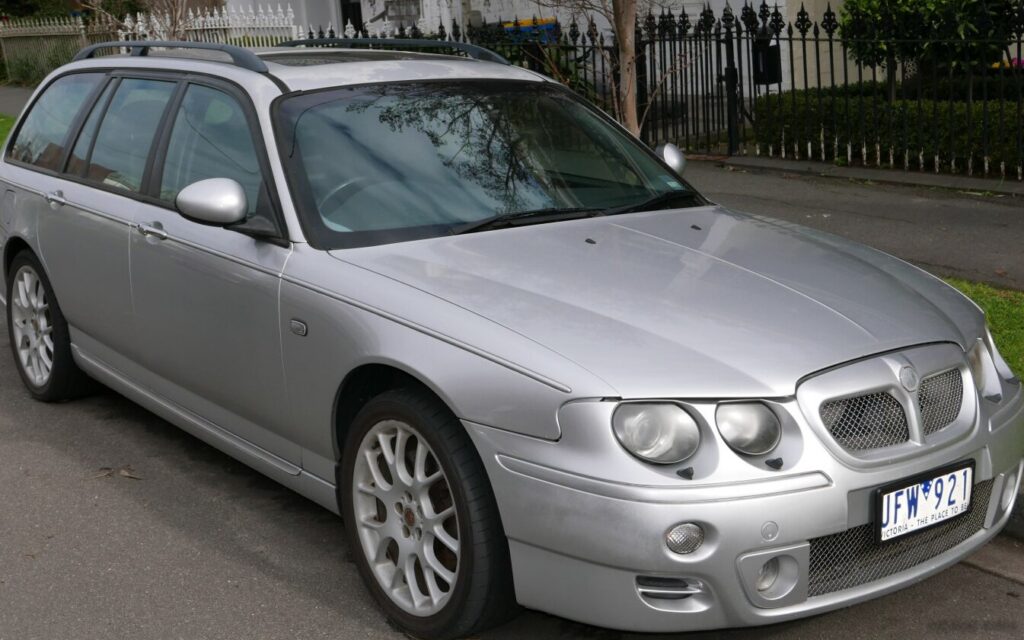
Technical Specifications
| Brand | MG |
| Model | ZT-T |
| Generation | ZT-T |
| Type (Engine) | 2.5 i V6 24V (160 Hp) |
| Start of production | 2002 |
| End of production | 2003 |
| Powertrain Architecture | Internal Combustion engine |
| Body type | Station wagon (estate) |
| Seats | 5 |
| Doors | 5 |
| Fuel consumption (urban) | 13.9 l/100 km (16.9 US mpg, 20.3 UK mpg, 7.2 km/l) |
| Fuel consumption (extra urban) | 7.1 l/100 km (33.1 US mpg, 39.8 UK mpg, 14.1 km/l) |
| Fuel consumption (combined) | 9.6 l/100 km (24.5 US mpg, 29.4 UK mpg, 10.4 km/l) |
| Fuel Type | Petrol (Gasoline) |
| Acceleration 0 – 100 km/h | 9.3 sec |
| Acceleration 0 – 62 mph | 9.3 sec |
| Acceleration 0 – 60 mph | 8.8 sec |
| Maximum speed | 211 km/h (131.11 mph) |
| Weight-to-power ratio | 9.6 kg/Hp, 103.9 Hp/tonne |
| Weight-to-torque ratio | 6.7 kg/Nm, 149.4 Nm/tonne |
| Power | 160 Hp @ 6250 rpm |
| Power per litre | 64.1 Hp/l |
| Torque | 230 Nm @ 4000 rpm (169.64 lb.-ft. @ 4000 rpm) |
| Engine layout | Front, Transverse |
| Engine Model/Code | 25K4F |
| Engine displacement | 2497 cm3 (152.38 cu. in.) |
| Number of cylinders | 6 |
| Engine configuration | V-engine |
| Cylinder Bore | 80 mm (3.15 in.) |
| Piston Stroke | 82.8 mm (3.26 in.) |
| Compression ratio | 10.5:1 |
| Number of valves per cylinder | 4 |
| Fuel injection system | Multi-port manifold injection |
| Engine aspiration | Naturally aspirated engine |
| Engine oil capacity | 5.2 l (5.49 US qt | 4.58 UK qt) |
| Coolant capacity | 7.5 l (7.93 US qt | 6.6 UK qt) |
| Kerb Weight | 1540 kg (3395.12 lbs.) |
| Max. weight | 2030 kg (4475.38 lbs.) |
| Max load | 490 kg (1080.27 lbs.) |
| Trunk (boot) space – minimum | 400 l (14.13 cu. ft.) |
| Trunk (boot) space – maximum | 1220 l (43.08 cu. ft.) |
| Fuel tank capacity | 65 l (17.17 US gal | 14.3 UK gal) |
| Length | 4790 mm (188.58 in.) |
| Width | 1780 mm (70.08 in.) |
| Height | 1410 mm (55.51 in.) |
| Wheelbase | 2746 mm (108.11 in.) |
| Front track | 1560 mm (61.42 in.) |
| Rear track | 1610 mm (63.39 in.) |
| Drivetrain Architecture | Front wheel drive |
| Number of gears | 5 |
| Gearbox type | Manual transmission |
| Front suspension | Spring Strut |
| Rear suspension | Coil spring |
| Front brakes | Ventilated discs |
| Rear brakes | Disc |
| Assisting systems | ABS (Anti-lock braking system) |
| Steering type | Steering rack and pinion |
| Power steering | Hydraulic Steering |
| Tires size | 225/45 R18 |
The MG ZT-T 2.5 i V6 24V, produced between 2002 and 2003, was a station wagon (estate) variant of the MG ZT. The ZT itself was a revival of the Rover 75 platform following BMW’s divestment of the Rover Group. Positioned as a more sporting alternative to traditional estates, the ZT-T aimed to blend practicality with MG’s performance heritage. It was built upon the X20 platform, commonly known as the 1HX0/A3 platform, and represented a relatively short production run for the model, reflecting the financial difficulties faced by MG Rover at the time. This particular 2.5-liter V6 variant occupied a mid-range position within the ZT-T lineup, offering a balance between performance and cost, sitting above the 1.8-liter models and below the more potent 3.1-liter V6.
Powertrain & Engine Architecture
The ZT-T 2.5 i V6 utilized the 25K4F engine, a 2.5-liter naturally aspirated V6. This engine was originally developed by Rover and continued in production under MG Rover ownership. It featured a 60-degree V-angle, four valves per cylinder, and multi-point fuel injection. The 25K4F was known for its relatively smooth operation and decent power output for its displacement. The engine’s design prioritized refinement over outright performance, making it well-suited to the ZT-T’s role as a comfortable and practical estate car. The five-speed manual transmission was a standard feature, providing a reasonable spread of gears for both cruising and spirited driving. While an automatic transmission was available on other ZT-T models, the 2.5 V6 was primarily offered with the manual gearbox in the UK market.
Driving Characteristics
The 2.5-liter V6, paired with the five-speed manual transmission, offered a balanced driving experience. Acceleration to 60 mph took approximately 8.8 seconds, and the car had a top speed of 131 mph. While not a sports car, the engine provided sufficient power for overtaking and maintaining comfortable cruising speeds on motorways. The gear ratios were well-chosen, allowing for relaxed highway driving and responsive acceleration in lower gears. Compared to the 1.8-liter four-cylinder models, the V6 offered significantly more torque and a smoother power delivery. However, it lacked the outright punch of the 3.1-liter V6, which was aimed at a more performance-oriented buyer. The front-wheel-drive layout provided predictable handling, although it could exhibit some torque steer under hard acceleration.
Equipment & Trim Levels
The ZT-T 2.5 i V6 typically came equipped with a reasonable level of standard features. These included central locking, electric windows, power steering, an ABS anti-lock braking system, and a basic stereo system. Interior upholstery was generally cloth, although leather options were available. Trim levels varied, but commonly included features like alloy wheels, air conditioning, and a trip computer. Optional extras could include a sunroof, upgraded audio systems, and parking sensors. The dashboard layout was inherited from the Rover 75, offering a relatively conservative and functional design.
Chassis & Braking
The ZT-T utilized a MacPherson strut front suspension and a coil spring rear suspension. This setup provided a comfortable ride quality, although it wasn’t particularly sporty. The front brakes were ventilated discs, while the rear brakes were solid discs. The ABS system provided effective stopping power in most conditions. The car’s weight distribution was slightly front-biased, which contributed to its predictable handling characteristics. Stabilizer bars were fitted to both the front and rear axles to reduce body roll during cornering.
Market Reception & Comparison
The MG ZT-T 2.5 i V6 was generally well-received by automotive critics, who praised its comfortable ride, spacious interior, and decent performance. However, it was often criticized for its somewhat dated design and the financial instability of MG Rover. Compared to other estates in its class, such as the Ford Mondeo Estate and the Vauxhall Vectra Estate, the ZT-T offered a more distinctive and upmarket feel. Fuel economy was reasonable for a V6 engine, averaging around 24.5 mpg in combined driving. Reliability was a concern, as with many MG Rover models, due to the company’s financial difficulties and the use of some components from other manufacturers.
Legacy
The MG ZT-T 2.5 i V6, like all MG Rover models, has become a relatively rare sight on the roads today. The collapse of MG Rover in 2005 led to a decline in parts availability and a gradual attrition of the remaining vehicles. However, a dedicated community of enthusiasts has emerged to preserve and restore these cars. The 25K4F V6 engine is generally considered to be a reliable unit, although regular maintenance is essential. ZT-Ts in good condition are now sought after by collectors and enthusiasts, and values have been steadily increasing in recent years. The car represents a unique chapter in British automotive history, and its blend of practicality, style, and performance continues to appeal to a niche market.
