
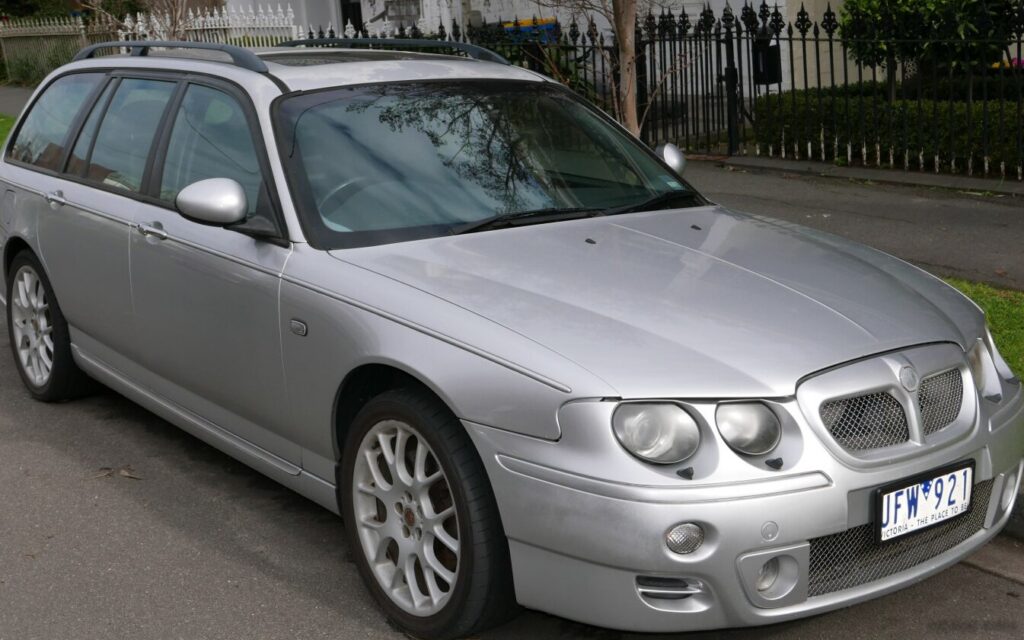
The MG ZT-T 2.5 i V6 24V, manufactured between 2002 and 2005, was the station wagon (estate) version of the MG ZT. The ZT itself represented a revival of the Rover 75 platform following BMW’s sale of the Rover Group. Positioned as a more practical alternative to the ZT saloon, the ZT-T aimed to combine British design, a reasonably powerful engine, and generous cargo capacity. It was a crucial model in MG’s efforts to re-establish itself as a performance-focused brand in the United Kingdom and European markets. The “T” designation, standing for “Tourer,” was consistent with British automotive tradition for estate cars.
Technical Specifications
| Brand | MG |
| Model | ZT |
| Generation | ZT-T |
| Type (Engine) | 2.5 i V6 24V (190 Hp) |
| Start of production | 2002 |
| End of production | 2005 |
| Powertrain Architecture | Internal Combustion engine |
| Body type | Station wagon (estate) |
| Seats | 5 |
| Doors | 5 |
| Fuel consumption (urban) | 14.3 l/100 km (16.4 US mpg) |
| Fuel consumption (extra urban) | 7.3 l/100 km (32.2 US mpg) |
| Fuel Type | Petrol (Gasoline) |
| Acceleration 0 – 100 km/h | 8.4 sec |
| Acceleration 0 – 62 mph | 8.4 sec |
| Acceleration 0 – 60 mph | 8 sec |
| Maximum speed | 227 km/h (141.05 mph) |
| Weight-to-power ratio | 8.1 kg/Hp |
| Weight-to-torque ratio | 6.3 kg/Nm |
| Power | 190 Hp @ 6500 rpm |
| Torque | 245 Nm @ 4000 rpm (180.7 lb.-ft. @ 4000 rpm) |
| Engine layout | Front, Transverse |
| Engine Model/Code | 25K4F |
| Engine displacement | 2497 cm3 (152.38 cu. in.) |
| Number of cylinders | 6 |
| Engine configuration | V-engine |
| Cylinder Bore | 80 mm (3.15 in.) |
| Piston Stroke | 82.8 mm (3.26 in.) |
| Compression ratio | 10.5:1 |
| Number of valves per cylinder | 4 |
| Fuel injection system | Multi-port manifold injection |
| Engine aspiration | Naturally aspirated engine |
| Engine oil capacity | 5.2 l (5.49 US qt | 4.58 UK qt) |
| Coolant capacity | 7.5 l (7.93 US qt | 6.6 UK qt) |
| Kerb Weight | 1540 kg (3395.12 lbs.) |
| Max. weight | 2030 kg (4475.38 lbs.) |
| Max load | 490 kg (1080.27 lbs.) |
| Trunk (boot) space – minimum | 400 l (14.13 cu. ft.) |
| Trunk (boot) space – maximum | 1220 l (43.08 cu. ft.) |
| Fuel tank capacity | 65 l (17.17 US gal | 14.3 UK gal) |
| Length | 4790 mm (188.58 in.) |
| Width | 1780 mm (70.08 in.) |
| Height | 1410 mm (55.51 in.) |
| Wheelbase | 2746 mm (108.11 in.) |
| Front track | 1560 mm (61.42 in.) |
| Rear track | 1610 mm (63.39 in.) |
| Drivetrain Architecture | Front wheel drive |
| Number of gears | 5 |
| Gearbox type | Manual transmission |
| Front suspension | Spring Strut |
| Rear suspension | Coil spring |
| Front brakes | Ventilated discs |
| Rear brakes | Disc |
| Assisting systems | ABS (Anti-lock braking system) |
| Steering type | Steering rack and pinion |
| Power steering | Hydraulic Steering |
| Tires size | 225/45 R18 |
The MG ZT-T 2.5 i V6 was built on the 1HX0/A3 platform, originally developed by Rover and later utilized by MG. It occupied a mid-range position within the ZT-T lineup, offering a step up in performance and refinement compared to the base 1.8-liter models, but remaining more accessible than the high-performance ZT 260 V6.
Powertrain & Engine Architecture
The ZT-T 2.5 i V6 was powered by the 25K4F engine, a 2.5-liter naturally aspirated V6 engine. This engine was derived from the Rover KV6 family, initially developed by Rover and subsequently refined under BMW’s ownership. The 25K4F featured a 60-degree V-angle and a dual overhead camshaft (DOHC) cylinder head with four valves per cylinder. It utilized multi-point fuel injection and a compression ratio of 10.5:1, generating 190 horsepower at 6500 rpm and 180.7 lb-ft of torque at 4000 rpm. The engine was mounted transversely at the front of the vehicle. The standard transmission was a five-speed manual gearbox, transmitting power to the front wheels. This powertrain combination provided a balance between performance and drivability.
Driving Characteristics
The 190 hp V6 engine, paired with the five-speed manual transmission, delivered respectable performance. The ZT-T could accelerate from 0 to 60 mph in approximately 8 seconds, with a top speed of around 141 mph. Compared to the 1.8-liter four-cylinder ZT-T models, the V6 offered a noticeable increase in torque, resulting in more responsive acceleration in everyday driving. However, it wasn’t designed as a dedicated sports car. The front-wheel-drive configuration and relatively soft suspension tuning prioritized ride comfort and stability over aggressive handling. The gear ratios were well-chosen for both acceleration and cruising, although some reviewers felt the fifth gear was slightly tall, sometimes requiring downshifts for overtaking. The 2.5 i V6 offered a more relaxed and refined driving experience compared to the more focused MG ZT 260 V6.
Equipment & Trim Levels
The ZT-T 2.5 i V6 was typically well-equipped, reflecting its mid-range positioning. Standard features included air conditioning, power steering, electric windows, central locking, and an RDS stereo system. The interior usually featured cloth upholstery, with leather options available. Dashboard trim was typically finished in wood veneer or metallic accents. Optional extras included a sunroof, upgraded audio systems, heated front seats, and parking sensors. The estate body style provided a generous 14.13 cubic feet of cargo space, expandable to 43.08 cubic feet with the rear seats folded down.
Chassis & Braking
The ZT-T employed a MacPherson strut front suspension and a multi-link coil spring rear suspension. The suspension was tuned for comfort, providing a smooth ride, although it could feel somewhat soft during spirited driving. Braking was provided by ventilated discs at the front and solid discs at the rear, assisted by an Anti-lock Braking System (ABS). The steering was a hydraulic power-assisted rack and pinion system, offering reasonable feel and precision. The ZT-T rode on 225/45 R18 tires, providing adequate grip for most driving conditions.
Market Reception & Comparison
The MG ZT-T 2.5 i V6 received generally positive reviews from automotive critics, who praised its spaciousness, comfortable ride, and relatively powerful engine. However, it faced competition from established estate cars like the Ford Mondeo Estate and Vauxhall Vectra Estate. Compared to the 1.8-liter ZT-T models, the 2.5 i V6 offered a significant performance improvement, but with slightly increased fuel consumption. Fuel economy was approximately 16.4 mpg in city driving and 32.2 mpg on the highway. Reliability was somewhat inconsistent, with some owners reporting issues with the engine’s variable valve timing system and electrical components.
Legacy
The MG ZT-T 2.5 i V6, like all MG models produced in the early 2000s, is now a relatively uncommon vehicle. The demise of MG Rover in 2005 ended production. Today, the ZT-T 2.5 i V6 is sought after by enthusiasts who appreciate its unique combination of British styling, V6 power, and estate car practicality. While the engine is generally considered durable, sourcing parts can be challenging. Well-maintained examples command a premium in the used car market, and the ZT-T is increasingly recognized as a distinctive and characterful classic car.
