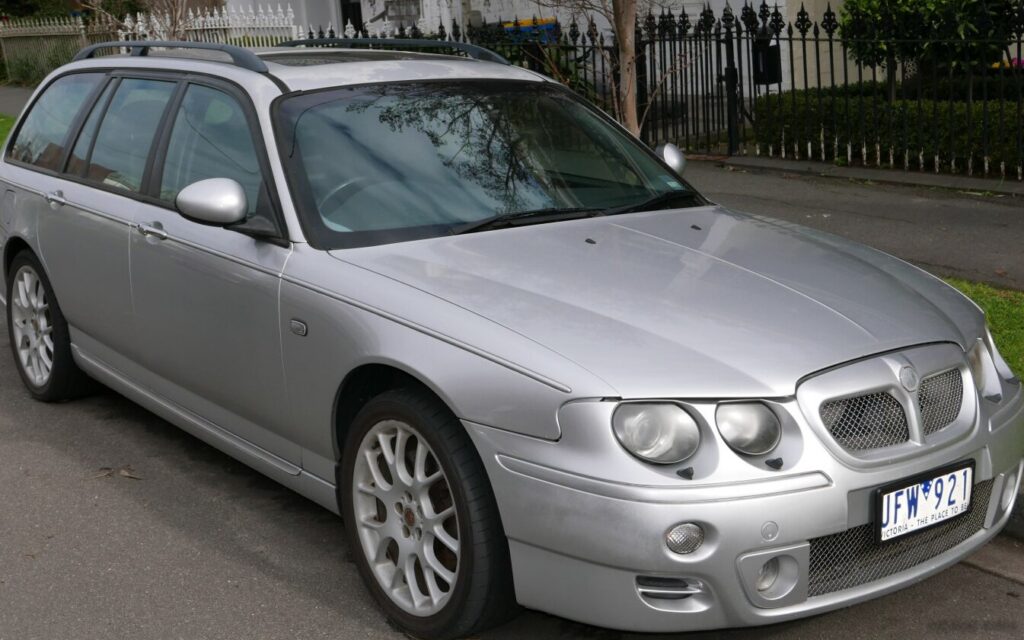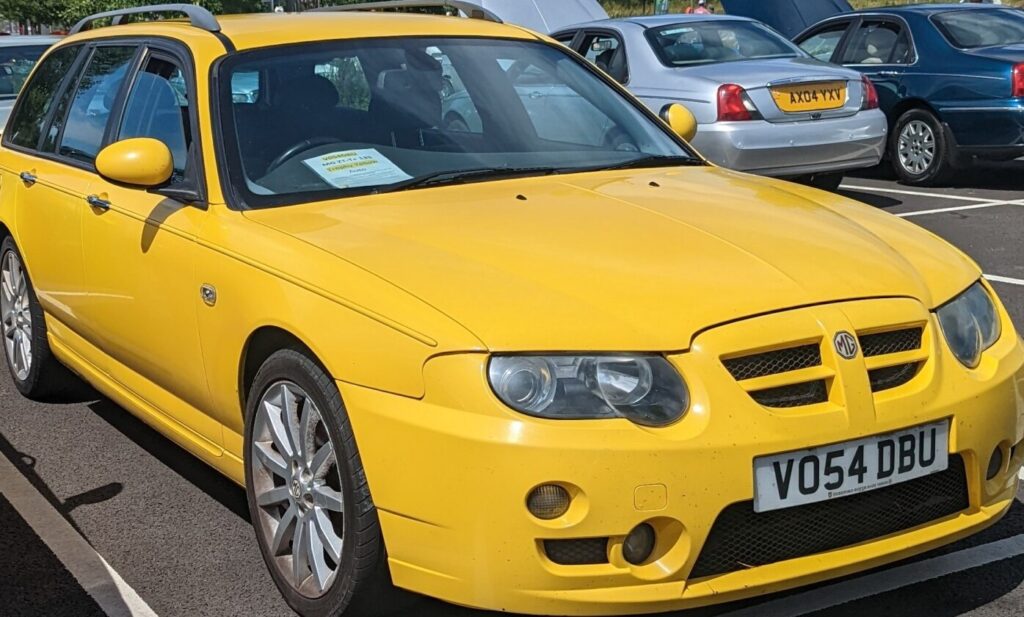
The MG ZT-T 1.8, produced during the 2004-2005 model years, represents a somewhat overlooked variant within the broader MG ZT range. Positioned as an entry-level offering in the ZT-T (estate) body style, it aimed to provide practicality and affordability within the MG lineup. The ZT-T itself was a significant model for MG, representing a return to its roots in producing sporty, British-designed vehicles, albeit built upon a platform developed under BMW ownership. This facelifted version, introduced in 2004, featured subtle styling revisions and refinements to the interior. The 1.8-liter engine and five-speed manual transmission combination was intended to appeal to buyers prioritizing fuel economy and everyday usability over outright performance.
Technical Specifications
| Brand | MG |
| Model | ZT |
| Generation | ZT-T (facelift 2004) |
| Type (Engine) | 1.8 (120 Hp) |
| Start of production | 2004 |
| End of production | 2005 |
| Powertrain Architecture | Internal Combustion engine |
| Body type | Station wagon (estate) |
| Seats | 5 |
| Doors | 5 |
| Fuel consumption (urban) | 10.6 l/100 km (22.2 US mpg, 26.6 UK mpg, 9.4 km/l) |
| Fuel consumption (extra urban) | 6.1 l/100 km (38.6 US mpg, 46.3 UK mpg, 16.4 km/l) |
| Fuel consumption (combined) | 7.8 l/100 km (30.2 US mpg, 36.2 UK mpg, 12.8 km/l) |
| CO2 emissions | 184 g/km |
| Fuel Type | Petrol (Gasoline) |
| Acceleration 0 – 60 mph | 11.3 sec |
| Maximum speed | 192 km/h (119.3 mph) |
| Emission standard | Euro 3 |
| Weight-to-power ratio | 12.3 kg/Hp, 81.1 Hp/tonne |
| Weight-to-torque ratio | 9.3 kg/Nm, 108.1 Nm/tonne |
| Power | 120 Hp @ 5500 rpm |
| Power per litre | 66.8 Hp/l |
| Torque | 160 Nm @ 4000 rpm (118.01 lb.-ft. @ 4000 rpm) |
| Maximum engine speed | 6750 rpm |
| Engine layout | Front, Transverse |
| Engine Model/Code | 18K4F |
| Engine displacement | 1796 cm3 (109.6 cu. in.) |
| Number of cylinders | 4 |
| Engine configuration | Inline |
| Cylinder Bore | 80 mm (3.15 in.) |
| Piston Stroke | 89.3 mm (3.52 in.) |
| Compression ratio | 10.5:1 |
| Number of valves per cylinder | 4 |
| Fuel injection system | Multi-port manifold injection |
| Engine aspiration | Naturally aspirated engine |
| Valvetrain | DOHC |
| Engine oil capacity | 4.5 l (4.76 US qt | 3.96 UK qt) |
| Coolant | 6.2 l (6.55 US qt | 5.46 UK qt) |
| Kerb Weight | 1480-1620 kg (3262.84 – 3571.49 lbs.) |
| Max. weight | 1980 kg (4365.15 lbs.) |
| Max load | 360-500 kg (793.66 – 1102.31 lbs.) |
| Trunk (boot) space – minimum | 400 l (14.13 cu. ft.) |
| Trunk (boot) space – maximum | 1222 l (43.15 cu. ft.) |
| Fuel tank capacity | 65 l (17.17 US gal | 14.3 UK gal) |
| Max. roof load | 100 kg (220.46 lbs.) |
| Permitted trailer load with brakes (12%) | 1200 kg (2645.55 lbs.) |
| Permitted trailer load without brakes | 750 kg (1653.47 lbs.) |
| Permitted towbar download | 100 kg (220.46 lbs.) |
| Length | 4791 mm (188.62 in.) |
| Width | 1778 mm (70 in.) |
| Height | 1428 mm (56.22 in.) |
| Wheelbase | 2746 mm (108.11 in.) |
| Drivetrain Architecture | The Internal combustion engine (ICE) drives the front wheels of the vehicle. |
| Drive wheel | Front wheel drive |
| Number of gears and type of gearbox | 5 gears, manual transmission |
| Front suspension | Independent, type McPherson with coil spring and anti-roll bar |
| Rear suspension | Independent multi-link spring suspension with stabilizer |
| Front brakes | Ventilated discs |
| Rear brakes | Disc |
| Assisting systems | ABS (Anti-lock braking system) |
| Steering type | Steering rack and pinion |
| Power steering | Hydraulic Steering |
| Tires size | 215/50 R17 |
| Wheel rims size | 7.5J x 17 |
Powertrain & Engine Architecture
The MG ZT-T 1.8 utilized the 18K4F engine, a 1.8-liter, naturally aspirated inline-four cylinder powerplant. This engine was originally developed by BMW during their ownership of Rover, and continued in use after MG Rover’s independence. It features a double overhead camshaft (DOHC) valvetrain and multi-point fuel injection. The 18K4F is known for its relatively simple design and reasonable reliability, though it isn’t a particularly high-performance unit. The engine’s 120 horsepower and 160 Nm (118 lb-ft) of torque are delivered to the front wheels via a five-speed manual transmission. This transmission, while not particularly sophisticated, is generally durable and provides a decent shift feel. The engine’s design prioritizes fuel efficiency and smooth operation over outright power, making it suitable for everyday driving.
Driving Characteristics
The 1.8-liter engine in the ZT-T provides adequate, but not exhilarating, performance. Acceleration from 0-60 mph takes around 11.3 seconds, and the top speed is approximately 119 mph. The engine feels somewhat strained when pushed hard, and the five-speed gearbox requires frequent shifting to maintain momentum. Compared to the more powerful 2.5-liter V6 models, the 1.8 feels significantly slower, particularly during overtaking maneuvers. However, the lighter engine weight contributes to better handling balance and improved fuel economy. The gear ratios are fairly well-spaced for everyday driving, but the lack of a sixth gear means that engine speeds can be relatively high at highway cruising speeds. The steering is direct and responsive, providing a reasonably engaging driving experience, even if the engine lacks the punch of its larger counterparts.
Equipment & Trim Levels
The 1.8-liter ZT-T typically came with a fairly basic level of equipment, reflecting its position as the entry-level model. Standard features generally included central locking, electric front windows, power steering, and an ABS anti-lock braking system. Interior upholstery was typically cloth, and the dashboard featured a relatively simple design. Optional extras included air conditioning, alloy wheels, a CD player, and upgraded interior trim. Higher trim levels, such as the 1.8+ or 1.8 SE, added some of these features as standard, but the base 1.8 model was deliberately kept affordable.
Chassis & Braking
The ZT-T utilizes an independent suspension setup, with McPherson struts at the front and a multi-link system at the rear. This provides a comfortable ride quality, although it can feel slightly firm on rough surfaces. The front brakes are ventilated discs, while the rear brakes are solid discs. The braking system is generally effective, providing adequate stopping power for everyday driving. Stabilizer bars are fitted to both the front and rear axles to reduce body roll during cornering. The chassis is relatively lightweight compared to the V6 models, which contributes to improved handling agility.
Market Reception & Comparison
The MG ZT-T 1.8 received mixed reviews from automotive critics. While praised for its practicality, spacious interior, and comfortable ride, it was often criticized for its lack of performance. Compared to the more powerful ZT-T variants, the 1.8 was seen as a compromise, offering lower running costs but sacrificing driving excitement. Fuel economy was generally considered to be reasonable for a vehicle of its size and type, averaging around 30 mpg in combined driving. Reliability was also a concern, as with many MG Rover vehicles, due to the company’s financial difficulties and eventual collapse. However, the 1.8-liter engine itself is generally considered to be relatively reliable.
Legacy
Today, the MG ZT-T 1.8 is a relatively rare sight on the roads. Its affordability and practicality have made it a popular choice among enthusiasts looking for a unique and spacious estate car. The 18K4F engine is known for its durability, but regular maintenance is essential to prevent issues. Parts availability can be a challenge, as MG Rover ceased production in 2005. However, a dedicated network of specialists and enthusiasts continues to support the model, ensuring that parts and expertise are still available. The ZT-T 1.8 represents a final chapter in MG’s long history of producing British-designed cars, and it remains a fondly remembered vehicle among those who appreciate its unique character and practicality.