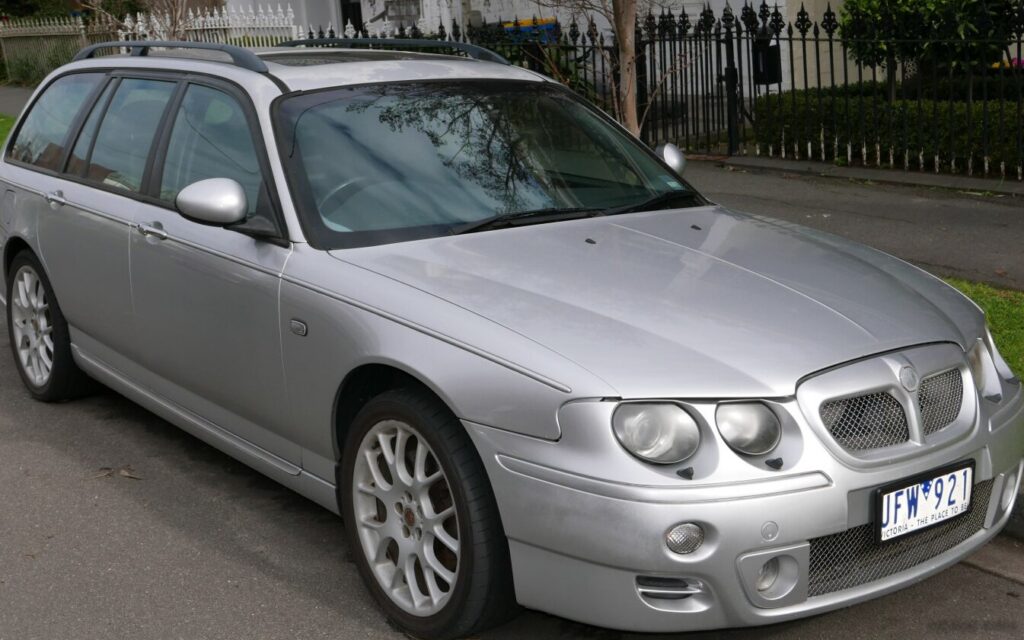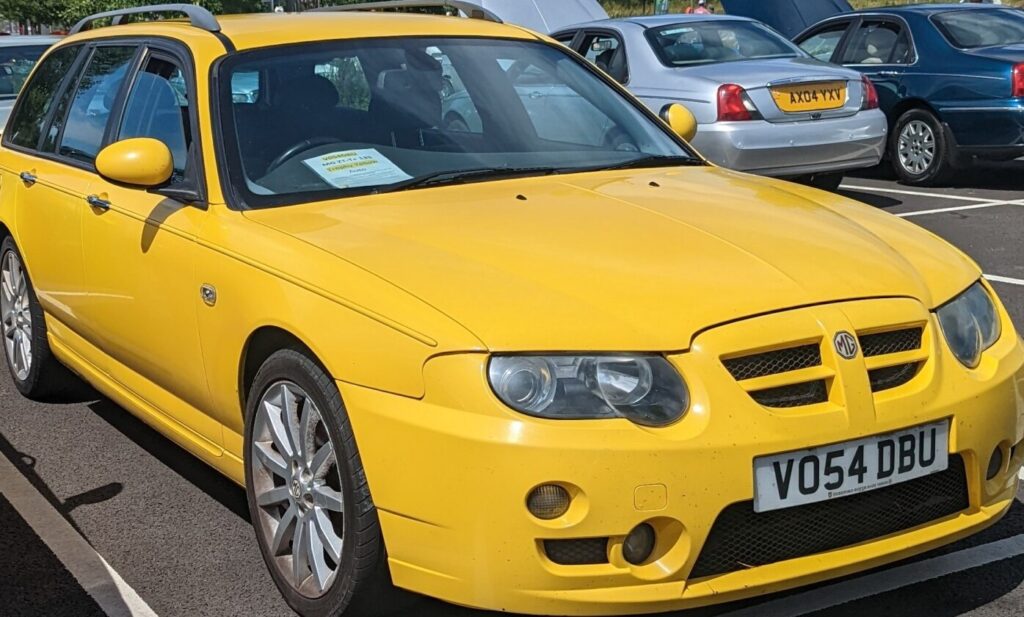
Technical Specifications
| Brand | MG |
| Model | ZT |
| Generation | ZT-T (facelift 2004) |
| Type (Engine) | 2.0 CDTi (116 Hp) |
| Start of production | 2004 |
| End of production | 2005 |
| Powertrain Architecture | Internal Combustion engine |
| Body type | Station wagon (estate) |
| Seats | 5 |
| Doors | 5 |
| Fuel consumption (urban) | 7.7 l/100 km (30.5 US mpg, 36.7 UK mpg, 13 km/l) |
| Fuel consumption (extra urban) | 4.7 l/100 km (50 US mpg, 60.1 UK mpg, 21.3 km/l) |
| Fuel consumption (combined) | 5.8 l/100 km (40.6 US mpg, 48.7 UK mpg, 17.2 km/l) |
| CO2 emissions | 163 g/km |
| Fuel Type | Diesel |
| Acceleration 0 – 60 mph | 11.5 sec |
| Maximum speed | 185 km/h (114.95 mph) |
| Emission standard | Euro 3 |
| Weight-to-power ratio | 13.7 kg/Hp, 73.2 Hp/tonne |
| Weight-to-torque ratio | 6.1 kg/Nm, 164 Nm/tonne |
| Power | 116 Hp @ 4000 rpm |
| Power per litre | 59.5 Hp/l |
| Torque | 260 Nm @ 2000 rpm (191.77 lb.-ft. @ 2000 rpm) |
| Maximum engine speed | 4900 rpm |
| Engine layout | Front, Transverse |
| Engine Model/Code | M47R / 204D2 |
| Engine displacement | 1951 cm3 (119.06 cu. in.) |
| Number of cylinders | 4 |
| Engine configuration | Inline |
| Cylinder Bore | 84 mm (3.31 in.) |
| Piston Stroke | 88 mm (3.46 in.) |
| Compression ratio | 18:1 |
| Number of valves per cylinder | 4 |
| Fuel injection system | Diesel Commonrail |
| Engine aspiration | Turbocharger, Intercooler |
| Valvetrain | DOHC |
| Engine oil capacity | 6.8 l (7.19 US qt | 5.98 UK qt) |
| Coolant | 8.2 l (8.66 US qt | 7.21 UK qt) |
| Kerb Weight | 1585-1670 kg (3494.33 – 3681.72 lbs.) |
| Max. weight | 2090 kg (4607.66 lbs.) |
| Max load | 420-505 kg (925.94 – 1113.33 lbs.) |
| Trunk (boot) space – minimum | 400 l (14.13 cu. ft.) |
| Trunk (boot) space – maximum | 1222 l (43.15 cu. ft.) |
| Fuel tank capacity | 65 l (17.17 US gal | 14.3 UK gal) |
| Max. roof load | 100 kg (220.46 lbs.) |
| Permitted trailer load with brakes (12%) | 1600 kg (3527.4 lbs.) |
| Permitted trailer load without brakes | 750 kg (1653.47 lbs.) |
| Permitted towbar download | 100 kg (220.46 lbs.) |
| Length | 4791 mm (188.62 in.) |
| Width | 1778 mm (70 in.) |
| Height | 1428 mm (56.22 in.) |
| Wheelbase | 2746 mm (108.11 in.) |
| Drivetrain Architecture | The Internal combustion engine (ICE) drives the front wheels of the vehicle. |
| Drive wheel | Front wheel drive |
| Number of gears and type of gearbox | 5 gears, manual transmission |
| Front suspension | Independent, type McPherson with coil spring and anti-roll bar |
| Rear suspension | Independent multi-link spring suspension with stabilizer |
| Front brakes | Ventilated discs |
| Rear brakes | Disc |
| Assisting systems | ABS (Anti-lock braking system) |
| Steering type | Steering rack and pinion |
| Power steering | Hydraulic Steering |
| Tires size | 225/45 R18 |
| Wheel rims size | 7.5J x 18 |
The MG ZT-T 2.0 CDTi, introduced in 2004 as part of the facelifted ZT range, represented a practical and fuel-efficient offering within the British marque’s lineup. Positioned as a mid-range variant, it aimed to provide estate car practicality with a reasonably economical diesel engine. Production continued until 2005, coinciding with the broader challenges faced by MG Rover. The ZT-T (Tourer) itself was based on the Rover 75 platform, and the 2.0 CDTi variant sought to appeal to buyers prioritizing space and running costs over outright performance. This model occupied a niche between the lower-powered petrol engines and the more expensive, higher-performance options.
Powertrain & Engine Architecture
The MG ZT-T 2.0 CDTi utilized the M47R engine, a 1951cc four-cylinder diesel engine. This engine, sourced from BMW (and designated 204D2 in MG Rover’s nomenclature), was a common rail direct injection (CRDI) unit. The common rail system allowed for precise control of fuel delivery, contributing to improved efficiency and reduced emissions. The engine featured a turbocharger with an intercooler, boosting power output to 116 horsepower at 4000 rpm and 260 Nm (192 lb-ft) of torque at 2000 rpm. The engine employed a double overhead camshaft (DOHC) valvetrain with four valves per cylinder. The engine was transversely mounted in the front of the vehicle. The 5-speed manual transmission was the standard offering, designed to handle the engine’s torque output.
Driving Characteristics
The 2.0 CDTi engine in the ZT-T provided a balance between fuel economy and usable performance. While not a particularly quick car – 0-60 mph took around 11.5 seconds – the engine offered sufficient torque for everyday driving and overtaking maneuvers. The manual gearbox, while not particularly sporty, was well-matched to the engine’s characteristics. Compared to the higher-powered petrol versions of the ZT-T, the 2.0 CDTi prioritized fuel efficiency, achieving around 40.6 US mpg on the combined cycle. The gear ratios were geared towards maximizing fuel economy rather than outright acceleration. The engine felt relatively relaxed at highway speeds, making it a comfortable cruiser.
Equipment & Trim Levels
The 2.0 CDTi trim level typically included features such as air conditioning, electric front windows, central locking, and an RDS stereo. Higher trim levels, often denoted by additions like ‘+’ or ‘SE’, added features like alloy wheels, upgraded upholstery, and climate control. Optional extras included leather seats, a sunroof, and parking sensors. Interior upholstery was typically cloth, although leather was available as an upgrade. The dashboard layout was consistent across the ZT range, featuring a relatively straightforward design with clearly labeled controls.
Chassis & Braking
The ZT-T utilized a McPherson strut front suspension and a multi-link rear suspension, providing a reasonably comfortable ride. The front suspension incorporated a stabilizer bar to reduce body roll. Braking was handled by ventilated discs at the front and solid discs at the rear, equipped with an Anti-lock Braking System (ABS). The steering was a hydraulic rack and pinion system, offering a reasonable level of feel and precision. The ZT-T’s chassis was tuned to prioritize comfort and stability over outright sportiness, reflecting its role as a practical estate car.
Market Reception & Comparison
The MG ZT-T 2.0 CDTi was generally well-received by critics as a practical and economical estate car. However, it was often overshadowed by more established competitors from brands like Ford and Vauxhall. The diesel engine offered competitive fuel economy, but some reviewers noted that it lacked the refinement of some rival engines. Compared to the petrol-powered ZT-T variants, the 2.0 CDTi appealed to a different type of buyer – one prioritizing running costs and practicality over performance. Reliability was a concern for some owners, reflecting the broader issues faced by MG Rover during its final years.
Legacy
The MG ZT-T 2.0 CDTi, while not a sales success, represents a significant chapter in the history of MG Rover. The M47R engine, despite its BMW origins, proved to be relatively durable when properly maintained. Today, the ZT-T 2.0 CDTi is a relatively rare sight on the roads, and well-maintained examples are sought after by enthusiasts. The car’s blend of practicality, fuel economy, and British heritage continues to appeal to a niche group of buyers. Parts availability can be a challenge, but a dedicated community of owners and specialists helps to keep these cars on the road.