
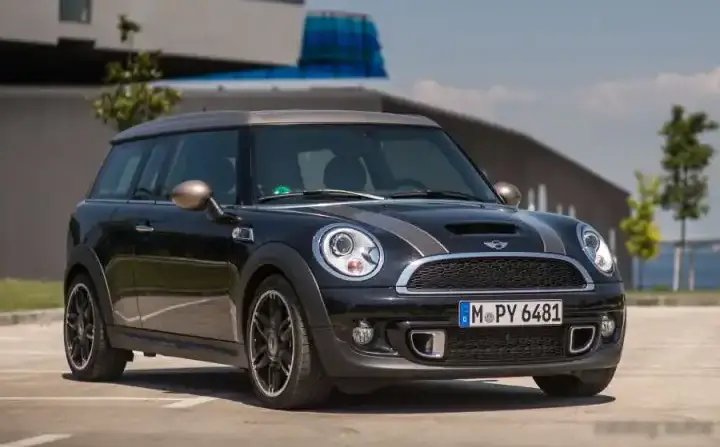
The Mini Clubman F54 2.0, produced from 2015 to 2018, represents a significant departure from the earlier, more compact Clubmans. Positioned as the more practical and upscale sibling to the Mini Cooper hatchback, the F54 Clubman adopted a traditional wagon (estate) body style with five doors, offering increased interior space and cargo capacity. The 2.0-liter variant, generating 192 horsepower, occupied a mid-range position within the Clubman lineup, slotting above the base 1.5-liter three-cylinder engine and below the performance-oriented John Cooper Works (JCW) model. This version aimed to balance spirited driving with everyday usability, appealing to buyers seeking a premium small wagon.
Technical Specifications
| Brand | Mini |
| Model | Clubman |
| Generation | Clubman (F54) |
| Type (Engine) | 2.0 (192 Hp) |
| Start of production | 2015 |
| End of production | 2018 |
| Powertrain Architecture | Internal Combustion engine |
| Body type | Station wagon (estate) |
| Seats | 5 |
| Doors | 5 |
| Fuel consumption (urban) | 7.9-8.0 l/100 km (29.8 – 29.4 US mpg) |
| Fuel consumption (extra urban) | 5.2-5.4 l/100 km (45.2 – 43.6 US mpg) |
| Fuel consumption (combined) | 6.2-6.3 l/100 km (37.9 – 37.3 US mpg) |
| CO2 emissions | 144-147 g/km |
| Fuel Type | Petrol (Gasoline) |
| Acceleration 0 – 100 km/h | 7.2 sec |
| Acceleration 0 – 62 mph | 7.2 sec |
| Acceleration 0 – 60 mph | 6.8 sec |
| Maximum speed | 228 km/h (141.67 mph) |
| Emission standard | Euro 6 |
| Weight-to-power ratio | 7.1 kg/Hp, 141.2 Hp/tonne |
| Weight-to-torque ratio | 4.9 kg/Nm, 205.9 Nm/tonne |
| Power | 192 Hp @ 5000 rpm |
| Torque | 280 Nm @ 1250 rpm (206.52 lb.-ft. @ 1250 rpm) |
| Engine layout | Front, Transverse |
| Engine Model/Code | B48A20F |
| Engine displacement | 1998 cm3 (121.93 cu. in.) |
| Number of cylinders | 4 |
| Engine configuration | Inline |
| Cylinder Bore | 82 mm (3.23 in.) |
| Piston Stroke | 94.6 mm (3.72 in.) |
| Compression ratio | 11:1 |
| Number of valves per cylinder | 4 |
| Fuel injection system | Direct injection |
| Engine aspiration | Twin-power turbo, Intercooler |
| Engine oil capacity | 5.3 l (5.6 US qt | 4.66 UK qt) |
| Coolant | 5.8 l (6.13 US qt | 5.1 UK qt) |
| Kerb Weight | 1360 kg (2998.29 lbs.) |
| Max. weight | 1930 kg (4254.92 lbs.) |
| Max load | 570 kg (1256.63 lbs.) |
| Trunk (boot) space – minimum | 360 l (12.71 cu. ft.) |
| Trunk (boot) space – maximum | 1250 l (44.14 cu. ft.) |
| Fuel tank capacity | 48 l (12.68 US gal | 10.56 UK gal) |
| Max. roof load | 75 kg (165.35 lbs.) |
| Permitted trailer load with brakes (12%) | 1300 kg (2866.01 lbs.) |
| Permitted trailer load without brakes | 720 kg (1587.33 lbs.) |
| Permitted towbar download | 75 kg (165.35 lbs.) |
| Length | 4253 mm (167.44 in.) |
| Width | 1800 mm (70.87 in.) |
| Height | 1441 mm (56.73 in.) |
| Wheelbase | 2670 mm (105.12 in.) |
| Front track | 1560 mm (61.42 in.) |
| Rear (Back) track | 1561 mm (61.46 in.) |
| Ride height (ground clearance) | 141 mm (5.55 in.) |
| Drag coefficient (Cd) | 0.34 |
| Minimum turning circle (turning diameter) | 11.3 m (37.07 ft.) |
| Drivetrain Architecture | The Internal combustion engine (ICE) drives the front wheels of the vehicle. |
| Drive wheel | Front wheel drive |
| Number of gears and type of gearbox | 6 gears, manual transmission |
| Front suspension | Independent, type McPherson with coil spring and anti-roll bar |
| Rear suspension | Independent multi-link suspension |
| Front brakes | Ventilated discs |
| Rear brakes | Disc |
| Assisting systems | ABS (Anti-lock braking system) |
| Steering type | Steering rack and pinion |
| Power steering | Electric Steering |
| Tires size | 225/45 R17 |
| Wheel rims size | 7.5J x 17 |
Powertrain & Engine Architecture
The heart of the Clubman 2.0 is BMW’s B48A20F 2.0-liter turbocharged inline-four engine. This engine is a member of BMW’s modular engine family, known for its efficiency and performance. It utilizes direct fuel injection, delivering fuel directly into the combustion chamber for improved combustion efficiency and reduced emissions. The engine also features a twin-scroll turbocharger with an intercooler, which minimizes turbo lag and provides a broad torque curve. The B48 engine boasts variable valve timing (VANOS) and variable valve lift (Valvetronic) technologies, optimizing engine performance across the rev range. The 2.0-liter engine in the Clubman 2.0 is paired with a six-speed automatic transmission, sending power to the front wheels. This transmission is known for its smooth shifts and responsiveness, though it lacks the sportiness of some dual-clutch transmissions.
Driving Characteristics
The Clubman 2.0 with the automatic transmission delivers a comfortable and refined driving experience. Acceleration from 0 to 60 mph takes approximately 6.8 seconds, making it adequately quick for everyday driving. The automatic transmission is well-tuned, providing smooth gear changes and responsive performance. However, it doesn’t offer the same level of engagement as the available six-speed manual transmission. The engine provides ample torque from low RPMs, making it easy to navigate city streets and maintain highway speeds. Compared to the base 1.5-liter engine, the 2.0-liter offers significantly more power and a more relaxed driving experience, especially when fully loaded or traveling uphill. The Clubman’s suspension provides a good balance between comfort and handling, absorbing bumps effectively while maintaining a stable feel in corners.
Equipment & Trim Levels
The Clubman 2.0 typically came standard with features such as automatic climate control, a 6.5-inch infotainment system with Bluetooth connectivity, and a leather-wrapped steering wheel. Higher trim levels added features like a larger 8.8-inch infotainment screen with navigation, a Harman Kardon premium sound system, and leather upholstery. Optional extras included a panoramic sunroof, adaptive headlights, and a variety of driver-assistance systems. Interior upholstery was typically cloth on base models, with leather options available on higher trims. The dashboard layout was modern and driver-focused, with a centrally-mounted infotainment screen and a clear instrument cluster.
Chassis & Braking
The Clubman F54 utilizes a front-wheel-drive platform with independent suspension at all four corners. The front suspension employs a McPherson strut design, while the rear features a multi-link setup. This configuration provides a comfortable ride and good handling characteristics. Brakes are ventilated discs at the front and solid discs at the rear, providing adequate stopping power for the vehicle’s weight. Anti-lock braking system (ABS) is standard, enhancing safety and control during emergency braking situations. The Clubman 2.0’s chassis is relatively lightweight, contributing to its agile handling.
Market Reception & Comparison
The Clubman 2.0 was generally well-received by automotive critics, who praised its spacious interior, comfortable ride, and refined driving experience. However, some critics noted that the front-wheel-drive layout didn’t provide the same level of driving engagement as some of its rear-wheel-drive competitors. Compared to the base 1.5-liter Clubman, the 2.0-liter offered a significant performance upgrade, but at a higher price point. Fuel economy was respectable, averaging around 37 mpg in combined driving. Reliability was generally good, although some owners reported minor issues with the infotainment system.
Legacy
The Clubman F54 2.0 remains a popular choice in the used car market, offering a blend of practicality, style, and performance. The B48 engine has proven to be relatively reliable, although regular maintenance is essential to ensure long-term durability. The automatic transmission is generally dependable, but it’s important to check for smooth shifting and proper operation. The Clubman 2.0 represents a compelling alternative to traditional hatchbacks and small SUVs, offering a unique combination of features and driving dynamics.
