
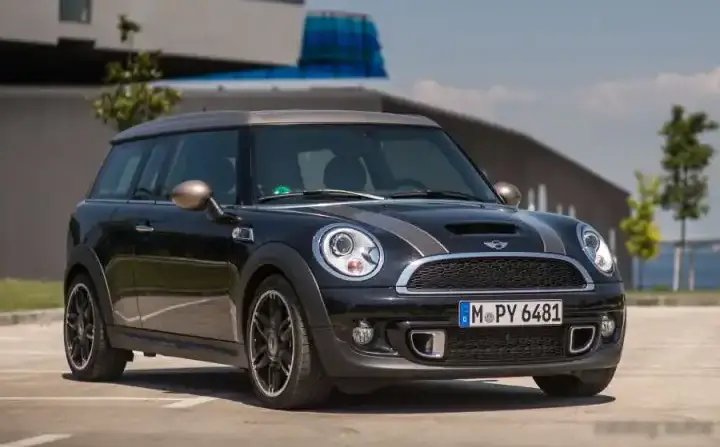
The Mini Clubman (F54) 2.0d, producing 150 horsepower, was a key variant within the second generation of the Clubman, produced from 2015 to 2018. Representing a shift towards a more practical, family-oriented vehicle while retaining Mini’s signature styling, the F54 Clubman moved away from the earlier, more unconventional Clubman design. This 2.0d model occupied a mid-range position in the Clubman lineup, offering a balance between performance, fuel efficiency, and price, appealing to buyers seeking a premium compact wagon. It was primarily marketed in Europe and other international markets, with limited availability in the United States.
Technical Specifications
| Brand | Mini |
| Model | Clubman |
| Generation | Clubman (F54) |
| Type (Engine) | 2.0d (150 Hp) |
| Start of production | 2015 |
| End of production | 2018 |
| Powertrain Architecture | Internal Combustion engine |
| Body type | Station wagon (estate) |
| Seats | 5 |
| Doors | 5 |
| Fuel consumption (urban) | 4.8-5.1 l/100 km (49 – 46.1 US mpg) |
| Fuel consumption (extra urban) | 3.7-4.0 l/100 km (63.6 – 58.8 US mpg) |
| Fuel consumption (combined) | 4.1-4.4 l/100 km (57.4 – 53.5 US mpg) |
| CO2 emissions | 109-115 g/km |
| Fuel Type | Diesel |
| Acceleration 0 – 100 km/h | 8.6 sec |
| Acceleration 0 – 62 mph | 8.6 sec |
| Acceleration 0 – 60 mph | 8.2 sec |
| Maximum speed | 212 km/h (131.73 mph) |
| Emission standard | Euro 6 |
| Weight-to-power ratio | 8.8 kg/Hp, 113.6 Hp/tonne |
| Weight-to-torque ratio | 4 kg/Nm, 250 Nm/tonne |
| Power | 150 Hp @ 4000 rpm |
| Torque | 330 Nm @ 1750 rpm (243.4 lb.-ft. @ 1750 rpm) |
| Engine Model/Code | B47C20B |
| Engine displacement | 1995 cm3 (121.74 cu. in.) |
| Number of cylinders | 4 |
| Engine configuration | Inline |
| Cylinder Bore | 84 mm (3.31 in.) |
| Piston Stroke | 90 mm (3.54 in.) |
| Compression ratio | 16.5:1 |
| Number of valves per cylinder | 4 |
| Fuel injection system | Diesel Commonrail |
| Engine aspiration | Twin-power turbo, Intercooler |
| Engine oil capacity | 5 l (5.28 US qt | 4.4 UK qt) |
| Coolant | 3.3 l (3.49 US qt | 2.9 UK qt) |
| Kerb Weight | 1320 kg (2910.1 lbs.) |
| Max. weight | 1910 kg (4210.83 lbs.) |
| Max load | 590 kg (1300.73 lbs.) |
| Trunk (boot) space – minimum | 360 l (12.71 cu. ft.) |
| Trunk (boot) space – maximum | 1250 l (44.14 cu. ft.) |
| Fuel tank capacity | 48 l (12.68 US gal | 10.56 UK gal) |
| Max. roof load | 75 kg (165.35 lbs.) |
| Permitted trailer load with brakes (12%) | 1300 kg (2866.01 lbs.) |
| Permitted trailer load without brakes | 710 kg (1565.28 lbs.) |
| Permitted towbar download | 75 kg (165.35 lbs.) |
| Length | 4253 mm (167.44 in.) |
| Width | 1800 mm (70.87 in.) |
| Height | 1441 mm (56.73 in.) |
| Wheelbase | 2670 mm (105.12 in.) |
| Front track | 1564 mm (61.57 in.) |
| Rear track | 1565 mm (61.61 in.) |
| Ride height (ground clearance) | 141 mm (5.55 in.) |
| Drag coefficient (Cd) | 0.31 |
| Minimum turning circle | 11.3 m (37.07 ft.) |
| Drivetrain Architecture | Front wheel drive |
| Number of gears and type of gearbox | 6 gears, manual transmission |
| Front suspension | Independent, type McPherson with coil spring and anti-roll bar |
| Rear suspension | Independent multi-link suspension |
| Front brakes | Ventilated discs |
| Rear brakes | Disc |
INTRODUCTION
The F54 Clubman represented a significant departure from its predecessors, embracing a more conventional wagon body style. Introduced in 2015, it aimed to broaden the Clubman’s appeal beyond its niche following. The 2.0d variant, powered by the BMW Group’s B47 engine, was a popular choice in Europe, offering a compelling blend of fuel economy and usable performance. This model was positioned as a practical and refined option within the Clubman range, targeting buyers who needed more space and efficiency than the standard Cooper models could provide. The split rear tailgate, a defining feature of the Clubman, was retained, adding a unique visual element to the vehicle.
Powertrain & Engine Architecture
At the heart of the Clubman 2.0d lies the BMW B47C20B, a 2.0-liter inline-four cylinder diesel engine. This engine is a member of BMW’s modular engine family, known for its efficiency and refinement. The B47 utilizes a common-rail direct injection system, delivering fuel at extremely high pressures for optimized combustion. It’s equipped with a twin-scroll turbocharger and an intercooler to boost power and torque. The engine produces 150 horsepower at 4000 rpm and 330 Nm (243 lb-ft) of torque at 1750 rpm. This torque output provides strong low-end and mid-range acceleration, making it well-suited for everyday driving. The engine also features a particulate filter to reduce emissions, meeting Euro 6 standards. The 2.0d Clubman was typically paired with a six-speed manual transmission, although an optional eight-speed automatic transmission was also available. The automatic transmission offered smoother shifts and enhanced convenience, but at a slight cost to fuel economy.
Driving Characteristics
The Clubman 2.0d with the manual transmission offered a reasonably engaging driving experience. While not a sports car, the engine’s torque allowed for effortless cruising and confident overtaking. The six-speed gearbox was well-matched to the engine’s characteristics, providing a good balance between acceleration and fuel efficiency. The automatic transmission, while smoother, could feel slightly less responsive. The Clubman’s suspension, tuned for comfort, provided a compliant ride, absorbing bumps and imperfections in the road. However, this did result in some body roll during cornering. Compared to the more powerful Cooper S models, the 2.0d felt less eager to rev, but its superior fuel economy and lower running costs made it a more sensible choice for many buyers. The front-wheel-drive configuration provided good traction in most conditions, but could experience some torque steer under hard acceleration.
Equipment & Trim Levels
The Clubman 2.0d was available in various trim levels, each offering a different level of equipment. Standard features typically included air conditioning, a leather-wrapped steering wheel, a 6.5-inch infotainment system with Bluetooth connectivity, and alloy wheels. Higher trim levels added features such as a larger infotainment screen, navigation, a panoramic sunroof, leather upholstery, and parking sensors. Optional extras included adaptive cruise control, a head-up display, and a premium sound system. Interior upholstery options ranged from cloth to leather, with a variety of color combinations available. The dashboard layout was modern and driver-focused, with a prominent central display and intuitive controls.
Chassis & Braking
The Clubman F54 utilized a McPherson strut front suspension and a multi-link rear suspension, providing a comfortable and controlled ride. The suspension was tuned to prioritize comfort over outright sportiness. The braking system consisted of ventilated discs at the front and solid discs at the rear. Anti-lock braking system (ABS) and electronic stability control (ESC) were standard features, enhancing safety and stability. The steering was electrically assisted, providing a light and precise feel. The Clubman’s chassis was relatively lightweight, contributing to its agility and fuel efficiency.
Market Reception & Comparison
The Clubman 2.0d was generally well-received by automotive critics. It was praised for its fuel efficiency, comfortable ride, and spacious interior. However, some critics noted that it lacked the sporty character of the Cooper S models. Compared to other diesel wagons in its class, such as the Volkswagen Golf Estate and the Ford Focus Estate, the Clubman 2.0d offered a more premium feel and distinctive styling. Its fuel economy was competitive, and its reliability was generally good, although some owners reported minor issues with the diesel particulate filter. The 2.0d variant represented a pragmatic choice for buyers seeking a stylish and practical wagon with low running costs.
Legacy
The Clubman F54 2.0d has proven to be a relatively reliable vehicle in the used car market. The B47 engine, while known for potential DPF issues if not properly maintained, is generally robust. Regular servicing and the use of high-quality diesel fuel are crucial for ensuring long-term reliability. Today, the F54 Clubman 2.0d remains a popular choice for buyers seeking a practical and stylish wagon with good fuel economy. Its unique design and premium interior continue to appeal to those looking for something a little different from the mainstream competition.
