
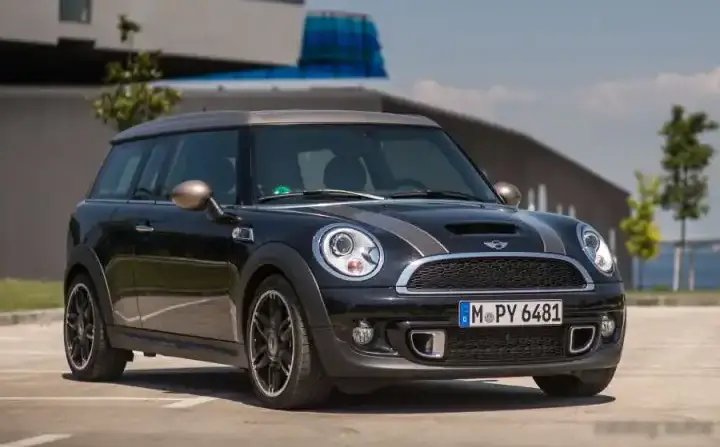
The Mini Clubman (F54) 2.0d, producing 190 horsepower, represents a significant iteration of Mini’s attempt to blend practicality with its signature sporty handling. Introduced in 2015 and continuing through 2018 model years, this variant occupied a middle ground within the F54 Clubman lineup, offering a balance between performance and fuel efficiency. Positioned above the Cooper and Cooper D models, but below the John Cooper Works (JCW) trim, the 2.0d aimed to appeal to buyers seeking a more refined and capable Clubman for everyday use and longer journeys. It’s a key example of Mini’s expansion beyond its iconic small hatchback roots, embracing the station wagon (estate) body style to cater to a broader customer base, particularly in European markets.
Technical Specifications
| Brand | Mini |
| Model | Clubman |
| Generation | Clubman (F54) |
| Type (Engine) | 2.0d (190 Hp) |
| Start of production | 2015 |
| End of production | 2018 |
| Powertrain Architecture | Internal Combustion engine |
| Body type | Station wagon (estate) |
| Seats | 5 |
| Doors | 5 |
| Fuel consumption (urban) | 5.3-5.4 l/100 km (44.4 – 43.6 US mpg) |
| Fuel consumption (extra urban) | 4.1-4.2 l/100 km (57.4 – 56 US mpg) |
| Fuel consumption (combined) | 4.5-4.6 l/100 km (52.3 – 51.1 US mpg) |
| CO2 emissions | 119-122 g/km |
| Fuel Type | Diesel |
| Acceleration 0 – 100 km/h | 7.4 sec |
| Acceleration 0 – 62 mph | 7.4 sec |
| Acceleration 0 – 60 mph | 7 sec |
| Maximum speed | 225 km/h (139.81 mph) |
| Emission standard | Euro 6 |
| Weight-to-power ratio | 7.3 kg/Hp |
| Weight-to-torque ratio | 3.5 kg/Nm |
| Power | 190 Hp @ 4000 rpm |
| Torque | 400 Nm @ 1750-2500 rpm (295.02 lb.-ft. @ 1750-2500 rpm) |
| Engine layout | Front, Transverse |
| Engine Model/Code | B47C20A |
| Engine displacement | 1995 cm3 (121.74 cu. in.) |
| Number of cylinders | 4 |
| Engine configuration | Inline |
| Cylinder Bore | 84 mm (3.31 in.) |
| Piston Stroke | 90 mm (3.54 in.) |
| Compression ratio | 16.5:1 |
| Number of valves per cylinder | 4 |
| Fuel injection system | Diesel Commonrail |
| Engine aspiration | Twin-power turbo, Intercooler |
| Engine oil capacity | 5 l (5.28 US qt | 4.4 UK qt) |
| Coolant | 3.3 l (3.49 US qt | 2.9 UK qt) |
| Kerb Weight | 1385 kg (3053.4 lbs.) |
| Max. weight | 1960 kg (4321.06 lbs.) |
| Max load | 575 kg (1267.66 lbs.) |
| Trunk (boot) space – minimum | 360 l (12.71 cu. ft.) |
| Trunk (boot) space – maximum | 1250 l (44.14 cu. ft.) |
| Fuel tank capacity | 48 l (12.68 US gal | 10.56 UK gal) |
| Max. roof load | 75 kg (165.35 lbs.) |
| Permitted trailer load with brakes (12%) | 1300 kg (2866.01 lbs.) |
| Permitted trailer load without brakes | 720 kg (1587.33 lbs.) |
| Permitted towbar download | 75 kg (165.35 lbs.) |
| Length | 4253 mm (167.44 in.) |
| Width | 1800 mm (70.87 in.) |
| Height | 1441 mm (56.73 in.) |
| Wheelbase | 2670 mm (105.12 in.) |
| Front track | 1560 mm (61.42 in.) |
| Rear (Back) track | 1561 mm (61.46 in.) |
| Ride height (ground clearance) | 141 mm (5.55 in.) |
| Drag coefficient (Cd) | 0.33 |
| Minimum turning circle (turning diameter) | 11.3 m (37.07 ft.) |
| Drivetrain Architecture | Front wheel drive |
| Drive wheel | Front wheel drive |
| Number of gears and type of gearbox | 6 gears, manual transmission |
| Front suspension | Independent, type McPherson with coil spring and anti-roll bar |
| Rear suspension | Independent multi-link suspension |
| Front brakes | Ventilated discs |
| Rear brakes | Disc |
| Assisting systems | ABS (Anti-lock braking system) |
| Steering type | Steering rack and pinion |
| Power steering | Electric Steering |
| Tires size | 225/45 R17 |
| Wheel rims size | 7.5J x 17 |
Powertrain & Engine Architecture
The heart of the Clubman 2.0d is BMW’s B47C20A engine, a 2.0-liter turbocharged four-cylinder diesel. This engine is a member of the modular BMW engine family, known for its efficiency and refinement. The B47 utilizes a common-rail direct injection system, delivering fuel at extremely high pressure for optimized combustion. A single twin-scroll turbocharger, coupled with an intercooler, provides a broad torque curve and responsive power delivery. The engine boasts 16 valves (four per cylinder) and a relatively high compression ratio of 16.5:1, contributing to its thermal efficiency. The 2.0d was typically paired with a six-speed manual transmission, although an optional eight-speed automatic was also available. The automatic transmission offered smoother shifts and enhanced convenience, but at a slight cost to fuel economy.
Driving Characteristics
The 190 hp and 400 Nm (295 lb-ft) of torque produced by the 2.0d engine provide brisk acceleration. The 0-60 mph sprint takes around 7 seconds, making it a genuinely quick estate car. The engine’s peak torque is available from a low 1750 rpm, resulting in strong pulling power in everyday driving situations. Compared to the base Cooper D models, the 2.0d offers a noticeable performance upgrade, particularly when overtaking or carrying a full load. While not as overtly sporty as the JCW variant, the 2.0d provides a comfortable and confident driving experience. The front-wheel-drive configuration, combined with the relatively modest power output, minimizes torque steer. The six-speed manual transmission offers precise shifts, while the optional eight-speed automatic provides seamless gear changes.
Equipment & Trim Levels
The Clubman 2.0d typically came well-equipped, reflecting its mid-range positioning. Standard features included automatic climate control, a 6.5-inch infotainment system with Bluetooth connectivity, and a leather-wrapped steering wheel. Higher trim levels added features such as a larger 8.8-inch infotainment screen with navigation, a panoramic sunroof, and premium upholstery. Optional extras included adaptive dampers, a head-up display, and a Harman Kardon sound system. Interior upholstery options ranged from cloth to leather, with a variety of color combinations available. The Clubman’s rear “splitgate” – two doors that open independently – provided convenient access to the cargo area.
Chassis & Braking
The F54 Clubman utilizes a front-wheel-drive platform with independent suspension all around. The front suspension employs McPherson struts with coil springs and an anti-roll bar, while the rear features a multi-link setup. This configuration provides a good balance between ride comfort and handling precision. Brakes consisted of ventilated discs at the front and solid discs at the rear. ABS (Anti-lock Braking System) was standard, ensuring safe and controlled braking in all conditions. The steering is electrically assisted, providing a light and responsive feel.
Market Reception & Comparison
The Clubman 2.0d was generally well-received by automotive critics. It was praised for its refined engine, comfortable ride, and practical interior. Fuel economy was a strong point, with combined figures averaging around 52 mpg. Compared to the Cooper D models, the 2.0d offered a significant performance boost without sacrificing fuel efficiency. Against competitors such as the Volkswagen Golf Estate and Ford Focus Estate, the Clubman 2.0d stood out with its distinctive styling and premium interior. However, some critics noted that the Clubman was more expensive than its rivals.
Legacy
The B47 engine, found in the Clubman 2.0d, has proven to be a relatively reliable unit, although some early examples experienced issues with the timing chain. Regular maintenance, including oil changes and timing chain inspections, is crucial for long-term reliability. On the used car market, the Clubman 2.0d represents a good value proposition, offering a blend of practicality, performance, and refinement. Its distinctive styling and premium interior continue to appeal to buyers seeking a more individualistic estate car. The F54 Clubman, and particularly the 2.0d variant, helped to broaden Mini’s appeal beyond its traditional customer base, establishing the brand as a serious contender in the premium compact segment.
