
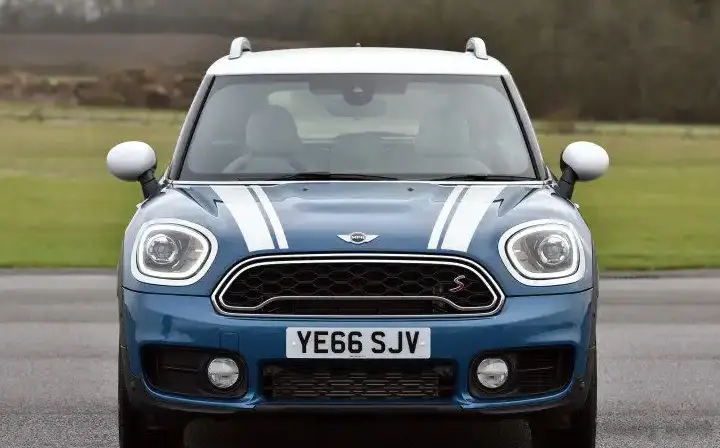
The Mini Countryman Cooper 1.5, producing 136 horsepower, was a key variant within the F60 Countryman generation, produced from 2017 to 2018. Positioned as an entry-level offering within the broader Countryman lineup, it aimed to provide the brand’s signature driving experience in a more practical, spacious package. The F60 Countryman represented Mini’s first foray into the compact SUV segment, built upon the UKL2 platform shared with BMW’s 2 Series Active Tourer. This variant specifically targeted buyers seeking a premium subcompact SUV with a focus on fuel efficiency and affordability, while still retaining the Mini brand’s characteristic style and handling.
Technical Specifications
| Brand | Mini |
| Model | Countryman |
| Generation | Countryman (F60) |
| Type (Engine) | Cooper 1.5 (136 Hp) |
| Start of production | 2017 |
| End of production | 2018 |
| Powertrain Architecture | Internal Combustion engine |
| Body type | SUV |
| Seats | 5 |
| Doors | 5 |
| Fuel consumption (urban) | 6.8-6.9 l/100 km (34.6 – 34.1 US mpg) |
| Fuel consumption (extra urban) | 4.8-5.0 l/100 km (49 – 47 US mpg) |
| Fuel consumption (combined) | 5.5-5.7 l/100 km (42.8 – 41.3 US mpg) |
| CO2 emissions | 126-130 g/km |
| Fuel Type | Petrol (Gasoline) |
| Acceleration 0 – 100 km/h | 9.6 sec |
| Acceleration 0 – 62 mph | 9.6 sec |
| Acceleration 0 – 60 mph | 9.1 sec |
| Maximum speed | 202 km/h (125.52 mph) |
| Emission standard | Euro 6 |
| Weight-to-power ratio | 10 kg/Hp, 99.6 Hp/tonne |
| Weight-to-torque ratio | 6.2 kg/Nm, 161.2 Nm/tonne |
| Power | 136 Hp @ 4400-6000 rpm |
| Torque | 220 Nm @ 1400-4300 rpm (162.26 lb.-ft. @ 1400-4300 rpm) |
| Engine layout | Front, Transverse |
| Engine Model/Code | B38A15A |
| Engine displacement | 1499 cm3 (91.47 cu. in.) |
| Number of cylinders | 3 |
| Engine configuration | Inline |
| Cylinder Bore | 82 mm (3.23 in.) |
| Piston Stroke | 94.6 mm (3.72 in.) |
| Compression ratio | 11:1 |
| Number of valves per cylinder | 4 |
| Fuel injection system | Direct injection |
| Engine aspiration | Turbocharger, Intercooler |
| Engine oil capacity | 4.25 l (4.49 US qt | 3.74 UK qt) |
| Coolant | 5.7 l (6.02 US qt | 5.02 UK qt) |
| Kerb Weight | 1365 kg (3009.31 lbs.) |
| Max. weight | 1950 kg (4299.01 lbs.) |
| Max load | 585 kg (1289.7 lbs.) |
| Trunk (boot) space – minimum | 450 l (15.89 cu. ft.) |
| Trunk (boot) space – maximum | 1390 l (49.09 cu. ft.) |
| Fuel tank capacity | 51 l (13.47 US gal | 11.22 UK gal) |
| Max. roof load | 75 kg (165.35 lbs.) |
| Permitted trailer load with brakes (12%) | 1500 kg (3306.93 lbs.) |
| Permitted trailer load without brakes | 715 kg (1576.31 lbs.) |
| Permitted towbar download | 75 kg (165.35 lbs.) |
| Length | 4299 mm (169.25 in.) |
| Width | 1822 mm (71.73 in.) |
| Height | 1557 mm (61.3 in.) |
| Wheelbase | 2670 mm (105.12 in.) |
| Front track | 1585 mm (62.4 in.) |
| Rear (Back) track | 1587 mm (62.48 in.) |
| Ride height (ground clearance) | 165 mm (6.5 in.) |
| Drag coefficient (Cd) | 0.32 |
| Minimum turning circle (turning diameter) | 11.4 m (37.4 ft.) |
| Drivetrain Architecture | The Internal combustion engine (ICE) drives the front wheels of the vehicle. |
| Drive wheel | Front wheel drive |
| Number of gears and type of gearbox | 6 gears, manual transmission |
| Front suspension | Independent, type McPherson with coil spring and anti-roll bar |
| Rear suspension | Independent multi-link suspension |
| Front brakes | Ventilated discs |
| Rear brakes | Disc |
| Assisting systems | ABS (Anti-lock braking system) |
| Steering type | Steering rack and pinion |
| Power steering | Electric Steering |
| Tires size | 205/65 R16 |
| Wheel rims size | 7J x 16 |
Powertrain & Engine Architecture
The heart of the Countryman Cooper 1.5 is the BMW-developed B38A15A 1.5-liter turbocharged inline-three cylinder engine. This engine is part of BMW’s modular engine family, known for its efficiency and compact size. It utilizes direct fuel injection, delivering fuel directly into the combustion chamber for improved combustion efficiency and reduced emissions. The engine also features a single twin-scroll turbocharger with an intercooler, which helps to mitigate turbo lag and provide a broader torque curve. The valvetrain employs four valves per cylinder, contributing to improved breathing and power output. The engine is transversely mounted in the front of the vehicle. The standard transmission for this variant was a six-speed manual, though an optional eight-speed automatic transmission was also available. The automatic transmission offered smoother shifts and enhanced convenience, but at the expense of some fuel economy and driver engagement.
Driving Characteristics
The 136-horsepower Cooper 1.5 offered a respectable, if not exhilarating, driving experience. Acceleration from 0-60 mph took approximately 9.1 seconds, making it competitive within the subcompact SUV segment. The turbocharger provided a noticeable boost in power, particularly in the mid-range, but the engine could feel somewhat strained at higher RPMs. The manual transmission offered precise shifts and allowed drivers to maximize the engine’s power, while the automatic transmission prioritized smoothness and ease of use. Compared to the more powerful Cooper S models, the 1.5 felt less urgent in its acceleration, but it provided a more relaxed and fuel-efficient driving experience. The Countryman’s suspension, tuned for comfort, absorbed bumps and imperfections in the road well, providing a comfortable ride for both driver and passengers.
Equipment & Trim Levels
The Countryman Cooper 1.5 came standard with a range of features, including Mini’s signature circular center display, automatic climate control, power windows and locks, and a basic audio system. Upholstery typically consisted of cloth seats, though leather options were available. Optional extras included a panoramic sunroof, navigation system, upgraded audio system, and various driver-assistance features such as parking sensors and a rearview camera. Trim levels beyond the base Cooper 1.5 often added cosmetic enhancements, such as unique alloy wheel designs and interior trim options. The overall interior design retained Mini’s quirky and stylish aesthetic, with a focus on creating a fun and engaging driving environment.
Chassis & Braking
The F60 Countryman utilized an independent suspension system on both the front and rear axles. The front suspension employed McPherson struts with coil springs and an anti-roll bar, while the rear suspension featured a multi-link setup. This configuration provided a good balance between ride comfort and handling precision. Braking duties were handled by ventilated discs at the front and solid discs at the rear, equipped with ABS (Anti-lock Braking System) as standard. The braking system provided adequate stopping power for everyday driving conditions. The chassis was designed to provide a stable and predictable driving experience, with a focus on minimizing body roll during cornering.
Market Reception & Comparison
The Mini Countryman Cooper 1.5 was generally well-received by automotive critics, who praised its stylish design, comfortable ride, and fuel efficiency. However, some reviewers noted that the engine could feel underpowered, particularly when fully loaded or driving uphill. Compared to other subcompact SUVs in its class, such as the Honda HR-V and Mazda CX-3, the Countryman offered a more premium interior and a more engaging driving experience, but at a higher price point. Fuel economy figures of around 42.8 mpg combined were competitive within the segment, making it an attractive option for buyers seeking a fuel-efficient SUV. Reliability reports were generally positive, with few major issues reported with the B38 engine and transmission.
Legacy
The B38 engine, found in the Countryman Cooper 1.5, has proven to be a relatively reliable powertrain. While some early models experienced minor issues with the timing chain tensioner, these were generally addressed through software updates and warranty repairs. On the used car market, the Countryman Cooper 1.5 represents a good value proposition for buyers seeking a stylish and well-equipped subcompact SUV. Its compact size, fuel efficiency, and engaging driving dynamics continue to appeal to a wide range of buyers. The F60 Countryman, and specifically this 1.5L variant, helped establish Mini as a serious contender in the competitive SUV market, paving the way for future generations of the model.

