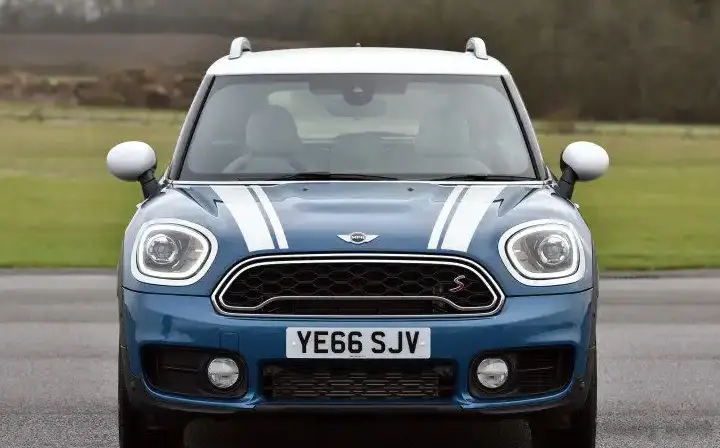
The Mini Countryman (F60) Cooper D 2.0 ALL4, produced from 2017 to 2018, represents a significant step in Mini’s expansion beyond its iconic small hatchbacks. This variant, positioned as a mid-range offering within the second-generation Countryman (F60) lineup, combined a 2.0-liter turbocharged diesel engine with Mini’s ALL4 all-wheel-drive system and a six-speed manual transmission. It aimed to provide a blend of fuel efficiency, practicality, and all-weather capability, appealing to buyers seeking a premium subcompact SUV. The F60 Countryman itself was a crucial model for Mini, broadening its appeal and competing directly with vehicles like the Audi Q3 and BMW X1.
Technical Specifications
| Brand | Mini |
| Model | Countryman |
| Generation | Countryman (F60) |
| Type (Engine) | Cooper D 2.0 (150 Hp) ALL4 |
| Start of production | 2017 |
| End of production | 2018 |
| Powertrain Architecture | Internal Combustion engine |
| Body type | SUV |
| Seats | 5 |
| Doors | 5 |
| Fuel consumption (urban) | 5.6-5.8 l/100 km (42 – 40.6 US mpg) |
| Fuel consumption (extra urban) | 4.4-4.6 l/100 km (53.5 – 51.1 US mpg) |
| Fuel consumption (combined) | 4.8-5.0 l/100 km (49 – 47 US mpg) |
| CO2 emissions | 127-132 g/km |
| Fuel Type | Diesel |
| Acceleration 0 – 100 km/h | 8.8 sec |
| Acceleration 0 – 62 mph | 8.8 sec |
| Acceleration 0 – 60 mph | 8.4 sec |
| Maximum speed | 205 km/h (127.38 mph) |
| Emission standard | Euro 6 |
| Weight-to-power ratio | 9.9 kg/Hp, 101 Hp/tonne |
| Weight-to-torque ratio | 4.5 kg/Nm, 222.2 Nm/tonne |
| Power | 150 Hp @ 4000 rpm |
| Torque | 330 Nm @ 1750-2500 rpm (243.4 lb.-ft. @ 1750-2500 rpm) |
| Engine layout | Front, Transverse |
| Engine Model/Code | B47C20B |
| Engine displacement | 1995 cm3 (121.74 cu. in.) |
| Number of cylinders | 4 |
| Engine configuration | Inline |
| Cylinder Bore | 84 mm (3.31 in.) |
| Piston Stroke | 90 mm (3.54 in.) |
| Compression ratio | 16.5:1 |
| Number of valves per cylinder | 4 |
| Fuel injection system | Diesel Commonrail |
| Engine aspiration | Turbocharger, Intercooler |
| Engine oil capacity | 5 l (5.28 US qt | 4.4 UK qt) |
| Coolant | 7 l (7.4 US qt | 6.16 UK qt) |
| Kerb Weight | 1485 kg (3273.86 lbs.) |
| Max. weight | 2090 kg (4607.66 lbs.) |
| Max load | 605 kg (1333.8 lbs.) |
| Trunk (boot) space – minimum | 450 l (15.89 cu. ft.) |
| Trunk (boot) space – maximum | 1390 l (49.09 cu. ft.) |
| Fuel tank capacity | 51 l (13.47 US gal | 11.22 UK gal) |
| Max. roof load | 75 kg (165.35 lbs.) |
| Permitted trailer load with brakes (12%) | 1800 kg (3968.32 lbs.) |
| Permitted trailer load without brakes | 750 kg (1653.47 lbs.) |
| Permitted towbar download | 75 kg (165.35 lbs.) |
| Length | 4299 mm (169.25 in.) |
| Width | 1822 mm (71.73 in.) |
| Height | 1557 mm (61.3 in.) |
| Wheelbase | 2670 mm (105.12 in.) |
| Front track | 1585 mm (62.4 in.) |
| Rear (Back) track | 1587 mm (62.48 in.) |
| Ride height (ground clearance) | 165 mm (6.5 in.) |
| Drag coefficient (Cd) | 0.32 |
| Minimum turning circle (turning diameter) | 11.4 m (37.4 ft.) |
| Drive wheel | All wheel drive (4×4) |
| Number of gears and type of gearbox | 6 gears, manual transmission |
| Front suspension | Independent, type McPherson with coil spring and anti-roll bar |
| Rear suspension | Independent multi-link suspension |
| Front brakes | Ventilated discs |
| Rear brakes | Disc |
Powertrain & Engine Architecture
The heart of the Cooper D 2.0 ALL4 is the BMW Group’s B47C20B 2.0-liter inline-four diesel engine. This engine is a member of the modular B-series engine family, known for its efficiency and refinement. It utilizes a common-rail direct injection system, delivering fuel at extremely high pressure for optimized combustion. The B47 engine features a single turbocharger with variable geometry turbine (VGT) technology, enhancing low-end torque and responsiveness. The engine also incorporates an intercooler to reduce intake air temperature, further improving performance. The six-speed manual transmission was standard, providing drivers with direct control over gear selection. The ALL4 system is a torque-on-demand all-wheel-drive system, primarily driving the front wheels but seamlessly engaging the rear axle when traction is needed.
Driving Characteristics
The 150 horsepower and 330 Nm (243 lb-ft) of torque delivered by the Cooper D 2.0 ALL4 provided adequate performance for everyday driving. Acceleration from 0 to 60 mph took approximately 8.4 seconds, and the car reached a top speed of 127.38 mph. While not a sports car, the engine offered a broad torque curve, making it easy to maintain speed on highways and navigate city streets. Compared to the more powerful Cooper S variants, the Cooper D prioritized fuel economy and relaxed cruising. The manual transmission, while engaging, offered a slightly less refined experience than the optional eight-speed automatic. The ALL4 system provided enhanced grip and stability, particularly in inclement weather conditions, making it a more confident vehicle than front-wheel-drive Countryman models.
Equipment & Trim Levels
The Cooper D 2.0 ALL4 typically came standard with features such as automatic climate control, a 6.5-inch infotainment system with Bluetooth connectivity, and a leather-wrapped steering wheel. Upholstery was typically cloth, but leather options were available. Optional extras included a larger touchscreen display, navigation system, panoramic sunroof, and a variety of driver-assistance systems like parking sensors and automatic emergency braking. Trim levels could vary slightly depending on the market, but generally, the Cooper D ALL4 sat in the middle of the Countryman range, offering a good balance of features and price.
Chassis & Braking
The F60 Countryman utilizes a McPherson strut front suspension and a multi-link rear suspension, providing a comfortable and controlled ride. The suspension was tuned to balance handling and comfort, making it suitable for both urban and highway driving. Brakes consisted of ventilated discs at the front and solid discs at the rear. ABS (Anti-lock Braking System) was standard, along with electronic stability control. The steering system was an electric power-assisted rack and pinion, offering precise and responsive steering feel.
Market Reception & Comparison
The Mini Countryman Cooper D 2.0 ALL4 was generally well-received by automotive critics. It was praised for its fuel efficiency, comfortable ride, and all-weather capability. However, some reviewers noted that the engine could feel strained when pushed hard, and the interior, while stylish, could be a bit cramped for taller passengers. Compared to the petrol-powered Cooper S variants, the Cooper D offered significantly better fuel economy, but at the expense of outright performance. Against competitors like the Audi Q3 and BMW X1, the Countryman offered a more distinctive and playful driving experience, but often at a slightly higher price point.
Legacy
The B47 engine, used in the Cooper D 2.0 ALL4, has proven to be a relatively reliable powertrain, although some early models experienced issues with the timing chain. Regular maintenance, including oil changes and filter replacements, is crucial for long-term reliability. On the used car market, the F60 Countryman Cooper D 2.0 ALL4 remains a popular choice for buyers seeking a stylish and practical subcompact SUV. Its combination of fuel efficiency, all-wheel drive, and Mini’s distinctive brand appeal continues to make it a compelling option.