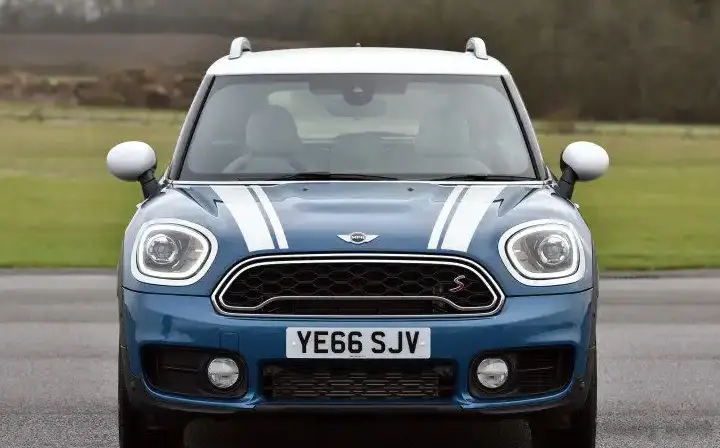
The Mini Countryman (F60) Cooper D 2.0 Steptronic, produced from 2017 to 2018, represents a significant step in Mini’s expansion beyond its iconic small hatchbacks. Positioned as a more practical and spacious offering, the F60 Countryman aimed to capture a broader segment of the market, particularly those seeking a premium subcompact SUV. This specific variant, powered by a 2.0-liter turbocharged diesel engine producing 150 horsepower and paired with a six-speed Steptronic automatic transmission, served as a mid-range option within the Countryman lineup, balancing fuel efficiency with acceptable performance. It was a key model for Mini in Europe and increasingly in North America, where the demand for compact SUVs was rapidly growing.
Technical Specifications
| Brand | Mini |
| Model | Countryman |
| Generation | Countryman (F60) |
| Type (Engine) | Cooper D 2.0 (150 Hp) Steptronic |
| Start of production | 2017 |
| End of production | 2018 |
| Powertrain Architecture | Internal Combustion engine |
| Body type | SUV |
| Seats | 5 |
| Doors | 5 |
| Fuel consumption (urban) | 4.8-4.9 l/100 km (49 – 48 US mpg, 58.9 – 57.6 UK mpg, 20.8 – 20.4 km/l) |
| Fuel consumption (extra urban) | 4.1-4.3 l/100 km (57.4 – 54.7 US mpg, 68.9 – 65.7 UK mpg, 24.4 – 23.3 km/l) |
| Fuel consumption (combined) | 4.4-4.6 l/100 km (53.5 – 51.1 US mpg, 64.2 – 61.4 UK mpg, 22.7 – 21.7 km/l) |
| CO2 emissions | 115-120 g/km |
| Fuel Type | Diesel |
| Acceleration 0 – 100 km/h | 8.8 sec |
| Acceleration 0 – 62 mph | 8.8 sec |
| Acceleration 0 – 60 mph | 8.4 sec |
| Maximum speed | 208 km/h (129.25 mph) |
| Emission standard | Euro 6 |
| Weight-to-power ratio | 9.5 kg/Hp, 104.9 Hp/tonne |
| Weight-to-torque ratio | 4.3 kg/Nm, 230.8 Nm/tonne |
| Power | 150 Hp @ 4000 rpm |
| Torque | 330 Nm @ 1750-2500 rpm (243.4 lb.-ft. @ 1750-2500 rpm) |
| Engine layout | Front, Transverse |
| Engine Model/Code | B47C20B |
| Engine displacement | 1995 cm3 (121.74 cu. in.) |
| Number of cylinders | 4 |
| Engine configuration | Inline |
| Cylinder Bore | 84 mm (3.31 in.) |
| Piston Stroke | 90 mm (3.54 in.) |
| Compression ratio | 16.5:1 |
| Number of valves per cylinder | 4 |
| Fuel injection system | Diesel Commonrail |
| Engine aspiration | Turbocharger, Intercooler |
| Engine oil capacity | 5 l (5.28 US qt | 4.4 UK qt) |
| Coolant | 7 l (7.4 US qt | 6.16 UK qt) |
| Kerb Weight | 1430 kg (3152.61 lbs.) |
| Max. weight | 2030 kg (4475.38 lbs.) |
| Max load | 600 kg (1322.77 lbs.) |
| Trunk (boot) space – minimum | 450 l (15.89 cu. ft.) |
| Trunk (boot) space – maximum | 1390 l (49.09 cu. ft.) |
| Fuel tank capacity | 51 l (13.47 US gal | 11.22 UK gal) |
| Max. roof load | 75 kg (165.35 lbs.) |
| Permitted trailer load with brakes (12%) | 1500 kg (3306.93 lbs.) |
| Permitted trailer load without brakes | 730 kg (1609.37 lbs.) |
| Permitted towbar download | 75 kg (165.35 lbs.) |
| Length | 4299 mm (169.25 in.) |
| Width | 1822 mm (71.73 in.) |
| Height | 1557 mm (61.3 in.) |
| Wheelbase | 2670 mm (105.12 in.) |
| Front track | 1585 mm (62.4 in.) |
| Rear (Back) track | 1587 mm (62.48 in.) |
| Ride height (ground clearance) | 165 mm (6.5 in.) |
| Drag coefficient (Cd) | 0.31 |
| Minimum turning circle (turning diameter) | 11.4 m (37.4 ft.) |
| Drivetrain Architecture | The Internal combustion engine (ICE) drives the front wheels of the vehicle. |
| Drive wheel | Front wheel drive |
| Front suspension | Independent, type McPherson with coil spring and anti-roll bar |
| Rear suspension | Independent multi-link suspension |
| Front brakes | Ventilated discs |
| Rear brakes | Disc |
| Assisting systems | ABS (Anti-lock braking system) |
| Steering type | Steering rack and pinion |
| Power steering | Electric Steering |
| Tires size | 205/65 R16 |
| Wheel rims size | 7J x 16 |
INTRODUCTION
The F60 Mini Countryman, launched in 2017, marked the second generation of Mini’s larger, more versatile model. Built on the UKL2 platform (shared with BMW’s 2 Series Active Tourer), the Countryman offered a significant increase in interior space and practicality compared to the standard Mini hatchback. The Cooper D 2.0 Steptronic variant, utilizing BMW’s B47C20B engine, was a popular choice, particularly in European markets where diesel engines remained dominant. It slotted into the lineup as a balance between the entry-level Cooper and the more performance-oriented Cooper S models, appealing to buyers prioritizing fuel economy and comfortable cruising.
Powertrain & Engine Architecture
At the heart of the Cooper D 2.0 Steptronic lies the BMW B47C20B, a 2.0-liter inline-four cylinder diesel engine. This engine is a member of BMW’s modular engine family, known for its efficiency and refinement. It features a common-rail direct injection system operating at pressures up to 2,000 bar, ensuring precise fuel delivery and optimized combustion. The engine also incorporates a variable geometry turbocharger (VGT) with intercooling, which helps to deliver strong torque across a wide rev range. The Steptronic six-speed automatic transmission is a conventional torque-converter type, offering smooth shifts and a focus on comfort. While not as sporty as some dual-clutch transmissions, it was well-suited to the Cooper D’s character. The engine produces 150 horsepower at 4,000 rpm and a substantial 330 Nm (243 lb-ft) of torque between 1,750 and 2,500 rpm.
Driving Characteristics
The Cooper D 2.0 Steptronic delivers a relaxed and refined driving experience. The 330 Nm of torque provides ample pulling power for everyday driving and overtaking maneuvers, despite the relatively modest 150 horsepower output. The automatic transmission is programmed for smooth, seamless shifts, prioritizing fuel efficiency over aggressive acceleration. Compared to the six-speed manual version, the Steptronic offers greater convenience, especially in urban traffic. However, it does slightly diminish the sense of driver engagement. Against the more powerful Cooper S models, the Cooper D feels noticeably slower, with a 0-60 mph time of around 8.4 seconds. The gear ratios are optimized for fuel economy, meaning the engine doesn’t rev as freely as in the Cooper S. The front-wheel-drive configuration provides predictable handling, but lacks the all-weather capability of the optional ALL4 all-wheel-drive system.
Equipment & Trim Levels
The Cooper D 2.0 Steptronic typically came equipped with a respectable level of standard features. These included air conditioning, a 6.5-inch infotainment system with Mini Connected services, Bluetooth connectivity, and a leather-wrapped steering wheel. Safety features such as ABS, stability control, and multiple airbags were also standard. Optional extras included a larger 8.8-inch infotainment screen with navigation, a panoramic sunroof, heated seats, and a variety of exterior styling packages. Interior upholstery options ranged from basic cloth to premium leather. Trim levels could vary slightly depending on the market, but generally, the Cooper D Steptronic occupied a mid-range position, offering a good balance of features and affordability.
Chassis & Braking
The F60 Countryman utilizes a McPherson strut front suspension and a multi-link rear suspension, providing a comfortable and controlled ride. The suspension is tuned to prioritize comfort over outright sportiness, absorbing bumps and imperfections in the road effectively. The front brakes are ventilated discs, while the rear brakes are solid discs. ABS (Anti-lock Braking System) is standard, providing enhanced stopping power and stability. The steering is electrically assisted, offering light and precise control. The chassis is relatively robust, contributing to the Countryman’s solid feel on the road. Stabilizer bars are fitted front and rear to reduce body roll during cornering.
Market Reception & Comparison
The Mini Countryman Cooper D 2.0 Steptronic was generally well-received by automotive critics. It was praised for its fuel efficiency, comfortable ride, and spacious interior. However, some reviewers noted that the diesel engine could be somewhat noisy under hard acceleration, and the automatic transmission wasn’t as engaging as some alternatives. Compared to the petrol-powered Cooper, the Cooper D offered significantly better fuel economy, making it a more practical choice for long-distance driving. Against the Cooper S, it lacked the same level of performance, but was more affordable and offered lower running costs. Reliability reports have been generally positive, although some owners have reported issues with the diesel particulate filter (DPF) system, a common concern with modern diesel engines.
Legacy
The F60 Countryman Cooper D 2.0 Steptronic remains a popular choice in the used car market. Its combination of fuel efficiency, practicality, and brand appeal continues to attract buyers. The B47 engine, while having some known issues with the timing chain on some BMW applications, has proven to be generally durable when properly maintained. Regular servicing, including oil changes and DPF regeneration, is crucial for long-term reliability. The Steptronic transmission is also generally reliable, but requires fluid changes at the recommended intervals. As a whole, the Cooper D 2.0 Steptronic represents a well-rounded and capable compact SUV that offers a compelling blend of style, comfort, and economy.