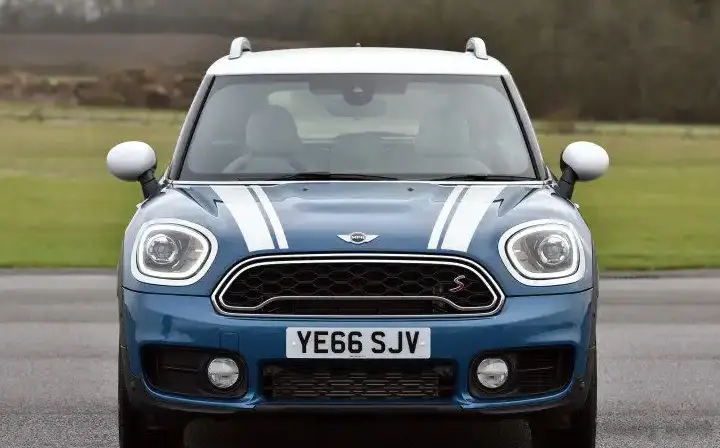
The Mini Countryman Cooper D 2.0 (150 hp) is a front-wheel-drive subcompact SUV produced by Mini from June 2020 to October 2023 as part of the F60 facelift generation. Positioned as a fuel-efficient and practical option within the Countryman lineup, it served as a key entry point for diesel buyers, offering a balance between performance and economy. This variant aimed to appeal to customers seeking a versatile vehicle for both urban commuting and longer journeys, while benefiting from the updated styling and technology introduced with the 2020 facelift.
Technical Specifications
| Brand | Mini |
| Model | Countryman |
| Generation | Countryman (F60, facelift 2020) |
| Type (Engine) | Cooper D 2.0 (150 Hp) |
| Start of production | June, 2020 |
| End of production | October, 2023 |
| Powertrain Architecture | Internal Combustion engine |
| Body type | SUV |
| Seats | 5 |
| Doors | 5 |
| Fuel consumption (urban) | 4.8-5.0 l/100 km (49 – 47 US mpg, 58.9 – 56.5 UK mpg, 20.8 – 20 km/l) |
| Fuel consumption (extra urban) | 3.8-4.0 l/100 km (61.9 – 58.8 US mpg, 74.3 – 70.6 UK mpg, 26.3 – 25 km/l) |
| Fuel consumption (combined) | 4.2-4.4 l/100 km (56 – 53.5 US mpg, 67.3 – 64.2 UK mpg, 23.8 – 22.7 km/l) |
| CO2 emissions | 110-116 g/km |
| Fuel Type | Diesel |
| Acceleration 0 – 100 km/h | 9.1 sec |
| Acceleration 0 – 62 mph | 9.1 sec |
| Acceleration 0 – 60 mph | 8.6 sec |
| Maximum speed | 214 km/h (132.97 mph) |
| Emission standard | Euro 6d |
| Weight-to-power ratio | 9.8 kg/Hp, 101.7 Hp/tonne |
| Weight-to-torque ratio | 4.2 kg/Nm, 237.3 Nm/tonne |
| Power | 150 Hp @ 4000 rpm |
| Torque | 350 Nm @ 1750-2500 rpm (258.15 lb.-ft. @ 1750-2500 rpm) |
| Engine layout | Front, Transverse |
| Engine Model/Code | B47C20B |
| Engine displacement | 1995 cm3 (121.74 cu. in.) |
| Number of cylinders | 4 |
| Engine configuration | Inline |
| Cylinder Bore | 84 mm (3.31 in.) |
| Piston Stroke | 90 mm (3.54 in.) |
| Compression ratio | 16.5:1 |
| Number of valves per cylinder | 4 |
| Fuel injection system | Diesel Commonrail |
| Engine aspiration | Turbocharger, Intercooler |
| Engine oil capacity | 5.5 l (5.81 US qt | 4.84 UK qt) |
| Coolant | 7 l (7.4 US qt | 6.16 UK qt) |
| Kerb Weight | 1475 kg (3251.82 lbs.) |
| Max. weight | 2050 kg (4519.48 lbs.) |
| Max load | 575 kg (1267.66 lbs.) |
| Trunk (boot) space – minimum | 450 l (15.89 cu. ft.) |
| Trunk (boot) space – maximum | 1390 l (49.09 cu. ft.) |
| Fuel tank capacity | 51 l (13.47 US gal | 11.22 UK gal) |
| Max. roof load | 75 kg (165.35 lbs.) |
| Permitted trailer load with brakes (12%) | 1500 kg (3306.93 lbs.) |
| Permitted trailer load without brakes | 750 kg (1653.47 lbs.) |
| Permitted towbar download | 75 kg (165.35 lbs.) |
| Length | 4297 mm (169.17 in.) |
| Width | 1822 mm (71.73 in.) |
| Width including mirrors | 2001 mm (78.78 in.) |
| Height | 1557 mm (61.3 in.) |
| Wheelbase | 2670 mm (105.12 in.) |
| Front track | 1585 mm (62.4 in.) |
| Rear (Back) track | 1587 mm (62.48 in.) |
| Ride height (ground clearance) | 165 mm (6.5 in.) |
| Drag coefficient (Cd) | 0.30 |
| Minimum turning circle (turning diameter) | 11.4 m (37.4 ft.) |
| Drivetrain Architecture | The Internal combustion engine (ICE) drives the front wheels of the vehicle. |
| Drive wheel | Front wheel drive |
| Number of gears and type of gearbox | 6 gears, manual transmission |
| Front suspension | Independent, type McPherson with coil spring and anti-roll bar |
| Rear suspension | Independent multi-link suspension |
| Front brakes | Ventilated discs |
| Rear brakes | Disc |
| Assisting systems | ABS (Anti-lock braking system) |
| Steering type | Steering rack and pinion |
| Power steering | Electric Steering |
| Tires size | 205/65 R16 95W |
| Wheel rims size | 7J x 16 |
INTRODUCTION
The F60 Mini Countryman, launched in 2010, represented Mini’s entry into the compact SUV segment. The facelifted version released in 2020 brought updated styling, improved technology, and refined engine options. The Cooper D 2.0 (150 hp) variant, powered by the BMW Group’s B47 diesel engine, was a significant offering in many European markets, where diesel fuel remained popular. In the US market, diesel options were less common, but the Countryman still appealed to buyers seeking fuel efficiency and a premium driving experience. This particular configuration occupied a mid-range position in the Countryman lineup, offering a step up in performance from the base Cooper models while remaining more accessible than the performance-oriented John Cooper Works variants.
Powertrain & Engine Architecture
At the heart of the Cooper D 2.0 lies the BMW B47C20B, a 2.0-liter inline-four cylinder diesel engine. This engine is a member of the modular BMW engine family, known for its efficiency and reliability. The B47 utilizes a common-rail direct injection system, delivering fuel at extremely high pressure for optimized combustion. A single turbocharger with an intercooler provides forced induction, boosting power and torque. The engine produces 150 horsepower at 4000 rpm and 350 Nm (258 lb-ft) of torque between 1750 and 2500 rpm. This torque curve provides strong low-end and mid-range acceleration, making it well-suited for everyday driving. The engine features four valves per cylinder and a compression ratio of 16.5:1. The 6-speed manual transmission was standard, offering precise gear changes and a direct connection to the engine.
Driving Characteristics
The 150 hp Cooper D 2.0 offered a comfortable and refined driving experience. While not overtly sporty, the engine’s ample torque allowed for effortless cruising and confident overtaking. The 0-60 mph acceleration time of around 8.6 seconds was respectable for a diesel-powered SUV. Compared to the more powerful Cooper S or John Cooper Works models, the Cooper D prioritized fuel economy over outright performance. The manual transmission, while engaging, had slightly longer throws than some competitors. The suspension, tuned for comfort, absorbed bumps and imperfections in the road well, providing a smooth ride. The front-wheel-drive configuration offered predictable handling, although it could exhibit some torque steer under hard acceleration.
Equipment & Trim Levels
The Cooper D 2.0 typically came standard with features such as air conditioning, a 6.5-inch infotainment system with Bluetooth connectivity, and cloth upholstery. Higher trim levels offered upgrades like leather seats, a larger touchscreen display, navigation, and a panoramic sunroof. Optional extras included adaptive cruise control, parking sensors, and a premium sound system. The interior design was characteristic of Mini, with a focus on retro styling and playful details. The dashboard featured a centrally mounted circular display, and the toggle switches added a touch of individuality.
Chassis & Braking
The Countryman F60 utilized a McPherson strut front suspension and a multi-link rear suspension, providing a good balance between ride comfort and handling. The front brakes were ventilated discs, while the rear brakes were solid discs. Anti-lock Braking System (ABS) was standard. The chassis was designed to minimize weight while maximizing rigidity, contributing to the vehicle’s stability and responsiveness. The steering was electrically assisted, providing light and precise control.
Market Reception & Comparison
The Cooper D 2.0 was generally well-received by automotive critics for its fuel efficiency and practicality. It offered a compelling alternative to gasoline-powered SUVs, particularly for drivers who covered long distances. Compared to the Cooper S, the Cooper D was more economical but less exciting to drive. The 1.5-liter three-cylinder diesel variants offered even better fuel economy but lacked the power and refinement of the 2.0-liter engine. Reliability was generally good, although some owners reported issues with the diesel particulate filter (DPF) system, a common concern with modern diesel engines.
Legacy
The Mini Countryman Cooper D 2.0 (150 hp) remains a popular choice in the used car market, particularly in Europe. Its combination of fuel efficiency, practicality, and brand appeal continues to attract buyers. The B47 engine, while known for some potential DPF issues, is generally considered a robust and reliable unit when properly maintained. As diesel technology evolves, the Cooper D 2.0 represents a transitional period, offering a balance between traditional diesel characteristics and modern emissions control technologies. Its enduring popularity is a testament to its well-rounded design and enduring appeal.