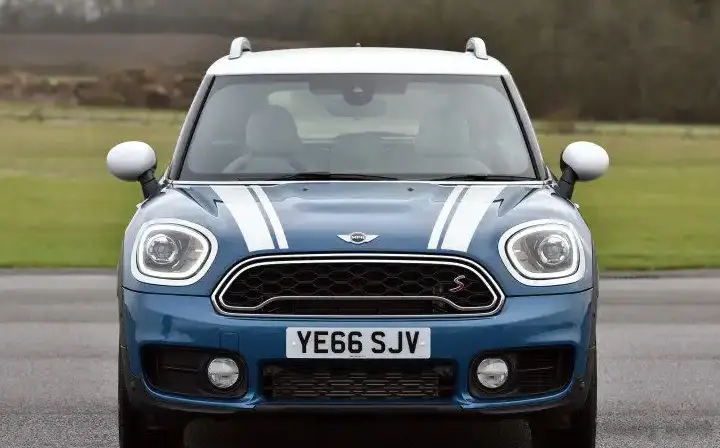
The Mini Countryman One D 1.5 (116 hp) represents a fuel-efficient entry point into the second-generation F60 Countryman lineup, specifically those produced after the 2020 facelift. Introduced as a diesel option, it aimed to provide a balance of practicality, running costs, and the signature Mini driving experience. Production of this variant ran from 2020 until July 2022. Positioned as the base diesel model, it catered to buyers prioritizing economy and lower running costs over outright performance. It slots into the broader Countryman range which included petrol variants like the Cooper and Cooper S, as well as more powerful diesel options.
Technical Specifications
| Brand | Mini |
| Model | Countryman |
| Generation | Countryman (F60, facelift 2020) |
| Type (Engine) | One D 1.5 (116 Hp) |
| Start of production | 2020 |
| End of production | July, 2022 |
| Powertrain Architecture | Internal Combustion engine |
| Body type | SUV |
| Seats | 5 |
| Doors | 5 |
| Fuel consumption (urban) | 4.8-5.1 l/100 km (49 – 46.1 US mpg, 58.9 – 55.4 UK mpg, 20.8 – 19.6 km/l) |
| Fuel consumption (extra urban) | 3.7-4.0 l/100 km (63.6 – 58.8 US mpg, 76.3 – 70.6 UK mpg, 27 – 25 km/l) |
| Fuel consumption (combined) | 4.1-4.4 l/100 km (57.4 – 53.5 US mpg, 68.9 – 64.2 UK mpg, 24.4 – 22.7 km/l) |
| CO2 emissions | 107-116 g/km |
| Fuel Type | Diesel |
| Acceleration 0 – 100 km/h | 11.2 sec |
| Acceleration 0 – 62 mph | 11.2 sec |
| Acceleration 0 – 60 mph | 10.6 sec |
| Maximum speed | 192 km/h (119.3 mph) |
| Emission standard | Euro 6d |
| Weight-to-power ratio | 12.4 kg/Hp, 80.6 Hp/tonne |
| Weight-to-torque ratio | 5.3 kg/Nm, 187.5 Nm/tonne |
| Power | 116 Hp @ 4000 rpm |
| Torque | 270 Nm @ 1750-2250 rpm (199.14 lb.-ft. @ 1750-2250 rpm) |
| Engine layout | Front, Transverse |
| Engine Model/Code | B37C15A |
| Engine displacement | 1496 cm3 (91.29 cu. in.) |
| Number of cylinders | 3 |
| Engine configuration | Inline |
| Cylinder Bore | 84 mm (3.31 in.) |
| Piston Stroke | 90 mm (3.54 in.) |
| Compression ratio | 16.5:1 |
| Number of valves per cylinder | 4 |
| Fuel injection system | Diesel Commonrail |
| Engine aspiration | Turbocharger, Intercooler |
| Engine oil capacity | 4.8 l (5.07 US qt | 4.22 UK qt) |
| Engine systems | Start & Stop System, Particulate filter |
| Kerb Weight | 1440 kg (3174.66 lbs.) |
| Max. weight | 2015 kg (4442.31 lbs.) |
| Max load | 575 kg (1267.66 lbs.) |
| Trunk (boot) space – minimum | 450 l (15.89 cu. ft.) |
| Trunk (boot) space – maximum | 1390 l (49.09 cu. ft.) |
| Fuel tank capacity | 51 l (13.47 US gal | 11.22 UK gal) |
| Max. roof load | 75 kg (165.35 lbs.) |
| Permitted trailer load with brakes (12%) | 1500 kg (3306.93 lbs.) |
| Permitted trailer load without brakes | 750 kg (1653.47 lbs.) |
| Permitted towbar download | 75 kg (165.35 lbs.) |
| Length | 4297 mm (169.17 in.) |
| Width | 1822 mm (71.73 in.) |
| Width including mirrors | 2001 mm (78.78 in.) |
| Height | 1557 mm (61.3 in.) |
| Wheelbase | 2670 mm (105.12 in.) |
| Front track | 1585 mm (62.4 in.) |
| Rear (Back) track | 1587 mm (62.48 in.) |
| Ride height (ground clearance) | 165 mm (6.5 in.) |
| Drag coefficient (Cd) | 0.30 |
| Minimum turning circle (turning diameter) | 11.4 m (37.4 ft.) |
| Drivetrain Architecture | The Internal combustion engine (ICE) drives the front wheels of the vehicle. |
| Drive wheel | Front wheel drive |
| Number of gears and type of gearbox | 6 gears, manual transmission |
| Front suspension | Independent, type McPherson with coil spring and anti-roll bar |
| Rear suspension | Independent multi-link suspension |
| Front brakes | Ventilated discs |
| Rear brakes | Disc |
| Assisting systems | ABS (Anti-lock braking system) |
| Steering type | Steering rack and pinion |
| Power steering | Electric Steering |
| Tires size | 205/65 R16 95W |
| Wheel rims size | 7J x 16 |
INTRODUCTION
The Mini Countryman One D 1.5, launched after the 2020 facelift of the F60 generation, offered a more economical diesel option within the Countryman range. The F60 Countryman, introduced in 2016, represented Mini’s foray into a more spacious, crossover-style vehicle, building upon the success of the smaller Mini Hatch. This facelift brought styling updates, revised technology, and powertrain refinements. The One D 1.5, with its 1.5-liter three-cylinder diesel engine, was designed to appeal to buyers seeking low running costs and reasonable practicality in a premium-branded package. It was primarily sold in the European market, where diesel engines remained popular due to fuel efficiency and tax incentives.
Powertrain & Engine Architecture
At the heart of the Countryman One D 1.5 lies the BMW Group’s B37C15A engine. This is a 1.5-liter inline three-cylinder diesel engine, part of the modular engine family shared across several BMW and Mini models. It utilizes a turbocharger with an intercooler to boost power and efficiency. The engine employs a common-rail direct fuel injection system, delivering fuel directly into the combustion chamber at high pressure for optimized combustion. The valvetrain features four valves per cylinder, contributing to improved breathing and performance. The engine produces 116 horsepower at 4000 rpm and 270 Nm (199 lb-ft) of torque between 1750 and 2250 rpm. The engine is transversely mounted at the front of the vehicle. The 6-speed manual transmission was standard, offering a balance between fuel economy and driver engagement. While an automatic transmission was available on other Countryman models, it wasn’t offered with the One D 1.5.
Driving Characteristics
The Countryman One D 1.5, with its 116 hp and manual transmission, provided adequate, but not exhilarating, performance. Acceleration from 0-60 mph took around 10.6 seconds, and top speed was 119.3 mph. The engine’s torque peak, available from relatively low revs, provided decent responsiveness for everyday driving situations. The manual gearbox, while engaging, had relatively long throws. The gear ratios were tuned for fuel efficiency, meaning the engine needed to be revved to access its full potential. Compared to the more powerful Cooper D or Cooper S variants, the One D 1.5 felt noticeably slower, particularly during overtaking maneuvers. However, its strength lay in its fuel economy and relaxed cruising ability. The relatively low power output also meant less stress on the drivetrain, potentially contributing to long-term reliability.
Equipment & Trim Levels
The One D 1.5 typically came with a reasonable level of standard equipment, reflecting its position as an entry-level model. Standard features included air conditioning, a 6.5-inch infotainment system with Bluetooth connectivity, and basic safety equipment like ABS, airbags, and stability control. Interior upholstery was typically cloth, with a functional, if not luxurious, design. Optional extras included larger infotainment screens, navigation, parking sensors, a panoramic sunroof, and upgraded interior trim materials. The Countryman One D 1.5 could be specified with various Mini personalization options, allowing buyers to customize the exterior and interior to their preferences. Trim levels were often bundled with specific option packages, making it easier to add desired features.
Chassis & Braking
The Countryman One D 1.5 utilized a front-wheel-drive configuration. The front suspension employed a McPherson strut setup with coil springs and an anti-roll bar, while the rear featured a multi-link independent suspension. This suspension setup aimed to provide a balance between ride comfort and handling agility. Braking duties were handled by ventilated discs at the front and solid discs at the rear. ABS (Anti-lock Braking System) was standard. The chassis was tuned to prioritize comfort and stability over outright sportiness, reflecting the One D 1.5’s focus on practicality and fuel efficiency. The relatively lower weight compared to higher-powered variants contributed to decent braking performance.
Market Reception & Comparison
The Countryman One D 1.5 was generally well-received by critics as a sensible and economical option within the Countryman range. Reviewers praised its fuel efficiency and low running costs, but noted its lack of outright performance compared to other variants. Compared to the Cooper D, the One D 1.5 offered lower purchase price and better fuel economy, but at the expense of power and acceleration. Against competitors like the Nissan Qashqai or Volkswagen Tiguan, the Countryman One D 1.5 offered a more premium brand image and a more engaging driving experience, but typically at a higher price point. Reliability reports suggested the B37 engine was generally robust, but like all diesel engines, it was susceptible to issues with the diesel particulate filter (DPF) if not driven on longer journeys regularly.
Legacy
The Countryman One D 1.5, while not the most powerful or exciting version of the F60 Countryman, remains a popular choice in the used car market, particularly for buyers seeking a fuel-efficient and relatively affordable crossover. The B37 engine, when properly maintained, has proven to be reasonably reliable. However, potential buyers should be aware of the potential for DPF issues and ensure the vehicle has a full service history. The One D 1.5 represents a pragmatic and economical entry point into the Mini Countryman ownership experience, offering a blend of practicality, style, and fuel efficiency.