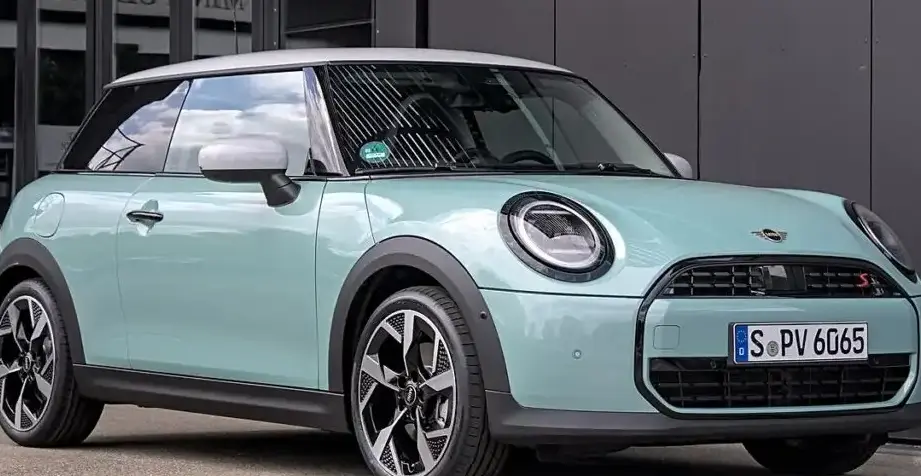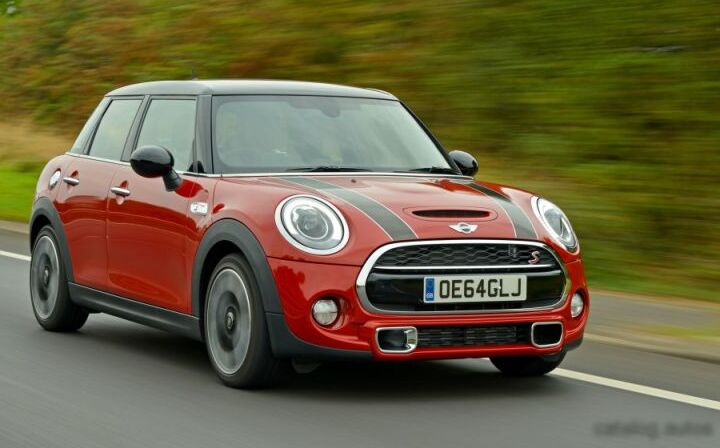
The Mini Hatch (F55) 5-door Cooper D 1.5, producing 116 horsepower, was a key variant in the third generation of the modern Mini, launched in March 2014 and continuing through 2018. Positioned as a fuel-efficient and practical option within the F55 range, it catered to buyers seeking the iconic Mini style with lower running costs. This five-door model expanded the Mini’s appeal, offering increased rear passenger space and usability compared to the traditional three-door hatchback. The Cooper D 1.5 represented a significant step towards broadening the Mini’s market reach, particularly in Europe where diesel engines were highly favored.
Technical Specifications
| Brand | Mini |
| Model | Hatch |
| Generation | Hatch (F55) 5-door |
| Type (Engine) | Cooper D 1.5 (116 Hp) |
| Start of production | March, 2014 |
| End of production | 2018 |
| Powertrain Architecture | Internal Combustion engine |
| Body type | Hatchback |
| Seats | 5 |
| Doors | 5 |
| Fuel consumption (urban) | 4.4 – 4.5 l/100 km (53.5 – 52.3 US mpg, 64.2 – 62.8 UK mpg, 22.7 – 22.2 km/l) |
| Fuel consumption (extra urban) | 3.2 – 3.3 l/100 km (73.5 – 71.3 US mpg, 88.3 – 85.6 UK mpg, 31.3 – 30.3 km/l) |
| Fuel consumption (combined) | 3.6 – 3.7 l/100 km (65.3 – 63.6 US mpg, 78.5 – 76.3 UK mpg, 27.8 – 27 km/l) |
| CO2 emissions | 95 – 97 g/km |
| Fuel Type | Diesel |
| Acceleration 0 – 100 km/h | 9.4 sec |
| Acceleration 0 – 62 mph | 9.4 sec |
| Acceleration 0 – 60 mph | 8.9 sec |
| Maximum speed | 203 km/h (126.14 mph) |
| Emission standard | Euro 6 |
| Weight-to-power ratio | 10.3 kg/Hp, 97.5 Hp/tonne |
| Weight-to-torque ratio | 4.4 kg/Nm, 226.9 Nm/tonne |
| Power | 116 Hp @ 4000 rpm |
| Power per litre | 77.5 Hp/l |
| Torque | 270 Nm @ 1750 rpm (199.14 lb.-ft. @ 1750 rpm) |
| Engine layout | Front, Transverse |
| Engine Model/Code | B37C15A |
| Engine displacement | 1496 cm3 (91.29 cu. in.) |
| Number of cylinders | 3 |
| Engine configuration | Inline |
| Cylinder Bore | 84 mm (3.31 in.) |
| Piston Stroke | 90 mm (3.54 in.) |
| Compression ratio | 16.5:1 |
| Number of valves per cylinder | 4 |
| Fuel injection system | Diesel Commonrail |
| Engine aspiration | Turbocharger, Intercooler |
| Engine oil capacity | 4.8 l (5.07 US qt | 4.22 UK qt) |
| Coolant | 6 l (6.34 US qt | 5.28 UK qt) |
| Kerb Weight | 1190 kg (2623.5 lbs.) |
| Max. weight | 1720 kg (3791.95 lbs.) |
| Max load | 530 kg (1168.45 lbs.) |
| Trunk (boot) space – minimum | 278 l (9.82 cu. ft.) |
| Trunk (boot) space – maximum | 941 l (33.23 cu. ft.) |
| Fuel tank capacity | 44 l (11.62 US gal | 9.68 UK gal) |
| Length | 3982 mm (156.77 in.) |
| Width | 1727 mm (67.99 in.) |
| Height | 1425 mm (56.1 in.) |
| Wheelbase | 2567 mm (101.06 in.) |
| Front track | 1501 mm (59.09 in.) |
| Rear (Back) track | 1501 mm (59.09 in.) |
| Ride height (ground clearance) | 146 mm (5.75 in.) |
| Minimum turning circle | 11 m (36.09 ft.) |
| Drivetrain Architecture | The Internal combustion engine (ICE) drives the front wheels of the vehicle. |
| Drive wheel | Front wheel drive |
| Number of gears and type of gearbox | 6 gears, manual transmission |
| Front suspension | Independent, type McPherson with coil spring and anti-roll bar |
| Rear suspension | Independent multi-link suspension |
| Front brakes | Ventilated discs |
| Rear brakes | Disc |
| Assisting systems | ABS (Anti-lock braking system) |
| Steering type | Steering rack and pinion |
| Tires size | 175/65 R15 84H |
| Wheel rims size | 5.5J x 15 |
Powertrain & Engine Architecture
The heart of the Cooper D 1.5 was the BMW Group’s B37C15A 1.5-liter three-cylinder turbocharged diesel engine. This engine was part of the modular engine family developed jointly by BMW and Mini, emphasizing efficiency and reduced emissions. The B37 featured a single overhead camshaft, four valves per cylinder, and a sophisticated common-rail direct fuel injection system operating at pressures up to 1,800 bar. This high-pressure injection ensured fine atomization of the fuel, leading to cleaner combustion and improved fuel economy. A turbocharger with an intercooler boosted power output, delivering 116 hp at 4,000 rpm and 270 Nm (199 lb-ft) of torque from as low as 1,750 rpm. The engine incorporated a diesel particulate filter (DPF) to meet stringent Euro 6 emission standards. The standard transmission was a six-speed manual gearbox, although a six-speed automatic transmission was also available as an option.
Driving Characteristics
The 1.5-liter diesel in the F55 Cooper D 1.5 offered a distinctly different driving experience compared to the petrol-powered Cooper models. While not offering blistering acceleration (0-60 mph in around 8.9 seconds), the engine’s strong low-end torque made it surprisingly responsive in everyday driving situations. The six-speed manual transmission provided precise shifts, and the gear ratios were well-matched to the engine’s powerband. The automatic transmission, while offering convenience, could feel slightly less engaging and occasionally hesitant during quick downshifts. Compared to the more powerful Cooper S models, the Cooper D prioritized fuel efficiency and relaxed cruising over outright performance. The five-door configuration added a small amount of weight, slightly impacting agility, but the well-tuned suspension maintained the Mini’s characteristic go-kart-like handling.
Equipment & Trim Levels
The Cooper D 1.5 5-door typically came equipped with a respectable level of standard features. These included air conditioning, power windows, a multi-function steering wheel, and a basic audio system with USB connectivity. Higher trim levels, such as the Sport or Exclusive, added features like alloy wheels, upgraded interior trim, a larger infotainment screen, and parking sensors. Optional extras included a panoramic sunroof, leather upholstery, navigation system, and a range of driver-assistance systems. Interior upholstery was typically cloth, with leather options available at extra cost. The dashboard layout was characteristic of the F55, featuring a centrally mounted infotainment screen and a distinctive circular instrument cluster.
Chassis & Braking
The F55 Cooper D 1.5 utilized a McPherson strut front suspension and a multi-link rear suspension, providing a good balance between ride comfort and handling precision. The suspension was tuned to be slightly softer than that of the Cooper S, prioritizing comfort over ultimate track performance. Brakes consisted of ventilated discs at the front and solid discs at the rear. Anti-lock Braking System (ABS) was standard. The steering was electrically assisted, providing precise and responsive control. The 175/65 R15 tires offered good grip in most conditions, although larger wheel and tire combinations were available as options.
Market Reception & Comparison
The Mini Cooper D 1.5 5-door was generally well-received by automotive critics. It was praised for its fuel efficiency, comfortable ride, and practical five-door layout. However, some reviewers noted that the engine could be slightly noisy and that the performance was not as exhilarating as that of the petrol-powered models. Compared to other diesel hatchbacks in its class, the Mini offered a more premium feel and a more engaging driving experience. Its fuel economy figures of around 65 mpg combined were competitive, and its CO2 emissions of 95-97 g/km were relatively low. The Cooper D 1.5 was positioned as a more sensible alternative to the sportier Cooper and Cooper S models, appealing to buyers who prioritized practicality and running costs.
Legacy
The B37C15A engine proved to be a reliable unit, although, like all modern diesels, it required regular maintenance, including DPF regeneration. The Cooper D 1.5 5-door remains a popular choice in the used car market, particularly for buyers seeking a stylish and fuel-efficient hatchback. Its relatively low running costs and strong resale value make it an attractive option. While newer Mini models have introduced more advanced technology and powertrains, the F55 Cooper D 1.5 continues to represent a well-rounded and enjoyable driving experience.