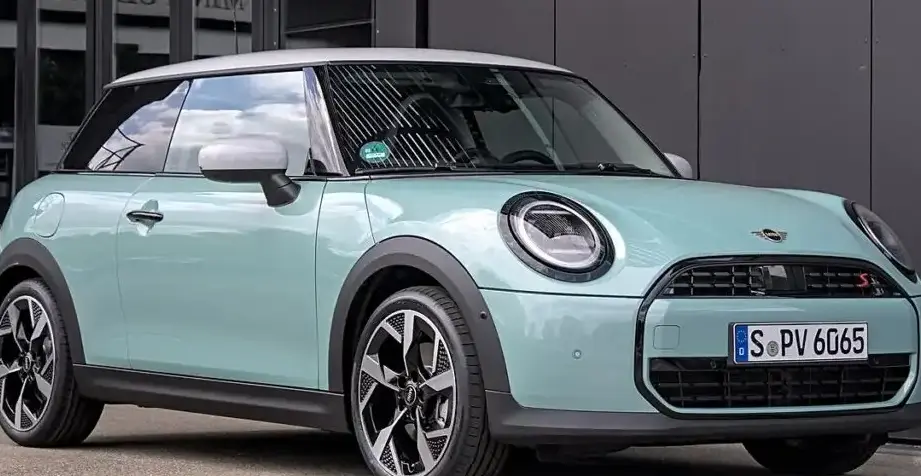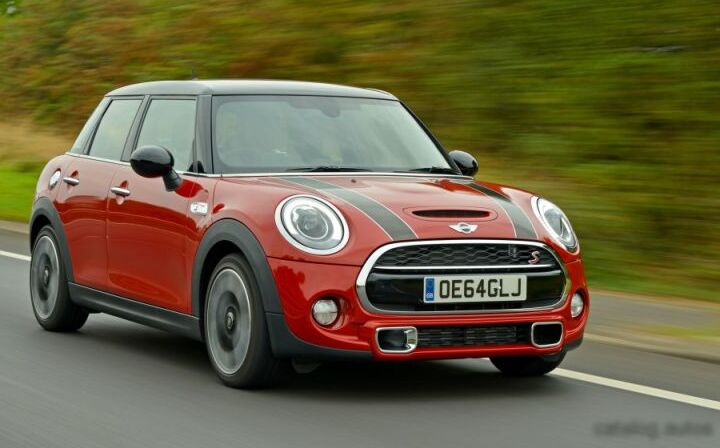
The Mini Hatch (F55) 5-door Cooper SD 2.0, produced from July 2014 to 2018, represents a significant expansion of the modern Mini lineup. Building upon the success of the F55 3-door hatch introduced in 2014, the 5-door variant aimed to broaden the Mini’s appeal by offering increased practicality and passenger space. The Cooper SD 2.0, positioned as a mid-range offering within the F55 series, combined a fuel-efficient diesel engine with a focus on providing a balance between performance and economy. It was a key model for the brand in the European market, where diesel engines held a substantial share of the automotive landscape, and also saw moderate success in other regions.
Technical Specifications
| Brand | Mini |
| Model | Hatch |
| Generation | Hatch (F55) 5-door |
| Type (Engine) | Cooper SD 2.0 (170 Hp) |
| Start of production | July, 2014 |
| End of production | 2018 |
| Powertrain Architecture | Internal Combustion engine |
| Body type | Hatchback |
| Seats | 5 |
| Doors | 5 |
| Fuel consumption (urban) | 5.0 – 5.1 l/100 km (47 – 46.1 US mpg, 56.5 – 55.4 UK mpg, 20 – 19.6 km/l) |
| Fuel consumption (extra urban) | 3.6 – 3.8 l/100 km (65.3 – 61.9 US mpg, 78.5 – 74.3 UK mpg, 27.8 – 26.3 km/l) |
| Fuel consumption (combined) | 4.1 – 4.3 l/100 km (57.4 – 54.7 US mpg, 68.9 – 65.7 UK mpg, 24.4 – 23.3 km/l) |
| CO2 emissions | 109 – 112 g/km |
| Fuel Type | Diesel |
| Acceleration 0 – 100 km/h | 7.4 sec |
| Acceleration 0 – 62 mph | 7.4 sec |
| Acceleration 0 – 60 mph | 7 sec (Calculated) |
| Maximum speed | 225 km/h (139.81 mph) |
| Emission standard | Euro 6 |
| Weight-to-power ratio | 7.2 kg/Hp, 138.2 Hp/tonne |
| Weight-to-torque ratio | 3.4 kg/Nm, 292.7 Nm/tonne |
| Power | 170 Hp @ 4000 rpm |
| Power per litre | 85.2 Hp/l |
| Torque | 360 Nm @ 1500-2750 rpm (265.52 lb.-ft. @ 1500-2750 rpm) |
| Engine layout | Front, Transverse |
| Engine Model/Code | B47C20B |
| Engine displacement | 1995 cm3 (121.74 cu. in.) |
| Number of cylinders | 4 |
| Engine configuration | Inline |
| Cylinder Bore | 84 mm (3.31 in.) |
| Piston Stroke | 90 mm (3.54 in.) |
| Compression ratio | 16.5:1 |
| Number of valves per cylinder | 4 |
| Fuel injection system | Diesel Commonrail |
| Engine aspiration | Turbocharger, Intercooler |
| Engine oil capacity | 5 l (5.28 US qt | 4.4 UK qt) |
| Coolant | 7 l (7.4 US qt | 6.16 UK qt) |
| Kerb Weight | 1230 kg (2711.69 lbs.) |
| Max. weight | 1755 kg (3869.11 lbs.) |
| Max load | 525 kg (1157.43 lbs.) |
| Trunk (boot) space – minimum | 278 l (9.82 cu. ft.) |
| Trunk (boot) space – maximum | 941 l (33.23 cu. ft.) |
| Fuel tank capacity | 44 l (11.62 US gal | 9.68 UK gal) |
| Length | 4005 mm (157.68 in.) |
| Width | 1727 mm (67.99 in.) |
| Height | 1425 mm (56.1 in.) |
| Wheelbase | 2567 mm (101.06 in.) |
| Front track | 1501 mm (59.09 in.) |
| Rear track | 1501 mm (59.09 in.) |
| Ride height (ground clearance) | 146 mm (5.75 in.) |
| Minimum turning circle | 11 m (36.09 ft.) |
| Drivetrain | Front wheel drive |
| Number of gears | 6 |
| Gearbox type | Manual transmission |
| Front suspension | Independent, McPherson with coil spring and anti-roll bar |
| Rear suspension | Independent multi-link suspension |
| Front brakes | Ventilated discs |
| Rear brakes | Disc |
| Assisting systems | ABS (Anti-lock braking system) |
| Steering type | Steering rack and pinion |
| Tires size | 195/55 R16 87W |
| Wheel rims size | 6.5J x 16 |
Powertrain & Engine Architecture
The Cooper SD 2.0 is powered by the BMW Group’s B47C20B engine, a 2.0-liter inline-four cylinder diesel. This engine is a member of the modular B-series engine family, known for its efficiency and refinement. The B47 utilizes a common-rail direct injection system, injecting fuel at extremely high pressures to optimize combustion. A single turbocharger with an intercooler provides forced induction, boosting power and torque. The engine features four valves per cylinder and a sophisticated engine management system to balance performance and fuel economy. The 6-speed manual transmission was standard, offering precise shifts and a direct connection to the engine. The B47 engine is known for its relatively quiet operation and strong low-end torque, characteristics desirable in a daily driver.
Driving Characteristics
The 170 horsepower and 360 Nm (265 lb-ft) of torque delivered by the Cooper SD 2.0 provided a brisk driving experience. Acceleration from 0 to 60 mph took approximately 7 seconds, making it noticeably quicker than the base Cooper models. The engine’s peak torque, available from 1500-2750 rpm, meant that strong acceleration was readily available in everyday driving situations. While not a sports car, the Cooper SD 2.0 offered ample power for highway merging and overtaking. Compared to the petrol-powered Cooper S, the SD offered superior fuel economy and a more relaxed driving experience, but lacked the higher-revving excitement of the petrol engine. The manual transmission’s gear ratios were well-matched to the engine’s powerband, providing smooth and efficient operation.
Equipment & Trim Levels
The Cooper SD 2.0 5-door typically came equipped with a generous level of standard features. These included air conditioning, power windows and mirrors, a multi-function steering wheel, and a basic infotainment system with Bluetooth connectivity. Interior upholstery was typically cloth, with options for leather upgrades. Common optional extras included a panoramic sunroof, navigation system, parking sensors, and upgraded sound systems. Trim levels beyond the base Cooper SD could add features like sport seats, unique interior trim, and exterior styling enhancements. The 5-door configuration itself was a significant upgrade in terms of practicality, offering easier access to the rear seats and a more spacious cabin compared to the 3-door model.
Chassis & Braking
The F55 5-door Mini Cooper SD 2.0 utilized a McPherson strut front suspension and a multi-link rear suspension, providing a comfortable yet engaging ride. The suspension was tuned to balance handling agility with everyday comfort. Front brakes were ventilated discs, while rear brakes were solid discs, providing adequate stopping power for the vehicle’s weight and performance. Anti-lock Braking System (ABS) was standard. The chassis was designed to be rigid, contributing to the car’s responsive handling. The 5-door model’s slightly increased weight compared to the 3-door version did have a minor impact on handling, but the difference was generally not noticeable in everyday driving.
Market Reception & Comparison
The Mini Cooper SD 2.0 5-door was generally well-received by automotive critics. It was praised for its fuel efficiency, comfortable ride, and practical interior space. Critics noted that the diesel engine provided ample power for most driving situations, and the manual transmission was engaging to use. Compared to the petrol-powered Cooper models, the SD offered significantly better fuel economy, making it an attractive option for drivers who covered long distances. However, some critics found the diesel engine to be less refined than the petrol engines, and the overall driving experience lacked the sporty character of the Cooper S. In terms of reliability, the B47 engine has been known to experience some issues with timing chain tensioners, but these problems are not universal and can often be addressed with preventative maintenance.
Legacy
The Mini F55 Cooper SD 2.0 5-door remains a popular choice in the used car market. Its combination of fuel efficiency, practicality, and brand appeal continues to attract buyers. While the B47 engine’s potential timing chain issues are a consideration, regular maintenance and preventative checks can mitigate this risk. The car’s relatively simple mechanical design and readily available parts make it a relatively affordable vehicle to maintain. The F55 generation, and specifically the 5-door variant, played a crucial role in expanding the Mini brand’s reach and solidifying its position as a premium small car offering.