Technical Specifications
| Brand | Mini |
| Model | Hatch |
| Generation | Hatch (F55, facelift 2018) 5-door |
| Type (Engine) | One First 1.5 (75 Hp) |
| Start of production | 2018 |
| End of production | 2018 |
| Powertrain Architecture | Internal Combustion engine |
| Body type | Hatchback |
| Seats | 5 |
| Doors | 5 |
| Fuel consumption (urban) | 5.9-6.1 l/100 km (39.9 – 38.6 US mpg, 47.9 – 46.3 UK mpg, 16.9 – 16.4 km/l) |
| Fuel consumption (extra urban) | 4.4-4.5 l/100 km (53.5 – 52.3 US mpg, 64.2 – 62.8 UK mpg, 22.7 – 22.2 km/l) |
| Fuel consumption (combined) | 4.9-5.1 l/100 km (48 – 46.1 US mpg, 57.6 – 55.4 UK mpg, 20.4 – 19.6 km/l) |
| CO2 emissions | 112-116 g/km |
| Fuel Type | Petrol (Gasoline) |
| Acceleration 0 – 100 km/h | 13.4 sec |
| Acceleration 0 – 62 mph | 13.4 sec |
| Acceleration 0 – 60 mph | 12.7 sec |
| Maximum speed | 172 km/h (106.88 mph) |
| Emission standard | Euro 6 |
| Weight-to-power ratio | 15.5 kg/Hp, 64.4 Hp/tonne |
| Weight-to-torque ratio | 7.3 kg/Nm, 137.3 Nm/tonne |
| Power | 75 Hp @ 3500-6500 rpm |
| Power per litre | 50 Hp/l |
| Torque | 160 Nm @ 1250-3000 rpm (118.01 lb.-ft. @ 1250-3000 rpm) |
| Engine layout | Front, Transverse |
| Engine Model/Code | B38A15A |
| Engine displacement | 1499 cm3 (91.47 cu. in.) |
| Number of cylinders | 3 |
| Engine configuration | Inline |
| Cylinder Bore | 82 mm (3.23 in.) |
| Piston Stroke | 94.6 mm (3.72 in.) |
| Compression ratio | 11:1 |
| Number of valves per cylinder | 4 |
| Fuel injection system | Direct injection |
| Engine aspiration | Twin-power turbo, Intercooler |
| Engine oil capacity | 4.25 l (4.49 US qt | 3.74 UK qt) |
| Coolant | 4.9 l (5.18 US qt | 4.31 UK qt) |
| Kerb Weight | 1165 kg (2568.39 lbs.) |
| Max. weight | 1680 kg (3703.77 lbs.) |
| Max load | 515 kg (1135.38 lbs.) |
| Trunk (boot) space – minimum | 278 l (9.82 cu. ft.) |
| Trunk (boot) space – maximum | 941 l (33.23 cu. ft.) |
| Fuel tank capacity | 40 l (10.57 US gal | 8.8 UK gal) |
| Max. roof load | 75 kg (165.35 lbs.) |
| Length | 3982 mm (156.77 in.) |
| Width | 1727 mm (67.99 in.) |
| Height | 1425 mm (56.1 in.) |
| Wheelbase | 2567 mm (101.06 in.) |
| Front track | 1501 mm (59.09 in.) |
| Rear (Back) track | 1501 mm (59.09 in.) |
| Ride height (ground clearance) | 146 mm (5.75 in.) |
| Drag coefficient (Cd) | 0.31 |
| Minimum turning circle | 11.0 m (36.09 ft.) |
| Drivetrain Architecture | Front wheel drive |
| Drive wheel | Front wheel drive |
| Number of gears and type of gearbox | 6 gears, manual transmission |
| Front suspension | Independent, type McPherson with coil spring and anti-roll bar |
| Rear suspension | Independent multi-link suspension |
| Front brakes | Ventilated discs |
| Rear brakes | Disc |
| Assisting systems | ABS (Anti-lock braking system) |
| Steering type | Steering rack and pinion |
| Power steering | Electric Steering |
| Tires size | 175/65 R15 84H |
| Wheel rims size | 5.5J x 15 |
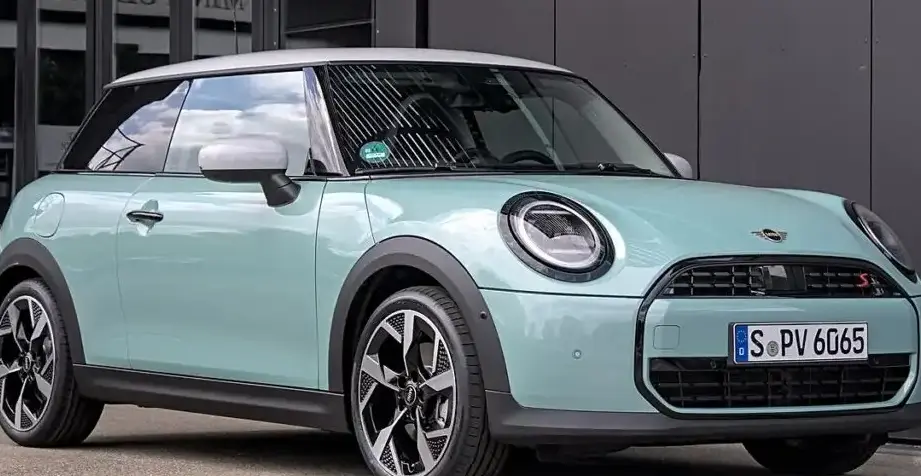
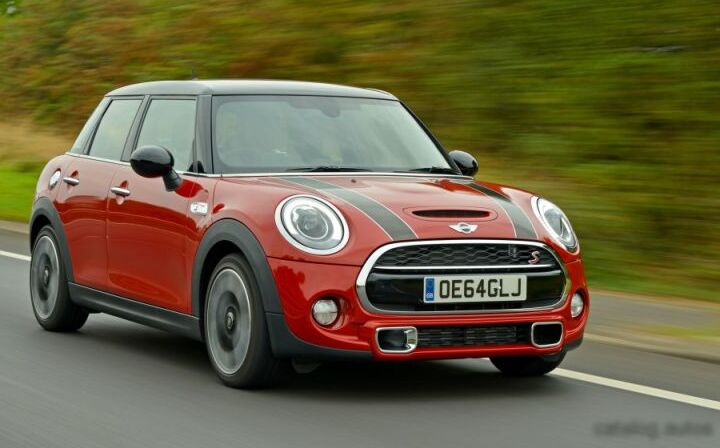
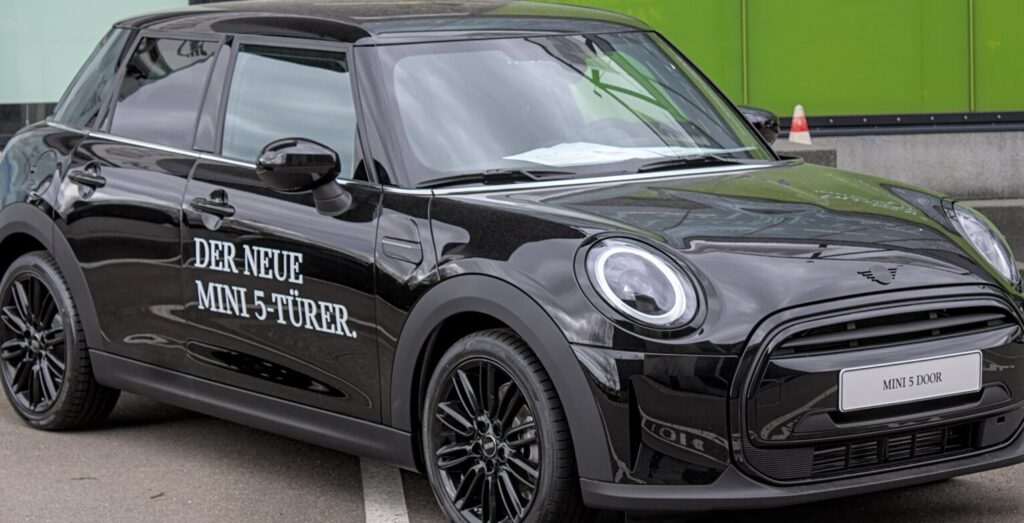
The Mini Hatch (F55) 5-door One First 1.5, produced during the 2018 facelift, represents the entry point into the third-generation Mini Hatchback lineup. Introduced as a more accessible option, this variant aimed to broaden the appeal of the iconic British brand. Utilizing the UKL1 platform – shared with BMW models – the F55 generation marked a significant departure from its predecessors, growing in size and offering a five-door configuration for increased practicality. The “One First” trim, powered by a 1.5-liter three-cylinder engine producing 75 horsepower, was specifically targeted at buyers prioritizing fuel efficiency and affordability over outright performance. Production of this specific configuration was limited to the 2018 model year following the facelift.
Powertrain & Engine Architecture
The heart of the One First 1.5 is the BMW-developed B38A15A 1.5-liter inline three-cylinder engine. This engine is part of BMW’s modular engine family, known for its compact size and efficiency. It features direct fuel injection, a single twin-scroll turbocharger, and an intercooler to enhance performance. The engine’s valvetrain utilizes BMW’s VALVETRONIC technology, which allows for stepless control of valve lift, optimizing both power and fuel economy. The 75 horsepower and 160 Nm (118 lb-ft) of torque are delivered between 1250 and 3000 rpm. The engine is paired with a six-speed manual transmission, sending power to the front wheels. This transmission was chosen to keep costs down and provide a more engaging driving experience compared to an automatic option, which wasn’t initially offered with this engine.
Driving Characteristics
The 1.5-liter engine in the One First provides adequate, though not exhilarating, performance. Acceleration from 0 to 60 mph takes around 12.7 seconds, and the top speed is 172 km/h (106.88 mph). The engine feels responsive at lower RPMs thanks to the turbocharger, but power does taper off as the revs climb. The six-speed manual transmission is well-matched to the engine’s characteristics, offering precise shifts and allowing the driver to keep the engine in its optimal power band. Compared to the more powerful Cooper models, the One First feels noticeably slower, particularly during overtaking maneuvers. However, its lighter weight and efficient engine contribute to better fuel economy and a more nimble feel in city driving.
Equipment & Trim Levels
The “One First” trim was designed as a value-oriented package. Standard equipment included air conditioning, power windows, a basic audio system with Bluetooth connectivity, and alloy wheels. Safety features such as ABS, electronic stability control, and multiple airbags were also standard. Interior upholstery was typically cloth, and the dashboard featured a minimalist design. Optional extras included a navigation system, upgraded audio, parking sensors, and a panoramic sunroof. The One First trim generally lacked the more luxurious features found in higher-spec Cooper models, such as leather seats and advanced driver-assistance systems.
Chassis & Braking
The F55 Mini Hatch utilizes a McPherson strut front suspension and a multi-link rear suspension, providing a comfortable yet sporty ride. The One First model typically featured smaller wheels and tires (175/65 R15) compared to higher-spec versions, contributing to a slightly softer ride quality. Braking duties are handled by ventilated discs at the front and solid discs at the rear. ABS (Anti-lock Braking System) is standard. The suspension setup is tuned to prioritize comfort and handling balance, making the One First a pleasant car to drive on both city streets and winding roads.
Market Reception & Comparison
The Mini One First 1.5 was generally well-received by critics as an affordable and fuel-efficient entry point into the Mini brand. Reviewers praised its nimble handling and stylish design, but noted its lack of outright performance compared to the Cooper models. Fuel economy was a major selling point, with combined figures ranging from 4.9 to 5.1 l/100 km (48-46.1 US mpg). Compared to the Cooper, the One First offered significantly lower running costs but lacked the same level of driving excitement. The 1.5-liter engine proved to be reliable, with few reported issues.
Legacy
The Mini Hatch (F55) One First 1.5, while only produced for a single model year in its facelifted form, remains a popular choice in the used car market. Its affordability, fuel efficiency, and iconic Mini styling continue to appeal to buyers. The B38 engine has proven to be a durable and reliable unit, although regular maintenance is essential. The One First represents a practical and accessible entry point into the world of Mini ownership, offering a blend of style, efficiency, and driving enjoyment.