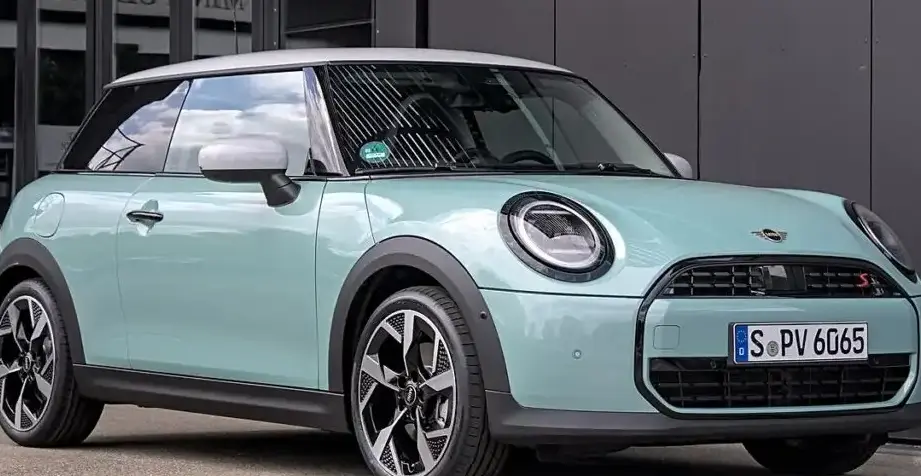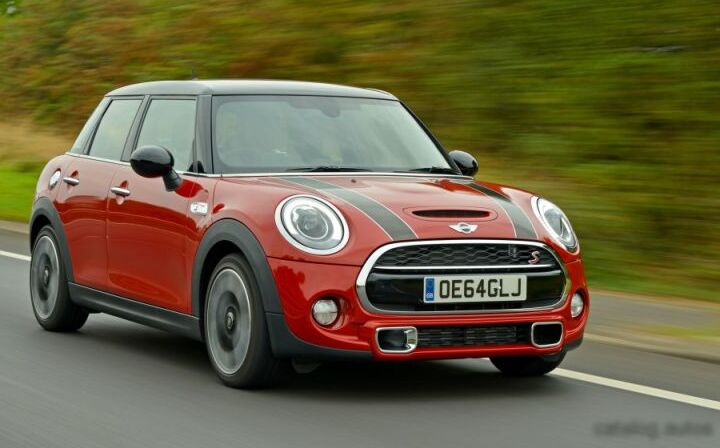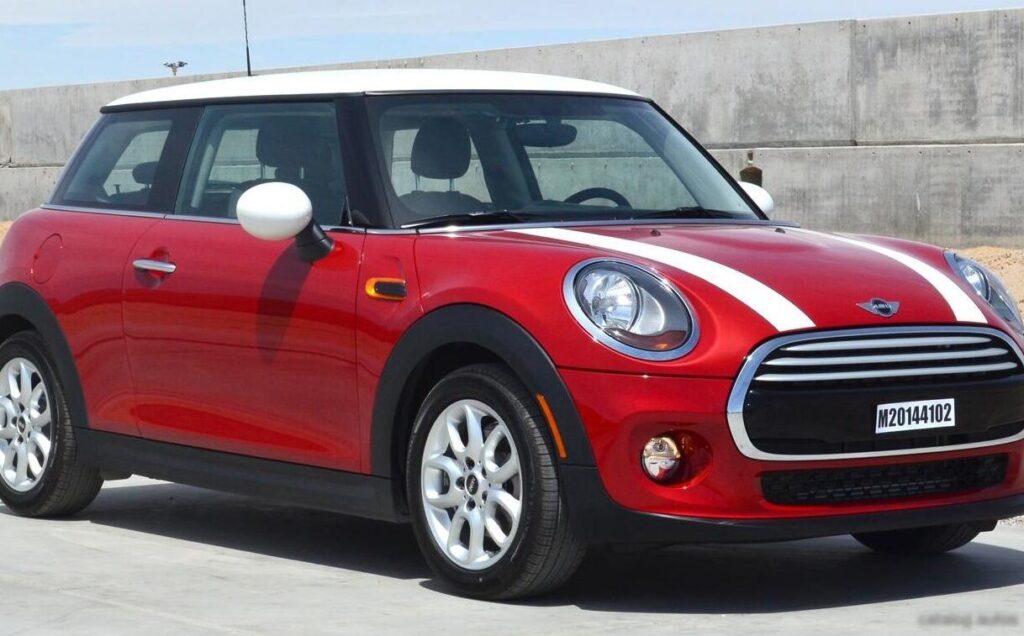
The Mini Hatch (F56) 3-door Cooper D 1.5, producing 116 horsepower, was a key variant in the relaunch of the iconic Mini brand under BMW ownership. Introduced in March 2014 and continuing through 2018, this model represented a significant shift towards more fuel-efficient and accessible options within the broader F56 generation. Positioned as an entry-level diesel offering, it aimed to broaden the Mini’s appeal beyond enthusiasts seeking sporty performance, targeting buyers prioritizing economy and practicality in a premium small car package. It was built on the UKL1 platform, shared with other BMW and Mini models of the period.
Technical Specifications
| Brand | Mini |
| Model | Hatch |
| Generation | Hatch (F56) 3-door |
| Type (Engine) | Cooper D 1.5 (116 Hp) |
| Start of production | March, 2014 |
| End of production | 2018 |
| Powertrain Architecture | Internal Combustion engine |
| Body type | Hatchback |
| Seats | 4 |
| Doors | 3 |
| Fuel consumption (urban) | 4.3 – 4.4 l/100 km (54.7 – 53.5 US mpg, 65.7 – 64.2 UK mpg, 23.3 – 22.7 km/l) |
| Fuel consumption (extra urban) | 3.1 – 3.2 l/100 km (75.9 – 73.5 US mpg, 91.1 – 88.3 UK mpg, 32.3 – 31.3 km/l) |
| Fuel consumption (combined) | 3.5 – 3.6 l/100 km (67.2 – 65.3 US mpg, 80.7 – 78.5 UK mpg, 28.6 – 27.8 km/l) |
| CO2 emissions | 92 – 95 g/km |
| Fuel Type | Diesel |
| Acceleration 0 – 100 km/h | 9.2 sec |
| Acceleration 0 – 62 mph | 9.2 sec |
| Acceleration 0 – 60 mph | 8.7 sec |
| Maximum speed | 205 km/h (127.38 mph) |
| Emission standard | Euro 6 |
| Weight-to-power ratio | 9.8 kg/Hp, 102.2 Hp/tonne |
| Weight-to-torque ratio | 4.2 kg/Nm, 237.9 Nm/tonne |
| Power | 116 Hp @ 4000 rpm |
| Power per litre | 77.5 Hp/l |
| Torque | 270 Nm @ 1750 rpm (199.14 lb.-ft. @ 1750 rpm) |
| Engine layout | Front, Transverse |
| Engine Model/Code | B37C15A |
| Engine displacement | 1496 cm3 (91.29 cu. in.) |
| Number of cylinders | 3 |
| Engine configuration | Inline |
| Cylinder Bore | 84 mm (3.31 in.) |
| Piston Stroke | 90 mm (3.54 in.) |
| Compression ratio | 16.5:1 |
| Number of valves per cylinder | 4 |
| Fuel injection system | Diesel Commonrail |
| Engine aspiration | Turbocharger, Intercooler |
| Engine oil capacity | 4.8 l (5.07 US qt | 4.22 UK qt) |
| Coolant | 3.3 l (3.49 US qt | 2.9 UK qt) |
| Kerb Weight | 1135 kg (2502.25 lbs.) |
| Max. weight | 1615 kg (3560.47 lbs.) |
| Max load | 480 kg (1058.22 lbs.) |
| Trunk (boot) space – minimum | 211 l (7.45 cu. ft.) |
| Fuel tank capacity | 44 l (11.62 US gal | 9.68 UK gal) |
| Length | 3821 mm (150.43 in.) |
| Width | 1727 mm (67.99 in.) |
| Height | 1414 mm (55.67 in.) |
| Wheelbase | 2495 mm (98.23 in.) |
| Front track | 1501 mm (59.09 in.) |
| Rear (Back) track | 1501 mm (59.09 in.) |
| Ride height (ground clearance) | 124 mm (4.88 in.) |
| Minimum turning circle (turning diameter) | 10.8 m (35.43 ft.) |
| Drivetrain Architecture | The Internal combustion engine (ICE) drives the front wheels of the vehicle. |
| Drive wheel | Front wheel drive |
| Number of gears and type of gearbox | 6 gears, manual transmission |
| Front suspension | Independent, type McPherson with coil spring and anti-roll bar |
| Rear suspension | Independent multi-link suspension |
| Front brakes | Ventilated discs |
| Rear brakes | Disc |
| Assisting systems | ABS (Anti-lock braking system) |
| Steering type | Steering rack and pinion |
| Tires size | 175/65 R15 84H |
| Wheel rims size | 5.5J x 15 |
Powertrain & Engine Architecture
The Cooper D 1.5 was powered by the BMW Group’s B37C15A engine, a 1.5-liter three-cylinder turbocharged diesel. This engine was part of BMW’s modular engine family, designed for efficiency and scalability. The B37 featured a single overhead camshaft, four valves per cylinder, and a sophisticated common-rail direct fuel injection system operating at pressures up to 2,000 bar. This high-pressure injection contributed to improved combustion efficiency and reduced emissions. A turbocharger with an intercooler boosted power output to 116 hp (86 kW) at 4,000 rpm and 270 Nm (199 lb-ft) of torque at a low 1,750 rpm. The engine incorporated particulate filter technology to meet stringent Euro 6 emission standards. The standard transmission was a six-speed manual, although a six-speed automatic option was also available, though less common.
Driving Characteristics
The 1.5-liter diesel in the Cooper D provided a surprisingly refined driving experience. While not overtly sporty, the engine delivered ample torque from low revs, making it well-suited for everyday driving and urban commutes. The six-speed manual transmission offered precise shifts, and the gear ratios were optimized for fuel efficiency. Acceleration to 60 mph took around 8.7 seconds, and top speed was 127.38 mph. Compared to the more powerful Cooper and Cooper S models, the Cooper D prioritized fuel economy and ease of driving over outright performance. The automatic transmission, while convenient, could feel slightly hesitant at times, and didn’t offer the same level of driver engagement as the manual.
Equipment & Trim Levels
The Cooper D 1.5 typically came equipped with a respectable level of standard features. These included air conditioning, power windows, central locking, a basic audio system with USB connectivity, and alloy wheels. Interior upholstery was typically cloth, with options for leather upgrades. Available optional extras included a navigation system, a panoramic sunroof, parking sensors, and upgraded sound systems. Trim levels varied slightly depending on the market, but generally followed a progression from base ‘Cooper’ to ‘Cooper Chili’ or similar packages offering more cosmetic and convenience features.
Chassis & Braking
The F56 Mini Cooper D utilized a McPherson strut front suspension and a multi-link rear suspension, providing a good balance between ride comfort and handling. The chassis was designed to be lightweight yet rigid, contributing to the car’s agile feel. Brakes were ventilated discs at the front and solid discs at the rear. ABS (Anti-lock Braking System) was standard. The suspension tuning was generally softer than that of the Cooper S, reflecting the Cooper D’s focus on comfort and fuel efficiency. Stabilizer bars were fitted front and rear to reduce body roll during cornering.
Market Reception & Comparison
The Mini Cooper D 1.5 was generally well-received by automotive critics. It was praised for its fuel efficiency, refined engine, and stylish design. However, some reviewers noted that the engine could feel a little strained at higher speeds, and the interior space was somewhat limited. Compared to other diesel hatchbacks in its class, such as the Volkswagen Polo TDI and the Audi A1 TDI, the Mini offered a more premium feel and a more engaging driving experience, but at a higher price point. Fuel economy was a key selling point, consistently achieving around 65-70 mpg in real-world driving.
Legacy
The B37C15A engine proved to be a reliable unit, although like any diesel engine, it required regular maintenance, including oil changes and diesel particulate filter regeneration. The Cooper D 1.5 remains a popular choice in the used car market, particularly for buyers seeking a stylish and economical small car. Its combination of fuel efficiency, practicality, and the Mini brand’s iconic design continues to appeal to a wide range of drivers. While not the fastest or most spacious car in its segment, the Cooper D 1.5 offers a unique blend of qualities that have ensured its enduring popularity.