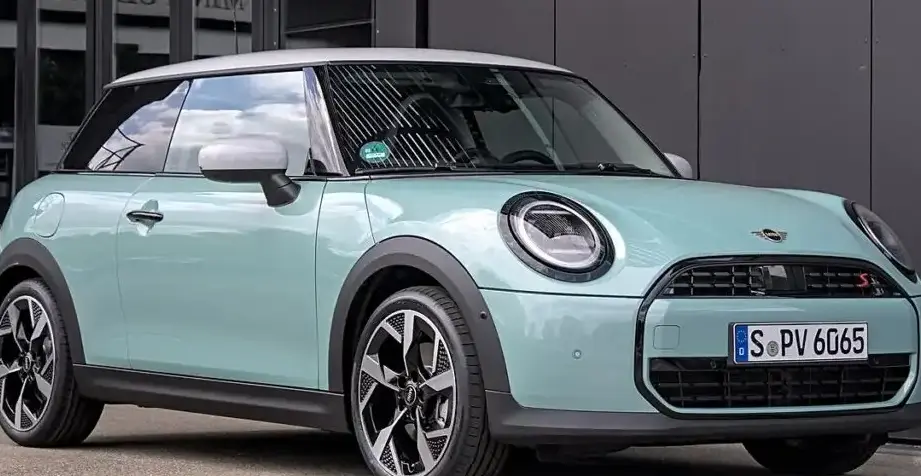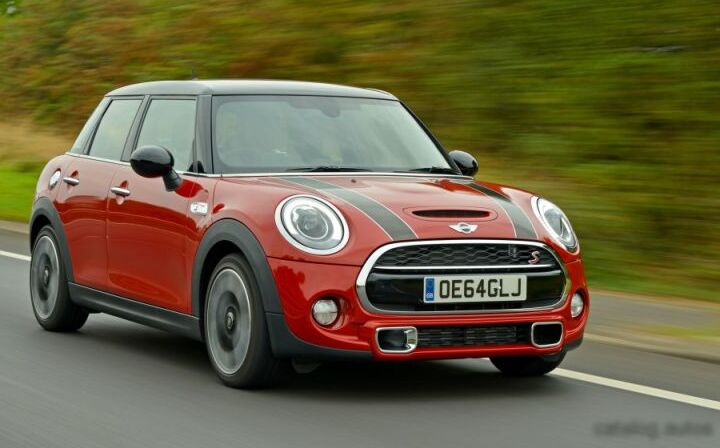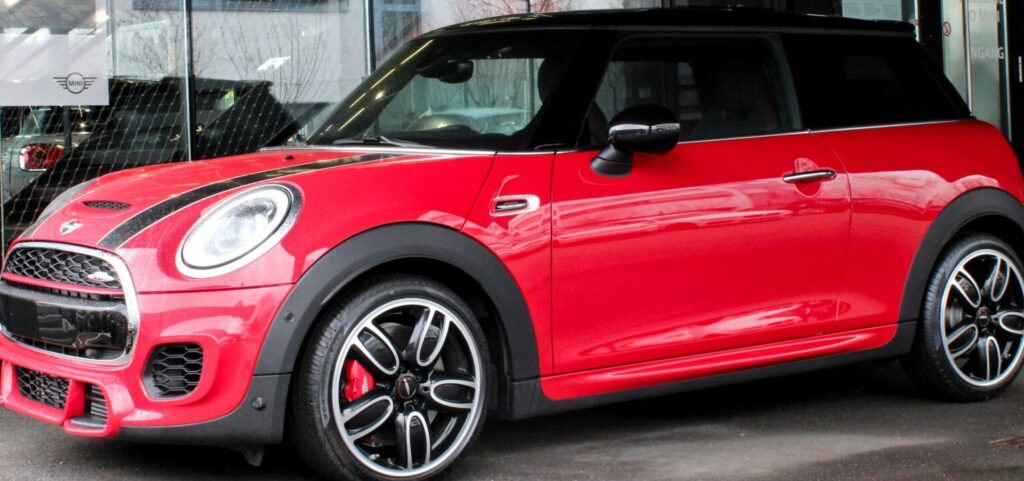
The Mini Hatch (F56) 3-door JCW 2.0, produced from May 2015 to May 2018, represents the high-performance variant of the third-generation Mini Hatchback. Positioned as the flagship model within the F56 range, the JCW 2.0 aimed to deliver a significantly more engaging driving experience than the standard Cooper and Cooper S models. Built upon the UKL1 platform (internally designated as 1HX0/A3), this iteration of the Mini sought to blend iconic design with modern technology and a focus on sporty handling. The JCW 2.0 was primarily marketed towards driving enthusiasts seeking a premium small car with substantial performance capabilities, particularly in European and North American markets.
Technical Specifications
| Brand | Mini |
| Model | Hatch |
| Generation | Hatch (F56) 3-door |
| Type (Engine) | JCW 2.0 (231 Hp) |
| Start of production | May, 2015 |
| End of production | May, 2018 |
| Powertrain Architecture | Internal Combustion engine |
| Body type | Hatchback |
| Seats | 4 |
| Doors | 3 |
| Fuel consumption (economy) – urban | 9.1 l/100 km (25.8 US mpg, 31 UK mpg, 11 km/l) |
| Fuel consumption (economy) – extra urban | 5.2 l/100 km (45.2 US mpg, 54.3 UK mpg, 19.2 km/l) |
| Fuel consumption (economy) – combined | 6.7 l/100 km (35.1 US mpg, 42.2 UK mpg, 14.9 km/l) |
| CO2 emissions | 155 g/km |
| Fuel Type | Petrol (Gasoline) |
| Acceleration 0 – 100 km/h | 6.3 sec |
| Acceleration 0 – 62 mph | 6.3 sec |
| Acceleration 0 – 60 mph | 6 sec |
| Maximum speed | 246 km/h (152.86 mph) |
| Emission standard | Euro 6 |
| Weight-to-power ratio | 5.2 kg/Hp, 191.7 Hp/tonne |
| Weight-to-torque ratio | 3.8 kg/Nm, 265.6 Nm/tonne |
| Power | 231 Hp @ 5200-6000 rpm |
| Power per litre | 115.6 Hp/l |
| Torque | 320 Nm @ 1250-4800 rpm (236.02 lb.-ft. @ 1250-4800 rpm) |
| Engine layout | Front, Transverse |
| Engine Model/Code | B48A20B |
| Engine displacement | 1998 cm3 (121.93 cu. in.) |
| Number of cylinders | 4 |
| Engine configuration | Inline |
| Cylinder Bore | 82 mm (3.23 in.) |
| Piston Stroke | 94.6 mm (3.72 in.) |
| Compression ratio | 10.2:1 |
| Number of valves per cylinder | 4 |
| Fuel injection system | Direct injection |
| Engine aspiration | Twin-power turbo, Intercooler |
| Engine oil capacity | 5.25 l (5.55 US qt | 4.62 UK qt) |
| Coolant | 6.6 l (6.97 US qt | 5.81 UK qt) |
| Kerb Weight | 1205 kg (2656.57 lbs.) |
| Max. weight | 1685 kg (3714.79 lbs.) |
| Max load | 480 kg (1058.22 lbs.) |
| Trunk (boot) space – minimum | 211 l (7.45 cu. ft.) |
| Fuel tank capacity | 44 l (11.62 US gal | 9.68 UK gal) |
| Length | 3874 mm (152.52 in.) |
| Width | 1727 mm (67.99 in.) |
| Height | 1414 mm (55.67 in.) |
| Wheelbase | 2495 mm (98.23 in.) |
| Front track | 1485 mm (58.46 in.) |
| Rear (Back) track | 1485 mm (58.46 in.) |
| Ride height (ground clearance) | 143 mm (5.63 in.) |
| Minimum turning circle (turning diameter) | 10.8 m (35.43 ft.) |
| Drivetrain Architecture | The Internal combustion engine (ICE) drives the front wheels of the vehicle. |
| Drive wheel | Front wheel drive |
| Number of gears and type of gearbox | 6 gears, manual transmission |
| Front suspension | Independent, type McPherson with coil spring and anti-roll bar |
| Rear suspension | Independent multi-link suspension |
| Front brakes | Ventilated discs |
| Rear brakes | Disc |
| Assisting systems | ABS (Anti-lock braking system) |
| Steering type | Steering rack and pinion |
| Tires size | 205/45 R17 88Y XL |
| Wheel rims size | 7J x 17 |
Powertrain & Engine Architecture
The heart of the JCW 2.0 is the BMW-sourced B48A20B 2.0-liter turbocharged inline-four engine. This engine is a significant departure from the earlier supercharged JCW engines, utilizing a single twin-scroll turbocharger and direct fuel injection to produce 231 horsepower and 236 lb-ft of torque. The B48 engine benefits from BMW’s Valvetronic technology, which allows for precise control of valve lift and timing, optimizing both power and efficiency. The engine’s robust bottom end and upgraded cooling system were crucial for handling the increased power output. The standard transmission was a six-speed manual, offering a direct and engaging driving experience. While an eight-speed automatic transmission was available as an option, the manual was favored by enthusiasts for its responsiveness.
Driving Characteristics
The JCW 2.0 delivers a noticeably sharper driving experience compared to other F56 variants. The increased power and torque, combined with the responsive chassis, result in brisk acceleration and confident handling. The six-speed manual transmission provides precise gear changes, allowing drivers to fully exploit the engine’s powerband. The JCW’s suspension is firmer than the standard Mini, reducing body roll and enhancing cornering stability. While the ride quality is firmer, it remains reasonably comfortable for daily driving. The JCW’s steering is precise and well-weighted, providing excellent feedback to the driver. Compared to the Cooper S, the JCW offers a more aggressive throttle response and a more pronounced exhaust note, further enhancing the sporty driving experience.
Equipment & Trim Levels
The JCW 2.0 came standard with a comprehensive list of features, including sport seats, a sport leather steering wheel, and unique JCW styling cues both inside and out. Exterior features included a distinctive JCW aerodynamic kit, larger brakes, and a sport exhaust system. Interior appointments included anthracite headliner, and JCW-specific trim accents. Optional extras included a panoramic sunroof, navigation system, Harman Kardon premium sound system, and various customization options through the Mini Yours program. The JCW trim was positioned as the premium offering in the F56 range, reflecting its higher price point and performance capabilities.
Chassis & Braking
The JCW 2.0 features a reinforced chassis and upgraded suspension components compared to other F56 models. The front suspension utilizes McPherson struts with a thicker anti-roll bar, while the rear suspension employs a multi-link setup. The brakes are also upgraded, featuring larger ventilated discs at all four corners. The JCW’s braking system provides excellent stopping power and fade resistance, essential for spirited driving. The standard tire size is 205/45 R17, providing a good balance of grip and ride comfort. The car’s electronic stability control system is tuned to allow for a more playful driving experience while still providing a safety net.
Market Reception & Comparison
The Mini JCW 2.0 was generally well-received by automotive critics, who praised its engaging driving dynamics, powerful engine, and distinctive styling. However, some critics noted that the JCW’s price was relatively high compared to other hot hatchbacks in its class. In terms of fuel economy, the JCW 2.0 achieved around 35.1 US mpg combined, which is respectable for a performance car of its caliber. Compared to the Cooper S, the JCW offered significantly more performance but at a higher cost and with slightly lower fuel economy. The JCW also faced competition from rivals such as the Volkswagen GTI and the Ford Focus ST.
Legacy
The F56 JCW 2.0 has established itself as a desirable and capable hot hatchback in the used car market. The B48 engine has proven to be relatively reliable, although regular maintenance is essential. Common issues include oil leaks and occasional turbocharger problems. The JCW’s sporty driving dynamics and distinctive styling continue to appeal to enthusiasts, making it a popular choice for those seeking a fun-to-drive and stylish small car. Its blend of performance, practicality, and iconic design ensures its place as a significant model in the Mini lineage.