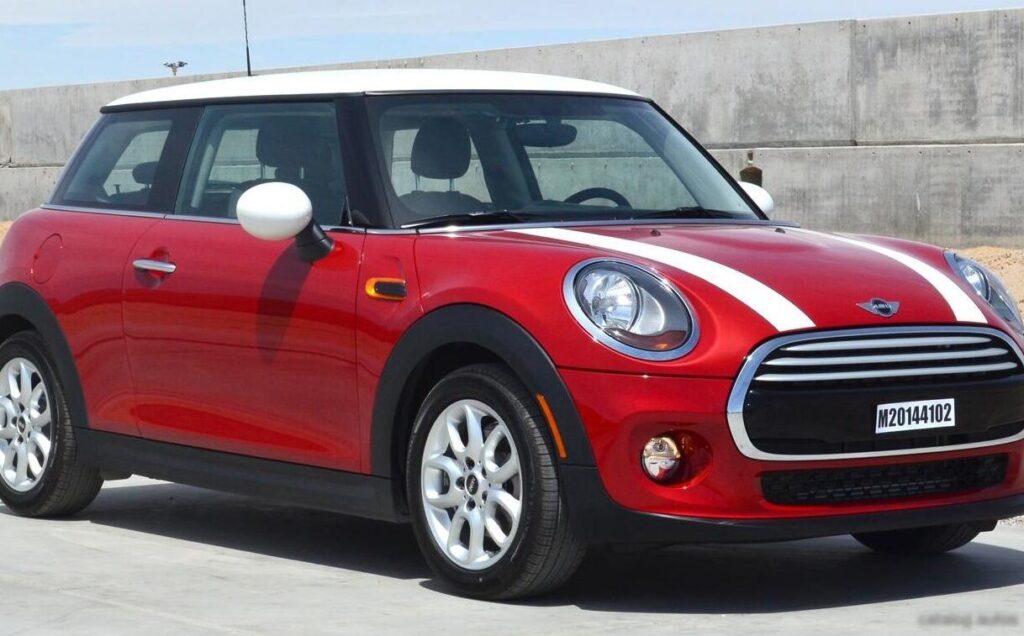
The Mini Hatch (F56) 3-door One 1.2, producing 102 horsepower, was a key entry point into the redesigned Mini lineup launched in March 2014 and remained in production through November 2017. Positioned as the base model of the third-generation Mini Hatch (F56), it represented a significant departure from its predecessors, utilizing the UKL1 platform shared with BMW models. This front-wheel-drive hatchback aimed to blend iconic Mini styling with modern efficiency and technology, targeting a broader audience than previous generations. The “One” trim served as the most accessible option, offering a balance of affordability and the core Mini driving experience.
Technical Specifications
| Brand | Mini |
| Model | Hatch |
| Generation | Hatch (F56) 3-door |
| Type (Engine) | One 1.2 (102 Hp) |
| Start of production | March, 2014 |
| End of production | November, 2017 |
| Powertrain Architecture | Internal Combustion engine |
| Body type | Hatchback |
| Seats | 4 |
| Doors | 3 |
| Fuel consumption (urban) | 5.7 – 5.8 l/100 km (41.3 – 40.6 US mpg) |
| Fuel consumption (extra urban) | 4 l/100 km (58.8 US mpg) |
| Fuel consumption (combined) | 4.6 – 4.7 l/100 km (51.1 – 50 US mpg) |
| CO2 emissions | 108 – 109 g/km |
| Fuel Type | Petrol (Gasoline) |
| Acceleration 0 – 100 km/h | 9.9 sec |
| Acceleration 0 – 62 mph | 9.9 sec |
| Acceleration 0 – 60 mph | 9.4 sec |
| Maximum speed | 195 km/h (121.17 mph) |
| Emission standard | Euro 6 |
| Weight-to-power ratio | 10.7 kg/Hp |
| Weight-to-torque ratio | 6.1 kg/Nm |
| Power | 102 Hp @ 4250-6000 rpm |
| Torque | 180 Nm @ 1400-4000 rpm (132.76 lb.-ft.) |
| Engine layout | Front, Transverse |
| Engine Model/Code | B38A12A |
| Engine displacement | 1198 cm3 (73.11 cu. in.) |
| Number of cylinders | 3 |
| Engine configuration | Inline |
| Cylinder Bore | 78 mm (3.07 in.) |
| Piston Stroke | 83.6 mm (3.29 in.) |
| Compression ratio | 11:1 |
| Number of valves per cylinder | 4 |
| Fuel injection system | Direct injection |
| Engine aspiration | Twin-power turbo, Intercooler |
| Engine oil capacity | 4.25 l (4.49 US qt | 3.74 UK qt) |
| Coolant | 5.7 l (6.02 US qt | 5.02 UK qt) |
| Kerb Weight | 1090 kg (2403.04 lbs.) |
| Max. weight | 1570 kg (3461.26 lbs.) |
| Max load | 480 kg (1058.22 lbs.) |
| Trunk (boot) space – minimum | 211 l (7.45 cu. ft.) |
| Fuel tank capacity | 40 l (10.57 US gal | 8.8 UK gal) |
| Length | 3821 mm (150.43 in.) |
| Width | 1727 mm (67.99 in.) |
| Height | 1414 mm (55.67 in.) |
| Wheelbase | 2495 mm (98.23 in.) |
| Front track | 1501 mm (59.09 in.) |
| Rear (Back) track | 1501 mm (59.09 in.) |
| Ride height (ground clearance) | 124 mm (4.88 in.) |
| Minimum turning circle | 10.8 m (35.43 ft.) |
| Drivetrain Architecture | Front wheel drive |
| Number of gears | 6 gears, manual transmission |
| Front suspension | Independent, type McPherson with coil spring and anti-roll bar |
| Rear suspension | Independent multi-link suspension |
| Front brakes | Ventilated discs |
| Rear brakes | Disc |
| Assisting systems | ABS (Anti-lock braking system) |
| Steering type | Steering rack and pinion |
| Tires size | 175/65 R15 84H |
| Wheel rims size | 5.5J x 15 |
Powertrain & Engine Architecture
The heart of the F56 One 1.2 is the BMW-developed B38A12A 1.2-liter turbocharged three-cylinder engine. This engine is a member of BMW’s modular engine family, known for its compact size and efficiency. It utilizes direct fuel injection, a single twin-scroll turbocharger, and variable valve timing (VANOS) on both the intake and exhaust sides. The turbocharger design helps to minimize turbo lag and provide a more responsive driving experience. The engine produces 102 horsepower at 4250-6000 rpm and 180 Nm (132.76 lb-ft) of torque between 1400-4000 rpm. The engine’s compact dimensions allowed for a transverse front-engine layout. The standard transmission for this variant was a six-speed manual gearbox, although a six-speed automatic transmission was also available as an option. The automatic transmission was a conventional torque-converter type, prioritizing smooth shifts over outright performance.
Driving Characteristics
The 1.2-liter engine, while adequate for city driving, provided modest performance in the F56 One. Acceleration from 0-60 mph took approximately 9.4 seconds, and top speed was limited to 195 km/h (121.17 mph). Compared to the more powerful Cooper and Cooper S models, the One felt noticeably slower, particularly during overtaking maneuvers. The manual transmission offered a more engaging driving experience, allowing drivers to maximize the available power. The automatic transmission, while convenient, resulted in some power loss and a less responsive feel. The gear ratios were tuned for fuel efficiency rather than outright acceleration. Despite the relatively low power output, the F56 One retained the characteristic Mini go-kart handling, thanks to its well-tuned suspension and precise steering.
Equipment & Trim Levels
The One trim level was the entry point to the F56 range, and as such, came with a respectable level of standard equipment. Features included air conditioning, power windows, power mirrors, a basic audio system with USB connectivity, and stability control. Interior upholstery was typically cloth, and the dashboard featured a simplified design compared to higher trims. Optional extras included alloy wheels, a panoramic sunroof, navigation system, and upgraded audio systems. The “Chilli Package” was a popular option, adding sport seats, a sport steering wheel, and other cosmetic enhancements. The interior design, while functional, lacked some of the premium materials found in the Cooper and Cooper S models.
Chassis & Braking
The F56 One utilized a McPherson strut front suspension and a multi-link rear suspension, providing a comfortable yet sporty ride. The suspension was tuned to prioritize handling and agility, characteristic of the Mini brand. Brakes consisted of ventilated discs at the front and solid discs at the rear. ABS (Anti-lock Braking System) was standard. The chassis was designed to be lightweight, contributing to the car’s nimble handling. Stabilizer bars were fitted to both the front and rear axles to reduce body roll during cornering. The relatively low weight of the One model, at 1090 kg (2403.04 lbs), helped to offset the modest power output.
Market Reception & Comparison
The Mini F56 One 1.2 was generally well-received by critics as an affordable and stylish entry into the premium small car segment. However, some reviewers noted that the engine felt underpowered, particularly when fully loaded or driving on inclines. Fuel economy was a strong point, with combined figures ranging from 4.6 to 4.7 l/100 km (51.1 – 50 US mpg). Compared to the Cooper model (with its 1.5-liter three-cylinder or 2.0-liter four-cylinder engine), the One offered significantly less performance but at a lower price point. The Cooper S, with its more powerful 2.0-liter engine, provided a substantial performance upgrade but came at a higher cost. The One appealed to buyers who prioritized style, fuel efficiency, and affordability over outright performance.
Legacy
The B38 engine family, including the 1.2-liter unit found in the F56 One, has proven to be relatively reliable. Common issues are typically related to the turbocharger and cooling system, but these are not widespread. On the used car market, the F56 One 1.2 represents a relatively affordable way to experience the modern Mini brand. Maintenance costs are generally reasonable, and parts availability is good. However, potential buyers should be aware of the engine’s limited power output and consider whether it meets their driving needs. The F56 One played a crucial role in expanding the Mini brand’s appeal to a wider audience, offering a more accessible entry point into the iconic British marque.