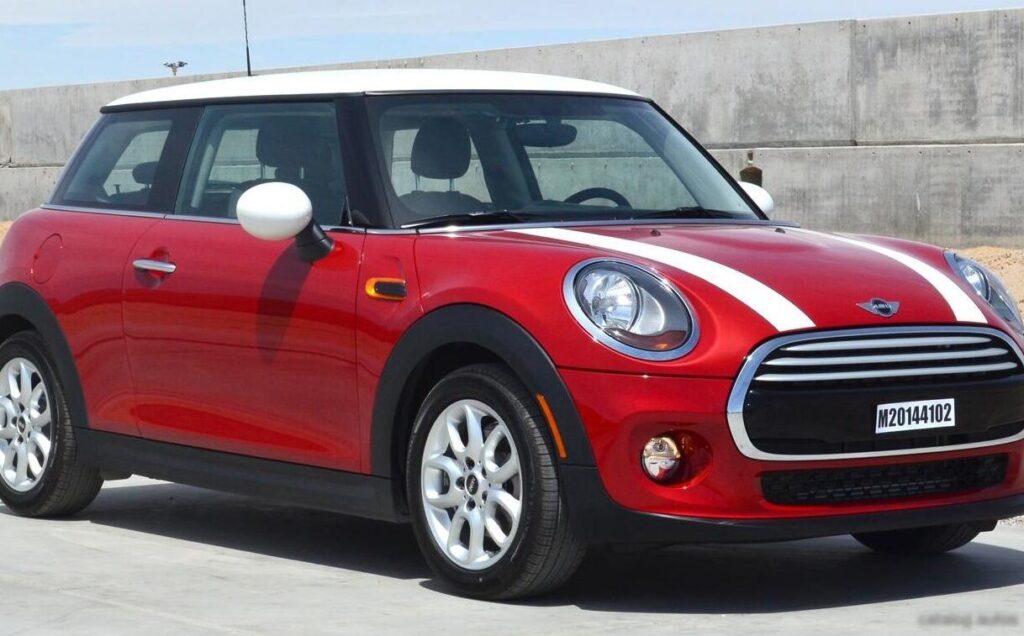
The Mini Hatch (F56) 3-door One 1.2 Automatic, produced from March 2014 to November 2017, represented the entry point into the third generation of the iconic Mini hatchback. Positioned within the F56 chassis code family – which also included the 5-door Hatch, and later the Clubman and Convertible – the One 1.2 Automatic offered a more accessible price point and focused on fuel efficiency and ease of driving. It served as a key model for attracting new customers to the Mini brand, particularly those prioritizing urban practicality and a premium small car experience. This variant utilized the BMW-developed B38 engine family and a six-speed automatic transmission, offering a different driving experience compared to its more powerful siblings.
Technical Specifications
| Brand | Mini |
| Model | Hatch |
| Generation | Hatch (F56) 3-door |
| Type (Engine) | One 1.2 (102 Hp) Automatic |
| Start of production | March, 2014 |
| End of production | November, 2017 |
| Powertrain Architecture | Internal Combustion engine |
| Body type | Hatchback |
| Seats | 4 |
| Doors | 3 |
| Fuel consumption (urban) | 5.8 – 5.9 l/100 km (40.6 – 39.9 US mpg, 48.7 – 47.9 UK mpg, 17.2 – 16.9 km/l) |
| Fuel consumption (extra urban) | 4.2 – 4.3 l/100 km (56 – 54.7 US mpg, 67.3 – 65.7 UK mpg, 23.8 – 23.3 km/l) |
| Fuel consumption (combined) | 4.8 – 4.9 l/100 km (49 – 48 US mpg, 58.9 – 57.6 UK mpg, 20.8 – 20.4 km/l) |
| CO2 emissions | 112 – 114 g/km |
| Fuel Type | Petrol (Gasoline) |
| Acceleration 0 – 100 km/h | 10.2 sec |
| Acceleration 0 – 62 mph | 10.2 sec |
| Acceleration 0 – 60 mph | 9.7 sec |
| Maximum speed | 195 km/h (121.17 mph) |
| Emission standard | Euro 6 |
| Weight-to-power ratio | 11 kg/Hp, 91.1 Hp/tonne |
| Weight-to-torque ratio | 6.2 kg/Nm, 160.7 Nm/tonne |
| Power | 102 Hp @ 4250-6000 rpm |
| Power per litre | 85.1 Hp/l |
| Torque | 180 Nm @ 1400-4000 rpm (132.76 lb.-ft. @ 1400-4000 rpm) |
| Engine layout | Front, Transverse |
| Engine Model/Code | B38A12A |
| Engine displacement | 1198 cm3 (73.11 cu. in.) |
| Number of cylinders | 3 |
| Engine configuration | Inline |
| Cylinder Bore | 78 mm (3.07 in.) |
| Piston Stroke | 83.6 mm (3.29 in.) |
| Compression ratio | 11:1 |
| Number of valves per cylinder | 4 |
| Fuel injection system | Direct injection |
| Engine aspiration | Twin-power turbo, Intercooler |
| Engine oil capacity | 4.25 l (4.49 US qt | 3.74 UK qt) |
| Coolant | 5.7 l (6.02 US qt | 5.02 UK qt) |
| Kerb Weight | 1120 kg (2469.18 lbs.) |
| Max. weight | 1600 kg (3527.4 lbs.) |
| Max load | 480 kg (1058.22 lbs.) |
| Trunk (boot) space – minimum | 211 l (7.45 cu. ft.) |
| Fuel tank capacity | 40 l (10.57 US gal | 8.8 UK gal) |
| Length | 3821 mm (150.43 in.) |
| Width | 1727 mm (67.99 in.) |
| Height | 1414 mm (55.67 in.) |
| Wheelbase | 2495 mm (98.23 in.) |
| Front track | 1501 mm (59.09 in.) |
| Rear (Back) track | 1501 mm (59.09 in.) |
| Ride height (ground clearance) | 124 mm (4.88 in.) |
| Minimum turning circle | 10.8 m (35.43 ft.) |
| Drivetrain Architecture | Front wheel drive |
| Number of gears and type of gearbox | 6 gears, automatic transmission |
| Front suspension | Independent, type McPherson with coil spring and anti-roll bar |
| Rear suspension | Independent multi-link suspension |
| Front brakes | Ventilated discs |
| Rear brakes | Disc |
| Assisting systems | ABS (Anti-lock braking system) |
| Steering type | Steering rack and pinion |
| Tires size | 175/65 R15 84H |
| Wheel rims size | 5.5J x 15 |
Powertrain & Engine Architecture
The heart of the One 1.2 Automatic is the BMW B38A12A engine, a 1.2-liter, three-cylinder turbocharged petrol engine. This engine is part of BMW’s modular engine family, known for its compact size and efficiency. It features direct fuel injection, a single twin-scroll turbocharger, and variable valve timing (VANOS) on both the intake and exhaust sides. The turbocharger is crucial for providing a reasonable level of performance from such a small displacement engine. The engine produces 102 horsepower at 4250-6000 rpm and 180 Nm (132.76 lb-ft) of torque between 1400-4000 rpm. This torque curve provides good low-end responsiveness, making it suitable for city driving. The engine is paired with a six-speed automatic transmission, which, while offering convenience, is not known for its particularly sporty or rapid shifts. The transmission is a conventional torque-converter automatic, prioritizing smoothness over outright performance.
Driving Characteristics
The 1.2-liter engine and automatic transmission combination delivers a comfortable, but not particularly exhilarating, driving experience. Acceleration from 0-60 mph takes around 9.7 seconds, and the top speed is 195 km/h (121.17 mph). The automatic transmission tends to prioritize fuel economy, resulting in relatively conservative gear changes. Compared to the more powerful Cooper models (and especially those with manual transmissions), the One 1.2 Automatic feels noticeably slower. However, the readily available low-end torque makes it perfectly adequate for everyday driving and urban commutes. The gear ratios are tuned for efficiency, meaning the engine can feel strained when attempting rapid acceleration or overtaking maneuvers. The steering, typical of Mini, is direct and responsive, providing a sense of agility despite the modest power output.
Equipment & Trim Levels
The One 1.2 Automatic typically came with a reasonable level of standard equipment, including air conditioning, power windows, central locking, and a basic audio system. Interior upholstery was usually cloth, and the dashboard featured a central infotainment screen, though the screen size and functionality were limited compared to higher trim levels. Optional extras included a panoramic sunroof, upgraded audio systems (often from Harman Kardon), navigation, and various styling packages. The ‘Chilli’ package was a popular option, adding sportier exterior styling cues and interior trim. Safety features included ABS, airbags, and stability control. The One trim was generally considered the base level, focusing on providing a stylish and well-equipped entry point into the Mini range.
Chassis & Braking
The F56 Mini Hatch utilizes a McPherson strut front suspension and a multi-link rear suspension. This setup provides a good balance between ride comfort and handling. The One 1.2 Automatic, being the entry-level model, typically featured slightly softer suspension settings compared to the Cooper and JCW variants. Braking duties are handled by ventilated discs at the front and solid discs at the rear. ABS (Anti-lock Braking System) is standard. The weight distribution is relatively balanced, contributing to the car’s agile handling characteristics. Stabilizer bars are present at both the front and rear, helping to reduce body roll during cornering.
Market Reception & Comparison
The Mini One 1.2 Automatic was generally well-received by critics as a stylish and fuel-efficient city car. However, the performance was often criticized as being underwhelming, particularly compared to the more powerful Cooper models. Fuel economy was a strong point, with combined figures around 4.8-4.9 l/100 km (49-48 US mpg). Reliability was generally good, although some owners reported minor issues with the automatic transmission. Compared to rivals like the Audi A1 and Volkswagen Polo, the Mini One offered a more premium interior and a more engaging driving experience, but at a higher price point.
Legacy
The B38 engine family has proven to be relatively reliable, and the six-speed automatic transmission, while not a performance standout, has generally held up well over time. On the used car market, the Mini One 1.2 Automatic represents a relatively affordable entry point into Mini ownership. However, potential buyers should be aware of the car’s limited performance and the possibility of higher maintenance costs compared to some other small cars. The F56 generation Mini, including the One 1.2 Automatic, helped to solidify Mini’s position as a premium small car brand, appealing to a wider audience than previous generations.