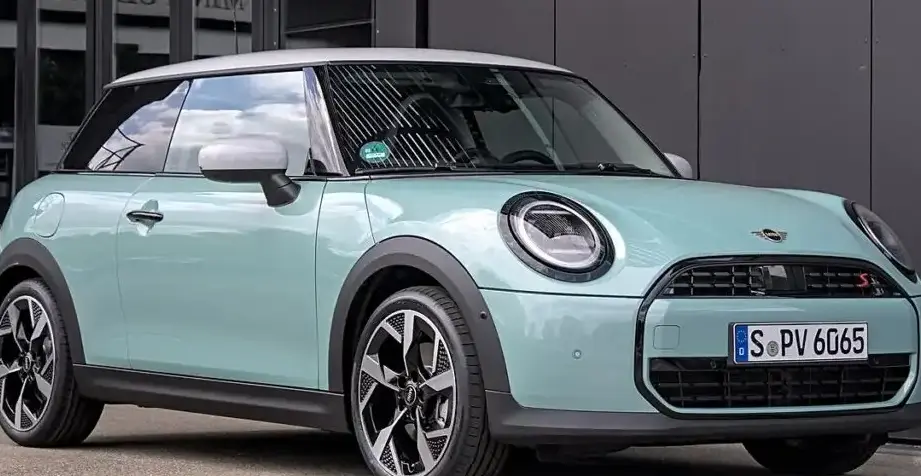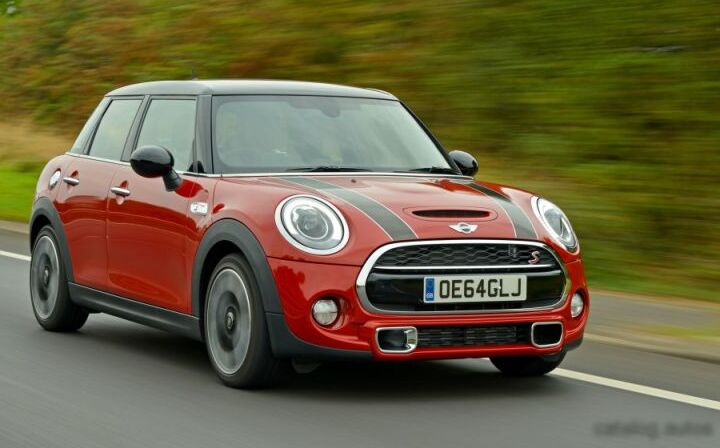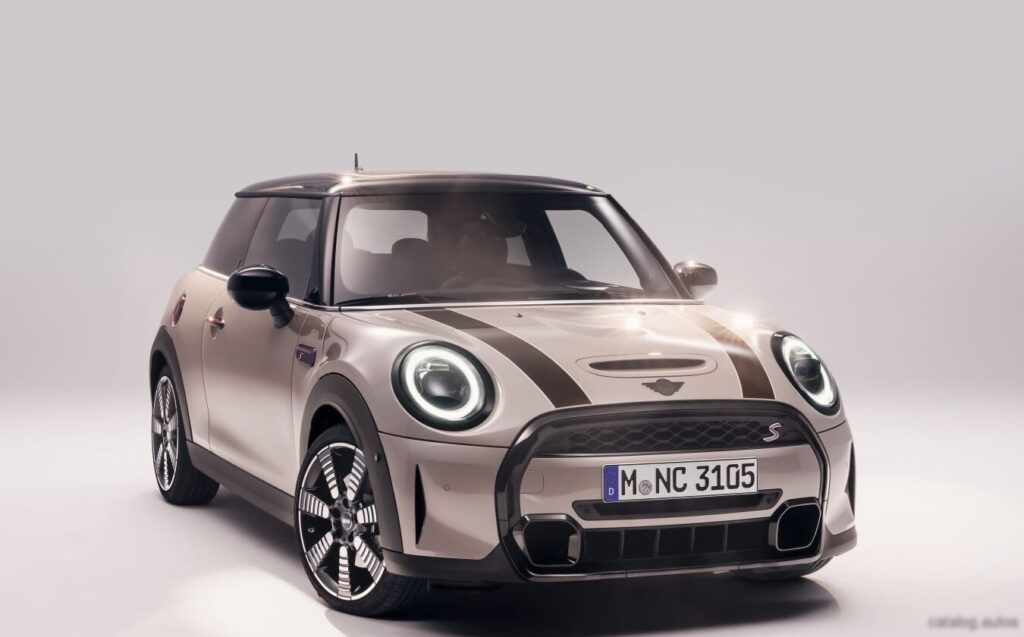
The Mini Hatch (F56) facelift, produced from March 2021 to February 2024, represents a mid-cycle refresh of the third-generation Mini Hatch. Within the F56 range, the Cooper S 2.0, generating 178 horsepower, occupied a performance-oriented niche, positioned above the standard Cooper models and below the more focused John Cooper Works (JCW) variants. This 3-door hatchback aimed to deliver a blend of sporty handling, modern technology, and Mini’s signature styling, appealing to buyers seeking a premium small car experience. The facelift brought updated styling cues, improved technology, and refinements to the engine and chassis.
Technical Specifications
| Brand | Mini |
| Model | Hatch |
| Generation | Hatch (F56, facelift 2021) 3-door |
| Type (Engine) | Cooper S 2.0 (178 Hp) |
| Start of production | March, 2021 |
| End of production | February, 2024 |
| Powertrain Architecture | Internal Combustion engine |
| Body type | Hatchback |
| Seats | 4 |
| Doors | 3 |
| Combined fuel consumption (WLTP) | 6.2-6.7 l/100 km (37.9 – 35.1 US mpg, 45.6 – 42.2 UK mpg, 16.1 – 14.9 km/l) |
| CO2 emissions (WLTP) | 140-151 g/km |
| Fuel consumption (economy) – urban (NEDC, WLTP equivalent) | 8.1-8.4 l/100 km (29 – 28 US mpg, 34.9 – 33.6 UK mpg, 12.3 – 11.9 km/l) |
| Fuel consumption (economy) – extra urban (NEDC, WLTP equivalent) | 5.1-5.3 l/100 km (46.1 – 44.4 US mpg, 55.4 – 53.3 UK mpg, 19.6 – 18.9 km/l) |
| Fuel consumption (economy) – combined (NEDC, WLTP equivalent) | 6.2-6.4 l/100 km (37.9 – 36.8 US mpg, 45.6 – 44.1 UK mpg, 16.1 – 15.6 km/l) |
| CO2 emissions (NEDC, WLTP equivalent) | 142-147 g/km |
| Fuel Type | Petrol (Gasoline) |
| Acceleration 0 – 100 km/h | 6.7 sec |
| Acceleration 0 – 62 mph | 6.7 sec |
| Acceleration 0 – 60 mph | 6.4 sec |
| Maximum speed | 235 km/h (146.02 mph) |
| Emission standard | Euro 6d |
| Weight-to-power ratio | 6.8 kg/Hp, 147.7 Hp/tonne |
| Weight-to-torque ratio | 4.3 kg/Nm, 232.4 Nm/tonne |
| Power | 178 Hp @ 5000-5500 rpm |
| Power per litre | 89.1 Hp/l |
| Torque | 280 Nm @ 1350-4200 rpm (206.52 lb.-ft. @ 1350-4200 rpm) |
| Engine layout | Front, Transverse |
| Engine Model/Code | B48A20F |
| Engine displacement | 1998 cm3 (121.93 cu. in.) |
| Number of cylinders | 4 |
| Engine configuration | Inline |
| Cylinder Bore | 82 mm (3.23 in.) |
| Piston Stroke | 94.6 mm (3.72 in.) |
| Compression ratio | 11:1 |
| Number of valves per cylinder | 4 |
| Fuel injection system | Direct injection |
| Engine aspiration | Twin-power turbo, Intercooler |
| Valvetrain | DOHC |
| Engine oil capacity | 5.25 l (5.55 US qt | 4.62 UK qt) |
| Coolant | 6.75 l (7.13 US qt | 5.94 UK qt) |
| Kerb Weight | 1205 kg (2656.57 lbs.) |
| Max. weight | 1640 kg (3615.58 lbs.) |
| Max load | 435 kg (959.01 lbs.) |
| Trunk (boot) space – minimum | 211 l (7.45 cu. ft.) |
| Trunk (boot) space – maximum | 731 l (25.82 cu. ft.) |
| Fuel tank capacity | 44 l (11.62 US gal | 9.68 UK gal) |
| Max. roof load | 60 kg (132.28 lbs.) |
| Length | 3876 mm (152.6 in.) |
| Width | 1727 mm (67.99 in.) |
| Width including mirrors | 1932 mm (76.06 in.) |
| Height | 1414 mm (55.67 in.) |
| Wheelbase | 2495 mm (98.23 in.) |
| Front track | 1485 mm (58.46 in.) |
| Rear (Back) track | 1485 mm (58.46 in.) |
| Front overhang | 771 mm (30.35 in.) |
| Rear overhang | 610 mm (24.02 in.) |
| Ride height (ground clearance) | 143 mm (5.63 in.) |
| Drag coefficient (Cd) | 0.31 |
| Minimum turning circle (turning diameter) | 10.8 m (35.43 ft.) |
| Drivetrain Architecture | The Internal combustion engine (ICE) drives the front wheels of the vehicle. |
| Drive wheel | Front wheel drive |
| Number of gears and type of gearbox | 6 gears, manual transmission |
| Front suspension | Independent, type McPherson with coil spring and anti-roll bar |
| Rear suspension | Independent multi-link spring suspension with stabilizer, Trailing arm |
| Front brakes | Ventilated discs |
| Rear brakes | Disc |
| Assisting systems | ABS (Anti-lock braking system) |
| Steering type | Steering rack and pinion |
| Power steering | Electric Steering |
| Tires size | 195/55 R16 |
| Wheel rims size | 6.5J x 16 |
Powertrain & Engine Architecture
The Cooper S 2.0 is powered by the BMW Group’s B48A20F 2.0-liter turbocharged inline-four cylinder engine. This engine is a member of the modular B-series engine family, known for its efficiency and performance. It utilizes direct fuel injection, a twin-scroll turbocharger, and a variable valve timing system (Double VANOS) to optimize power delivery and fuel economy. The engine produces 178 horsepower at 5000-5500 rpm and 280 Nm (206.52 lb.-ft.) of torque between 1350 and 4200 rpm. The engine’s compression ratio is 11:1. The 6-speed manual transmission was standard, offering precise shifts and a direct connection to the engine. The engine also features start/stop functionality and a particulate filter to reduce emissions, meeting Euro 6d standards.
Driving Characteristics
The 178 hp Cooper S 2.0 offered a noticeable step up in performance compared to the base Cooper models. Acceleration from 0 to 60 mph took approximately 6.4 seconds, and the car could reach a top speed of 235 km/h (146 mph). While not as aggressively tuned as the JCW variant, the Cooper S provided ample power for spirited driving. The manual transmission allowed for precise control, and the turbocharger provided a broad torque curve, making the car responsive in various driving situations. The front-wheel-drive layout, while contributing to efficiency, could exhibit some torque steer under hard acceleration. The suspension, tuned for a balance between comfort and handling, provided a firm but compliant ride.
Equipment & Trim Levels
The Cooper S 2.0 typically came equipped with a generous array of standard features, including automatic climate control, a 6.5-inch infotainment system with Bluetooth connectivity, and a sport steering wheel. Exterior features included unique styling cues like a sport exhaust system, aerodynamic body kit, and alloy wheels. Optional extras included a larger touchscreen display, navigation system, premium sound system, leather upholstery, and various driver-assistance features like parking sensors and adaptive cruise control. Interior trim options allowed for personalization, with a range of color and material choices available.
Chassis & Braking
The F56 chassis utilized McPherson struts at the front and a multi-link suspension at the rear. This setup provided a good balance of handling and ride comfort. The Cooper S 2.0 featured slightly stiffer suspension components compared to the standard Cooper models to enhance handling. Braking duties were handled by ventilated discs at the front and solid discs at the rear, providing adequate stopping power. ABS (Anti-lock Braking System) was standard. The steering system was an electric power-assisted rack and pinion, offering precise and responsive steering feel.
Market Reception & Comparison
The Mini Cooper S 2.0 was generally well-received by automotive critics. It was praised for its sporty handling, responsive engine, and stylish design. However, some reviewers noted that the front-wheel-drive layout could limit traction in certain situations. Compared to the base Cooper, the Cooper S offered a significant performance upgrade. Compared to the JCW, it provided a more accessible entry point into the performance Mini lineup, offering a good balance of power and affordability. Fuel economy was respectable, averaging around 37.9 – 35.1 US mpg (combined WLTP cycle).
Legacy
The F56 Cooper S 2.0 has proven to be a relatively reliable vehicle, with the B48 engine generally considered robust. Common issues, if any, often relate to the electrical system or minor turbocharger components. On the used car market, these models hold their value reasonably well, particularly those with low mileage and a well-maintained service history. The combination of performance, style, and practicality continues to make the F56 Cooper S 2.0 an appealing option for buyers seeking a premium small car with a sporty character.