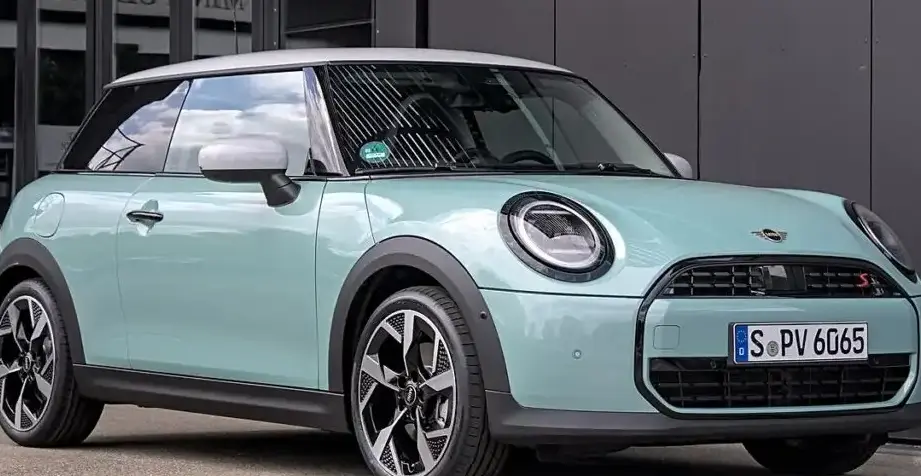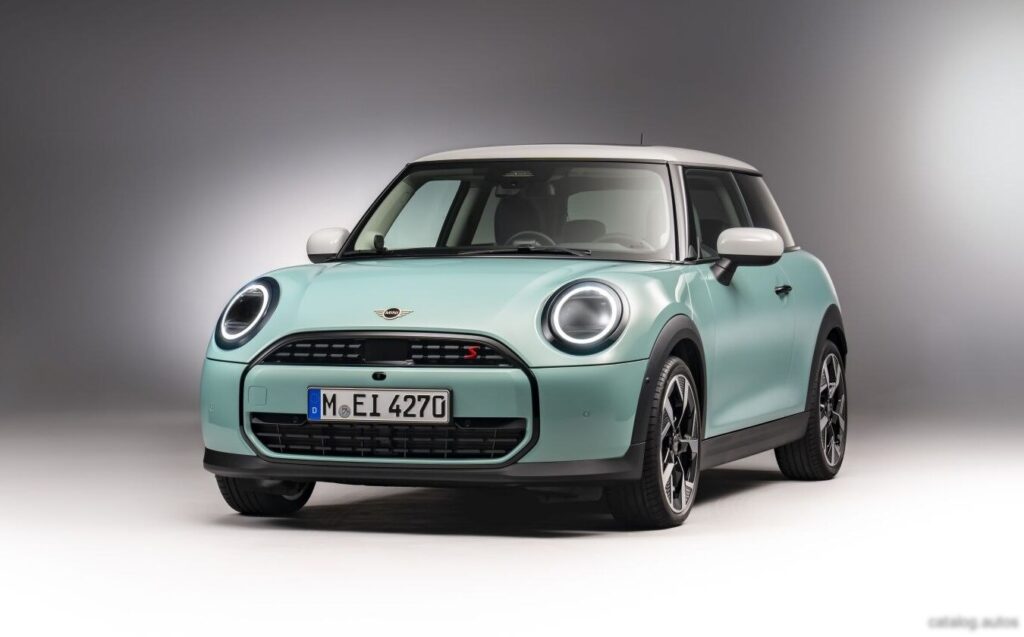
The Mini Hatch (F66) 3-door JCW 2.0 Steptronic represents the performance pinnacle of the third-generation Mini Hatchback, launched in November 2024. Positioned as the flagship model within the F66 range, it builds upon the established Mini formula of compact dimensions, agile handling, and distinctive styling, but with a significant boost in power and sporting intent. This variant is a key offering for Mini in markets where a premium, driver-focused small car is desired, particularly in Europe and North America. It continues the John Cooper Works (JCW) tradition of enhancing the Mini experience with performance-oriented upgrades.
Technical Specifications
| Brand | Mini |
| Model | Hatch |
| Generation | Hatch (F66) 3-door |
| Type (Engine) | JCW 2.0 (231 Hp) Steptronic |
| Start of production | November, 2024 |
| Powertrain Architecture | Internal Combustion engine |
| Body type | Hatchback |
| Seats | 4 |
| Doors | 3 |
| Combined fuel consumption (WLTP) | 6.5-6.8 l/100 km (36.2 – 34.6 US mpg, 43.5 – 41.5 UK mpg, 15.4 – 14.7 km/l) |
| CO2 emissions (WLTP) | 147-154 g/km |
| Fuel Type | Petrol (Gasoline) |
| Acceleration 0 – 100 km/h | 6.1 sec |
| Acceleration 0 – 62 mph | 6.1 sec |
| Acceleration 0 – 60 mph | 5.8 sec |
| Maximum speed | 250 km/h (155.34 mph) |
| Emission standard | Euro 6e-to-FCM |
| Weight-to-power ratio | 5.8 kg/Hp, 173.7 Hp/tonne |
| Weight-to-torque ratio | 3.5 kg/Nm, 285.7 Nm/tonne |
| Power | 231 Hp @ 5000-6000 rpm |
| Power per litre | 115.6 Hp/l |
| Torque | 380 Nm @ 1500-4000 rpm (280.27 lb.-ft. @ 1500-4000 rpm) |
| Engine layout | Front, Transverse |
| Engine Model/Code | B48A2002 |
| Engine displacement | 1998 cm3 (121.93 cu. in.) |
| Number of cylinders | 4 |
| Engine configuration | Inline |
| Cylinder Bore | 82 mm (3.23 in.) |
| Piston Stroke | 94.6 mm (3.72 in.) |
| Compression ratio | 10.5:1 |
| Number of valves per cylinder | 4 |
| Fuel injection system | Direct injection |
| Engine aspiration | Turbocharger, Intercooler |
| Engine systems | Start & Stop System, Particulate filter |
| Kerb Weight | 1330 kg (2932.15 lbs.) |
| Max. weight | 1770 kg (3902.18 lbs.) |
| Max load | 440 kg (970.03 lbs.) |
| Trunk (boot) space – minimum | 210 l (7.42 cu. ft.) |
| Trunk (boot) space – maximum | 725 l (25.6 cu. ft.) |
| Fuel tank capacity | 44 l (11.62 US gal | 9.68 UK gal) |
| Max. roof load | 75 kg (165.35 lbs.) |
| Length | 3876 mm (152.6 in.) |
| Width | 1744 mm (68.66 in.) |
| Height | 1452 mm (57.17 in.) |
| Wheelbase | 2495 mm (98.23 in.) |
| Front track | 1499 mm (59.02 in.) |
| Rear (Back) track | 1499 mm (59.02 in.) |
| Ride height (ground clearance) | 130 mm (5.12 in.) |
| Minimum turning circle (turning diameter) | 11.1 m (36.42 ft.) |
| Drivetrain Architecture | The Internal combustion engine (ICE) drives the front wheels of the vehicle. |
| Drive wheel | Front wheel drive |
| Number of gears and type of gearbox | 7 gears, automatic transmission Steptronic |
| Front suspension | Independent type McPherson |
| Rear suspension | Independent multi-link suspension |
| Front brakes | Ventilated discs |
| Rear brakes | Ventilated discs |
| Assisting systems | ABS (Anti-lock braking system) |
| Steering type | Steering rack and pinion |
| Power steering | Electric Steering |
| Tires size | 215/45 R17 91Y XL |
| Wheel rims size | 7J x 17 LM |
INTRODUCTION
The F66 JCW 2.0 Steptronic is the latest iteration of Mini’s high-performance hatchback. Building on the foundation laid by previous JCW models, this version represents a significant step forward in terms of power and technology. The F66 generation, introduced in 2024, benefits from a revised chassis and updated interior, while the JCW variant adds a potent 2.0-liter turbocharged engine and a sophisticated 7-speed Steptronic automatic transmission. This model aims to deliver a thrilling driving experience combined with the practicality and style that Mini is known for. It slots in at the top of the 3-door Hatch range, offering a more focused and engaging alternative to the Cooper and Cooper S models.
Powertrain & Engine Architecture
At the heart of the F66 JCW 2.0 Steptronic lies the BMW Group’s B48A2002 2.0-liter inline-four cylinder engine. This engine is a member of the modular B-series engine family, known for its efficiency and performance. It utilizes direct fuel injection, a single twin-scroll turbocharger with an intercooler, and variable valve timing (VANOS) on both intake and exhaust camshafts. The engine produces 231 horsepower at 5000-6000 rpm and 380 Nm (280 lb-ft) of torque between 1500-4000 rpm. The Steptronic 7-speed dual-clutch transmission (DCT) is a crucial component, offering rapid and smooth gear changes. This transmission features a torque converter for improved low-speed smoothness and efficiency. The engine also incorporates a particulate filter to meet stringent emissions regulations. The engine’s layout is front-transverse, driving the front wheels.
Driving Characteristics
The JCW 2.0 Steptronic delivers a noticeably more engaging driving experience than its lower-powered siblings. The 231 hp output, combined with the quick-shifting Steptronic transmission, results in a 0-60 mph time of around 5.8 seconds and a top speed of 155 mph. The DCT provides precise control, allowing drivers to select gears manually via steering wheel-mounted paddles or leave it in automatic mode. The automatic transmission is well-tuned for both spirited driving and everyday usability. While the manual transmission is not offered in the US market, the Steptronic unit provides a compelling alternative. The chassis benefits from JCW-specific suspension tuning, including stiffer springs and dampers, and a more direct steering ratio. This results in reduced body roll and improved responsiveness. The car feels nimble and eager to change direction, making it enjoyable on twisty roads.
Equipment & Trim Levels
The JCW 2.0 Steptronic comes standard with a comprehensive list of features. Interior appointments include sport seats upholstered in a combination of cloth and leatherette, a JCW-specific steering wheel, and unique interior trim elements. Standard technology includes a digital instrument cluster, a central infotainment display with navigation, Apple CarPlay, and Android Auto compatibility. Available options include a panoramic sunroof, premium Harman Kardon audio system, and adaptive cruise control. Exterior features include JCW-specific aerodynamic body kit, larger brakes with red calipers, and 17-inch alloy wheels. Paint options are extensive, allowing for a high degree of personalization.
Chassis & Braking
The F66 JCW utilizes a McPherson strut front suspension and a multi-link rear suspension, both tuned for enhanced performance. The suspension geometry and damping characteristics are optimized to minimize body roll and maximize grip. The braking system features ventilated discs on all four wheels, providing ample stopping power. The JCW model also benefits from larger brake rotors and calipers compared to the standard Mini Hatch. ABS (Anti-lock Braking System) is standard, along with electronic stability control and traction control. The steering system is an electric power-assisted rack and pinion system, offering precise and responsive steering feel.
Market Reception & Comparison
The F66 JCW 2.0 Steptronic has been generally well-received by automotive critics. Reviewers praise its potent engine, engaging handling, and distinctive styling. Compared to the Cooper S, the JCW offers a significant performance upgrade, but at a higher price point. The automatic transmission has been noted for its smoothness and responsiveness, although some enthusiasts still prefer the engagement of a manual gearbox. Fuel economy is respectable for a performance hatchback, averaging around 36 mpg combined. Reliability is expected to be similar to other BMW Group products, with regular maintenance being crucial for long-term durability.
Legacy
The JCW variants have consistently been the performance benchmark for the Mini brand. The F66 JCW 2.0 Steptronic continues this tradition, offering a compelling blend of performance, style, and practicality. While it’s still early to assess its long-term reliability, the B48 engine has proven to be robust in other BMW applications. On the used car market, well-maintained JCW models are likely to hold their value due to their desirability and performance credentials. The F66 JCW represents a significant step forward for the Mini brand, solidifying its position as a premium and engaging small car.