
Technical Specifications
| Brand | Mini |
| Model | Paceman |
| Generation | Paceman (R61) |
| Type (Engine) | Cooper D 1.6 (112 Hp) |
| Start of production | 2014 |
| End of production | 2016 |
| Powertrain Architecture | Internal Combustion engine |
| Body type | Hatchback |
| Seats | 4 |
| Doors | 3 |
| Fuel consumption (urban) | 4.7 l/100 km (50 US mpg, 60.1 UK mpg, 21.3 km/l) |
| Fuel consumption (extra urban) | 3.9 l/100 km (60.3 US mpg, 72.4 UK mpg, 25.6 km/l) |
| Fuel consumption (combined) | 4.2 l/100 km (56 US mpg, 67.3 UK mpg, 23.8 km/l) |
| CO2 emissions | 111 g/km |
| Fuel Type | Diesel |
| Acceleration 0 – 100 km/h | 10.8 sec |
| Acceleration 0 – 62 mph | 10.8 sec |
| Acceleration 0 – 60 mph | 10.3 sec |
| Maximum speed | 188 km/h (116.82 mph) |
| Emission standard | Euro 6 |
| Weight-to-power ratio | 11.7 kg/Hp, 85.5 Hp/tonne |
| Weight-to-torque ratio | 4.9 kg/Nm, 206.1 Nm/tonne |
| Power | 112 Hp @ 4000 rpm |
| Power per litre | 70.1 Hp/l |
| Torque | 270 Nm @ 1750-2250 rpm (199.14 lb.-ft. @ 1750-2250 rpm) |
| Engine layout | Front, Transverse |
| Engine Model/Code | N47C16A |
| Engine displacement | 1598 cm3 (97.52 cu. in.) |
| Number of cylinders | 4 |
| Engine configuration | Inline |
| Cylinder Bore | 78 mm (3.07 in.) |
| Piston Stroke | 83.6 mm (3.29 in.) |
| Compression ratio | 16.5:1 |
| Number of valves per cylinder | 4 |
| Fuel injection system | Diesel Commonrail |
| Engine aspiration | Twin-power turbo, Intercooler |
| Engine oil capacity | 5.2 l (5.49 US qt | 4.58 UK qt) |
| Coolant | 6 l (6.34 US qt | 5.28 UK qt) |
| Kerb Weight | 1310 kg (2888.06 lbs.) |
| Max. weight | 1770 kg (3902.18 lbs.) |
| Max load | 460 kg (1014.13 lbs.) |
| Trunk (boot) space – minimum | 330 l (11.65 cu. ft.) |
| Trunk (boot) space – maximum | 1080 l (38.14 cu. ft.) |
| Fuel tank capacity | 47 l (12.42 US gal | 10.34 UK gal) |
| Max. roof load | 75 kg (165.35 lbs.) |
| Permitted trailer load with brakes (12%) | 800 kg (1763.7 lbs.) |
| Permitted trailer load without brakes | 500 kg (1102.31 lbs.) |
| Permitted towbar download | 75 kg (165.35 lbs.) |
| Length | 4109 mm (161.77 in.) |
| Width | 1786 mm (70.31 in.) |
| Height | 1518 mm (59.76 in.) |
| Wheelbase | 2596 mm (102.2 in.) |
| Front track | 1538 mm (60.55 in.) |
| Rear (Back) track | 1566 mm (61.65 in.) |
| Ride height (ground clearance) | 133 mm (5.24 in.) |
| Drag coefficient (Cd) | 0.35 |
| Minimum turning circle (turning diameter) | 11.6 m (38.06 ft.) |
| Drivetrain Architecture | The Internal combustion engine (ICE) drives the front wheels of the vehicle. |
| Drive wheel | Front wheel drive |
| Number of gears and type of gearbox | 6 gears, manual transmission |
| Front suspension | Independent, type McPherson with coil spring and anti-roll bar |
| Rear suspension | Independent multi-link suspension |
| Front brakes | Ventilated discs |
| Rear brakes | Disc |
| Assisting systems | ABS (Anti-lock braking system) |
| Steering type | Steering rack and pinion |
| Power steering | Electric Steering |
| Tires size | 205/60 R16 |
| Wheel rims size | 6.5J x 16 |
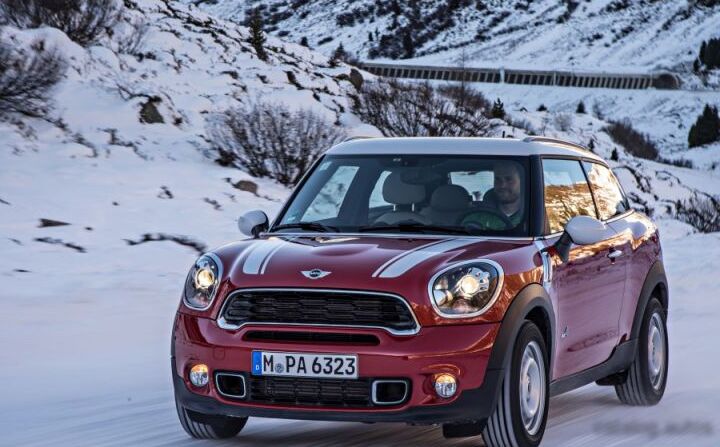
The Mini Paceman Cooper D 1.6 (112 hp) debuted in 2014 as part of the R61 Paceman series, a three-door, four-seater crossover. It represented Mini’s attempt to broaden its appeal by offering a vehicle with a slightly higher ride height and more cargo space than the standard Cooper hatchback. The “Cooper D” designation indicated the use of a diesel engine, and the 1.6-liter displacement and 112 horsepower output defined this specific variant. It occupied the lower-mid range of the Paceman lineup, positioned above the base Cooper but below the more powerful Cooper S and ALL4 (all-wheel drive) models. The Paceman, and this variant specifically, was primarily marketed in Europe and other regions where diesel engines and compact crossovers were popular.
Powertrain & Engine Architecture
The heart of the Paceman Cooper D 1.6 was the N47C16A engine, a 1.6-liter turbocharged four-cylinder diesel. This engine was a mainstay in many BMW and Mini models of the era. It featured common-rail direct injection, delivering fuel at extremely high pressure for improved combustion efficiency and reduced emissions. The N47 engine was known for its relatively sophisticated technology, including a variable geometry turbocharger (VGT) to optimize boost across the rev range. The engine also utilized four valves per cylinder and an overhead camshaft. The 112 hp output was achieved at 4000 rpm, while peak torque of 270 Nm (199 lb-ft) was available between 1750 and 2250 rpm. This engine was paired with a 6-speed manual transmission, delivering power to the front wheels. The transmission was chosen for its efficiency and relatively low cost, contributing to the vehicle’s overall affordability.
Driving Characteristics
The 1.6-liter diesel engine, while not exceptionally powerful, provided adequate performance for everyday driving. Acceleration from 0 to 60 mph took around 10.3 seconds, and the top speed was 116.82 mph. The engine’s strong low-end torque made it feel more responsive than its horsepower figure might suggest, particularly in urban environments. The manual transmission offered precise shifts, but the gear ratios were tuned for fuel economy rather than outright performance. Compared to the Cooper S variants, the Cooper D felt noticeably slower, especially during overtaking maneuvers. However, it offered a more relaxed and economical driving experience. The front-wheel-drive configuration provided predictable handling, but lacked the all-weather capability of the ALL4 variants.
Equipment & Trim Levels
The Paceman Cooper D 1.6 typically came equipped with a reasonable level of standard features. These included air conditioning, power windows, power mirrors, a basic audio system with USB connectivity, and alloy wheels. Interior upholstery was typically cloth, with options for leather upgrades. Available optional extras included a panoramic sunroof, navigation system, upgraded audio systems (Harman Kardon), parking sensors, and automatic climate control. Trim levels varied slightly depending on the market, but generally offered packages that bundled popular options together. The interior design retained Mini’s signature quirky and stylish aesthetic, with a large central speedometer and a toggle switch-based infotainment system.
Chassis & Braking
The Paceman Cooper D 1.6 utilized a McPherson strut front suspension and a multi-link rear suspension, providing a good balance between ride comfort and handling. The suspension was tuned to be slightly firmer than that of the standard Cooper, reflecting the Paceman’s more sporty aspirations. Brakes consisted of ventilated discs at the front and solid discs at the rear. Anti-lock Braking System (ABS) was standard. The steering was electrically assisted, providing light and precise control. The relatively low weight of the vehicle (1310 kg / 2888 lbs) helped to contribute to its nimble handling characteristics.
Market Reception & Comparison
The Mini Paceman Cooper D 1.6 received mixed reviews from automotive critics. While praised for its fuel efficiency (achieving around 56 US mpg combined) and stylish design, it was often criticized for its limited rear passenger space and relatively high price compared to other subcompact crossovers. Compared to the Cooper S variants, the Cooper D offered significantly less performance, but at a lower purchase price and with superior fuel economy. The 1.6-liter diesel engine was generally considered reliable, but required regular maintenance, including diesel particulate filter (DPF) regeneration. The manual transmission was also generally reliable, but clutch wear could be an issue for drivers who spent a lot of time in stop-and-go traffic.
Legacy
The Mini Paceman Cooper D 1.6 has become a relatively affordable option in the used car market. The N47 engine, while generally robust, is known to have potential issues with the timing chain, which can lead to costly repairs if not addressed proactively. Regular servicing and preventative maintenance are crucial for ensuring the long-term reliability of this powertrain. Despite its shortcomings, the Paceman Cooper D 1.6 remains a popular choice for buyers seeking a stylish, fuel-efficient, and relatively compact crossover with a premium brand image. Its unique design and Mini’s characteristic driving dynamics continue to appeal to a niche market of enthusiasts.
