
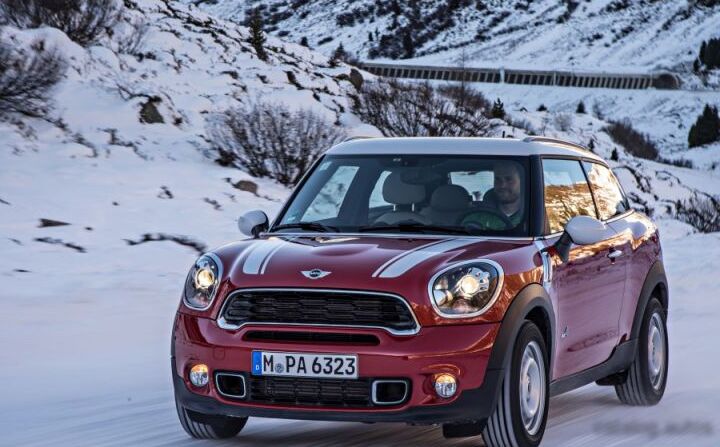
The Mini Paceman Cooper SD ALL4, produced between 2014 and 2016, represented a unique offering within the second generation Paceman (R61) lineup. Positioned as a premium subcompact crossover, the Paceman aimed to blend Mini’s iconic styling with a more practical, four-door body style. The Cooper SD ALL4 variant, powered by a 2.0-liter turbocharged diesel engine producing 143 horsepower, served as a mid-range option, offering a balance between performance, fuel efficiency, and all-weather capability thanks to its standard all-wheel-drive system. It occupied a space between the base Cooper models and the more potent John Cooper Works variants.
Technical Specifications
| Brand | Mini |
| Model | Paceman |
| Generation | Paceman (R61) |
| Type (Engine) | Cooper SD 2.0 (143 Hp) ALL4 |
| Start of production | 2014 |
| End of production | 2016 |
| Powertrain Architecture | Internal Combustion engine |
| Body type | Hatchback |
| Seats | 4 |
| Doors | 3 |
| Fuel consumption (urban) | 5.4 l/100 km (43.6 US mpg, 52.3 UK mpg, 18.5 km/l) |
| Fuel consumption (extra urban) | 4.5 l/100 km (52.3 US mpg, 62.8 UK mpg, 22.2 km/l) |
| Fuel consumption (combined) | 4.8 l/100 km (49 US mpg, 58.9 UK mpg, 20.8 km/l) |
| CO2 emissions | 126 g/km |
| Fuel Type | Diesel |
| Acceleration 0 – 100 km/h | 9.2 sec |
| Acceleration 0 – 62 mph | 9.2 sec |
| Acceleration 0 – 60 mph | 8.7 sec |
| Maximum speed | 199 km/h (123.65 mph) |
| Emission standard | Euro 6 |
| Weight-to-power ratio | 9.8 kg/Hp, 102.5 Hp/tonne |
| Weight-to-torque ratio | 4.6 kg/Nm, 218.6 Nm/tonne |
| Power | 143 Hp @ 4000 rpm |
| Power per litre | 71.7 Hp/l |
| Torque | 305 Nm @ 1750-2700 rpm (224.96 lb.-ft. @ 1750-2700 rpm) |
| Engine layout | Front, Transverse |
| Engine Model/Code | N47C20A |
| Engine displacement | 1995 cm3 (121.74 cu. in.) |
| Number of cylinders | 4 |
| Engine configuration | Inline |
| Cylinder Bore | 84 mm (3.31 in.) |
| Piston Stroke | 90 mm (3.54 in.) |
| Compression ratio | 16.5:1 |
| Number of valves per cylinder | 4 |
| Fuel injection system | Diesel Commonrail |
| Engine aspiration | Twin-power turbo, Intercooler |
| Engine oil capacity | 5.2 l (5.49 US qt | 4.58 UK qt) |
| Coolant | 6 l (6.34 US qt | 5.28 UK qt) |
| Kerb Weight | 1395 kg (3075.45 lbs.) |
| Max. weight | 1865 kg (4111.62 lbs.) |
| Max load | 470 kg (1036.17 lbs.) |
| Trunk (boot) space – minimum | 330 l (11.65 cu. ft.) |
| Trunk (boot) space – maximum | 1080 l (38.14 cu. ft.) |
| Fuel tank capacity | 47 l (12.42 US gal | 10.34 UK gal) |
| Max. roof load | 75 kg (165.35 lbs.) |
| Permitted trailer load with brakes (12%) | 800 kg (1763.7 lbs.) |
| Permitted trailer load without brakes | 500 kg (1102.31 lbs.) |
| Permitted towbar download | 75 kg (165.35 lbs.) |
| Length | 4114 mm (161.97 in.) |
| Width | 1786 mm (70.31 in.) |
| Height | 1518 mm (59.76 in.) |
| Wheelbase | 2596 mm (102.2 in.) |
| Front track | 1531 mm (60.28 in.) |
| Rear (Back) track | 1558 mm (61.34 in.) |
| Ride height (ground clearance) | 138 mm (5.43 in.) |
| Drag coefficient (Cd) | 0.35 |
| Minimum turning circle (turning diameter) | 11.6 m (38.06 ft.) |
| Drive wheel | All wheel drive (4×4) |
| Number of gears and type of gearbox | 6 gears, manual transmission |
| Front suspension | Independent, type McPherson with coil spring and anti-roll bar |
| Rear suspension | Independent multi-link suspension |
| Front brakes | Ventilated discs |
| Rear brakes | Disc |
| Assisting systems | ABS (Anti-lock braking system) |
| Steering type | Steering rack and pinion |
| Power steering | Electric Steering |
| Tires size | 205/55 R17 |
| Wheel rims size | 7J x 17 |
INTRODUCTION
The Mini Paceman Cooper SD ALL4, launched in 2014, was a distinctive addition to the Mini family. Built on the R61 platform – shared with the Countryman – the Paceman aimed to offer a more sporty and stylish alternative to traditional compact crossovers. The “Cooper SD” designation indicated the use of a 2.0-liter diesel engine, while “ALL4” denoted Mini’s all-wheel-drive system. This particular variant was positioned as a practical yet premium option, appealing to buyers seeking fuel efficiency, all-weather traction, and the Mini brand’s unique character. Production continued until 2016, when the Paceman was discontinued as Mini refined its crossover offerings.
Powertrain & Engine Architecture
At the heart of the Cooper SD ALL4 lies the N47C20A engine, a 2.0-liter inline-four cylinder diesel. This engine utilizes a common rail direct injection system, delivering fuel at extremely high pressure for optimized combustion. A twin-power turbocharger, incorporating a variable geometry turbine (VGT), provides enhanced responsiveness and power delivery across a broad RPM range. The engine also features an intercooler to further cool the intake air, increasing density and efficiency. The N47 engine family is known for its relatively complex valvetrain, featuring chain-driven dual overhead camshafts. The 6-speed manual transmission was standard, offering precise shifts and a direct connection to the engine. The transmission’s gear ratios were tuned to balance fuel economy with usable performance, prioritizing mid-range torque for everyday driving.
Driving Characteristics
The Cooper SD ALL4 offered a surprisingly capable driving experience. While not overtly sporty, the 143 horsepower and 305 Nm (224.96 lb-ft) of torque provided adequate acceleration, with a 0-60 mph time of around 8.7 seconds. The ALL4 all-wheel-drive system, utilizing a Haldex clutch, intelligently distributed power between the front and rear axles, enhancing traction in slippery conditions. The manual transmission, while engaging, had a slightly longer throw compared to some competitors. The suspension, tuned for comfort, absorbed bumps effectively, but body roll was noticeable during aggressive cornering. Overall, the driving experience was refined and predictable, making it well-suited for daily commutes and longer journeys.
Equipment & Trim Levels
The Cooper SD ALL4 came reasonably well-equipped as standard. Interior features typically included cloth upholstery, a leather-wrapped steering wheel, and air conditioning. Infotainment was provided by Mini’s central display, offering navigation, Bluetooth connectivity, and audio controls. Optional extras included leather seats, a panoramic sunroof, parking sensors, and upgraded audio systems. Trim levels beyond the base Cooper SD often added cosmetic enhancements, such as unique alloy wheel designs and exterior trim accents. The Paceman’s interior design was characterized by its retro-inspired circular center console and toggle switches, a hallmark of the Mini brand.
Chassis & Braking
The Paceman’s chassis was based on the BMW UKL1 platform, providing a solid foundation for handling and stability. The front suspension utilized McPherson struts with coil springs and an anti-roll bar, while the rear employed a multi-link setup. This configuration offered a good balance between ride comfort and handling precision. Braking duties were handled by ventilated discs at the front and solid discs at the rear, providing adequate stopping power. Anti-lock braking system (ABS) was standard, enhancing safety in emergency braking situations. The ALL4 system added to the vehicle’s stability, particularly on loose surfaces.
Market Reception & Comparison
The Mini Paceman Cooper SD ALL4 received generally positive reviews from automotive critics. It was praised for its distinctive styling, fuel efficiency, and all-weather capability. However, some reviewers noted the relatively high price compared to competitors and the limited rear passenger space due to the sloping roofline. Compared to the petrol-powered Cooper S variants, the Cooper SD offered superior fuel economy and torque, making it a more practical choice for long-distance driving. Against other diesel-powered crossovers, the Paceman stood out with its unique design and premium brand image. Reliability reports suggested that the N47 engine, while generally robust, could be prone to timing chain issues if not properly maintained.
Legacy
The Mini Paceman Cooper SD ALL4 remains a relatively popular choice in the used car market. Its combination of style, practicality, and fuel efficiency continues to appeal to buyers. The N47 engine, while requiring diligent maintenance, is generally considered durable. However, potential buyers should be aware of the potential for timing chain wear and ensure that the vehicle has been regularly serviced. The Paceman’s unique design and Mini’s brand cachet ensure that it remains a desirable and recognizable vehicle on the road today, representing a distinctive chapter in Mini’s evolving history.
