
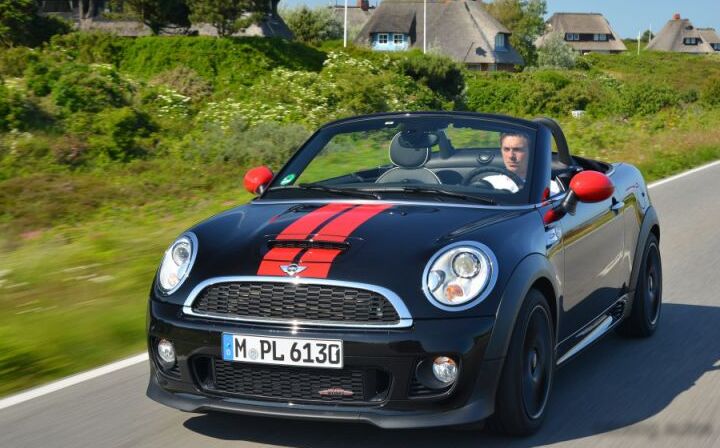
The Mini Roadster Cooper 1.6 (122 hp) was a two-seat, open-top sports car produced by Mini from 2012 to 2015. Part of the R59 generation Roadster series, it represented Mini’s foray into the compact roadster segment, aiming to deliver the brand’s signature fun-to-drive character in a new body style. This particular variant, powered by the N16B16A 1.6-liter engine and paired with a six-speed manual transmission, served as the entry point into the Roadster lineup, offering a balance of affordability and engaging performance. It was positioned below the more powerful Cooper S models.
Technical Specifications
| Brand | Mini |
| Model | Roadster |
| Generation | Roadster (R59) |
| Type (Engine) | Cooper 1.6 (122 Hp) |
| Start of production | 2012 |
| End of production | 2015 |
| Powertrain Architecture | Internal Combustion engine |
| Body type | Roadster |
| Seats | 2 |
| Doors | 2 |
| Fuel consumption (urban) | 7.2 l/100 km (32.7 US mpg) |
| Fuel consumption (extra urban) | 4.9 l/100 km (48 US mpg) |
| Fuel consumption (combined) | 5.7 l/100 km (41.3 US mpg) |
| CO2 emissions | 133 g/km |
| Fuel Type | Petrol (Gasoline) |
| Acceleration 0 – 100 km/h | 9.2 sec |
| Acceleration 0 – 62 mph | 9.2 sec |
| Acceleration 0 – 60 mph | 8.7 sec |
| Maximum speed | 199 km/h (123.65 mph) |
| Emission standard | Euro 5 |
| Weight-to-power ratio | 9.2 kg/Hp |
| Weight-to-torque ratio | 7 kg/Nm |
| Power | 122 Hp @ 6000 rpm |
| Torque | 160 Nm @ 4250 rpm (118.01 lb.-ft. @ 4250 rpm) |
| Engine layout | Front, Transverse |
| Engine Model/Code | N16B16A |
| Engine displacement | 1598 cm3 (97.52 cu. in.) |
| Number of cylinders | 4 |
| Engine configuration | Inline |
| Cylinder Bore | 77 mm (3.03 in.) |
| Piston Stroke | 85.8 mm (3.38 in.) |
| Compression ratio | 11:1 |
| Number of valves per cylinder | 4 |
| Fuel injection system | Multi-port manifold injection |
| Engine aspiration | Naturally aspirated engine |
| Engine oil capacity | 4.2 l (4.44 US qt | 3.7 UK qt) |
| Coolant capacity | 7.5 l (7.93 US qt | 6.6 UK qt) |
| Kerb Weight | 1120 kg (2469.18 lbs.) |
| Max. weight | 1410 kg (3108.52 lbs.) |
| Max load | 290 kg (639.34 lbs.) |
| Trunk (boot) space – minimum | 240 l (8.48 cu. ft.) |
| Fuel tank capacity | 40 l (10.57 US gal | 8.8 UK gal) |
| Length | 3728 mm (146.77 in.) |
| Width | 1683 mm (66.26 in.) |
| Height | 1384 mm (54.49 in.) |
| Wheelbase | 2467 mm (97.13 in.) |
| Front track | 1459 mm (57.44 in.) |
| Rear (Back) track | 1467 mm (57.76 in.) |
| Ride height (ground clearance) | 134 mm (5.28 in.) |
| Minimum turning circle | 10.7 m (35.1 ft.) |
| Drivetrain Architecture | Front wheel drive |
| Number of gears | 6 gears, manual transmission |
| Front suspension | Independent, type McPherson with coil spring and anti-roll bar |
| Rear suspension | Independent multi-link suspension |
| Front brakes | Ventilated discs |
| Rear brakes | Disc |
| Assisting systems | ABS (Anti-lock braking system) |
| Steering type | Steering rack and pinion |
| Tires size | 175/65 R15 84H |
| Wheel rims size | 5.5J x 15 |
Powertrain & Engine Architecture
The heart of the Cooper 1.6 Roadster was the N16B16A 1.6-liter inline-four cylinder engine. This engine was a member of the BMW/PSA Prince engine family, known for its compact size and relatively efficient design. It featured double overhead camshafts (DOHC), four valves per cylinder, and multi-point fuel injection. The engine produced 122 horsepower at 6000 rpm and 160 Nm (118 lb-ft) of torque at 4250 rpm. The six-speed manual transmission offered precise shifts and contributed to the car’s engaging driving experience. While not a powerhouse, the N16B16A was known for its responsiveness and willingness to rev, characteristics that aligned well with the Roadster’s sporty intentions. The engine’s relatively simple design also contributed to its overall reliability.
Driving Characteristics
The 1.6-liter engine, coupled with the manual transmission, provided a lively, if not blistering, driving experience. Acceleration from 0 to 60 mph took approximately 8.7 seconds, and the car reached a top speed of 123.65 mph. The gear ratios were well-matched to the engine’s powerband, allowing for brisk acceleration in everyday driving situations. Compared to the Cooper S models with their turbocharged engines, the 1.6-liter felt less powerful, particularly at higher speeds. However, it offered a more linear power delivery and a lighter front end, which some drivers preferred for its more balanced handling. The Roadster’s relatively short wheelbase and well-tuned suspension contributed to its nimble handling and responsive steering.
Equipment & Trim Levels
The Cooper 1.6 Roadster came standard with a respectable level of equipment. Interior features included cloth upholstery, a leather-wrapped steering wheel, and air conditioning. Standard safety features included ABS, electronic stability control, and airbags. Optional extras included leather seats, a Harman Kardon sound system, navigation, and various cosmetic enhancements. The Roadster’s interior design mirrored that of other first-generation Minis, with a large central speedometer and a retro-inspired dashboard layout. The convertible top was manually operated, adding to the car’s driver-focused character.
Chassis & Braking
The Mini Roadster utilized a McPherson strut front suspension and a multi-link rear suspension, providing a good balance of ride comfort and handling precision. The front brakes were ventilated discs, while the rear brakes were solid discs. ABS (Anti-lock Braking System) was standard. The chassis was designed to be lightweight and rigid, contributing to the car’s agile handling. The Roadster’s suspension was tuned to provide a sporty, yet comfortable ride, making it suitable for both daily commuting and spirited driving on winding roads.
Market Reception & Comparison
The Mini Roadster Cooper 1.6 received generally positive reviews from automotive critics. It was praised for its fun-to-drive character, stylish design, and relatively affordable price. However, some critics noted that the 1.6-liter engine lacked the outright performance of the Cooper S models. Fuel economy was a strong point, with combined fuel consumption averaging around 41.3 US mpg. Compared to other roadsters in its class, such as the Mazda MX-5 Miata, the Mini Roadster offered a more premium interior and a more distinctive design, but it was generally considered to be less focused on pure driving dynamics.
Legacy
The N16B16A engine, while not without its quirks, proved to be a relatively reliable powertrain when properly maintained. Common issues included oil leaks and occasional problems with the VANOS variable valve timing system. However, these issues were generally not catastrophic and could be addressed with routine maintenance and repairs. On the used car market, the Mini Roadster Cooper 1.6 remains a popular choice for buyers seeking a stylish and fun-to-drive roadster. Its relatively low running costs and readily available parts contribute to its ongoing appeal. The R59 Roadster, while a relatively short-lived model, helped to expand the Mini brand’s appeal and demonstrated the company’s willingness to experiment with new body styles.
